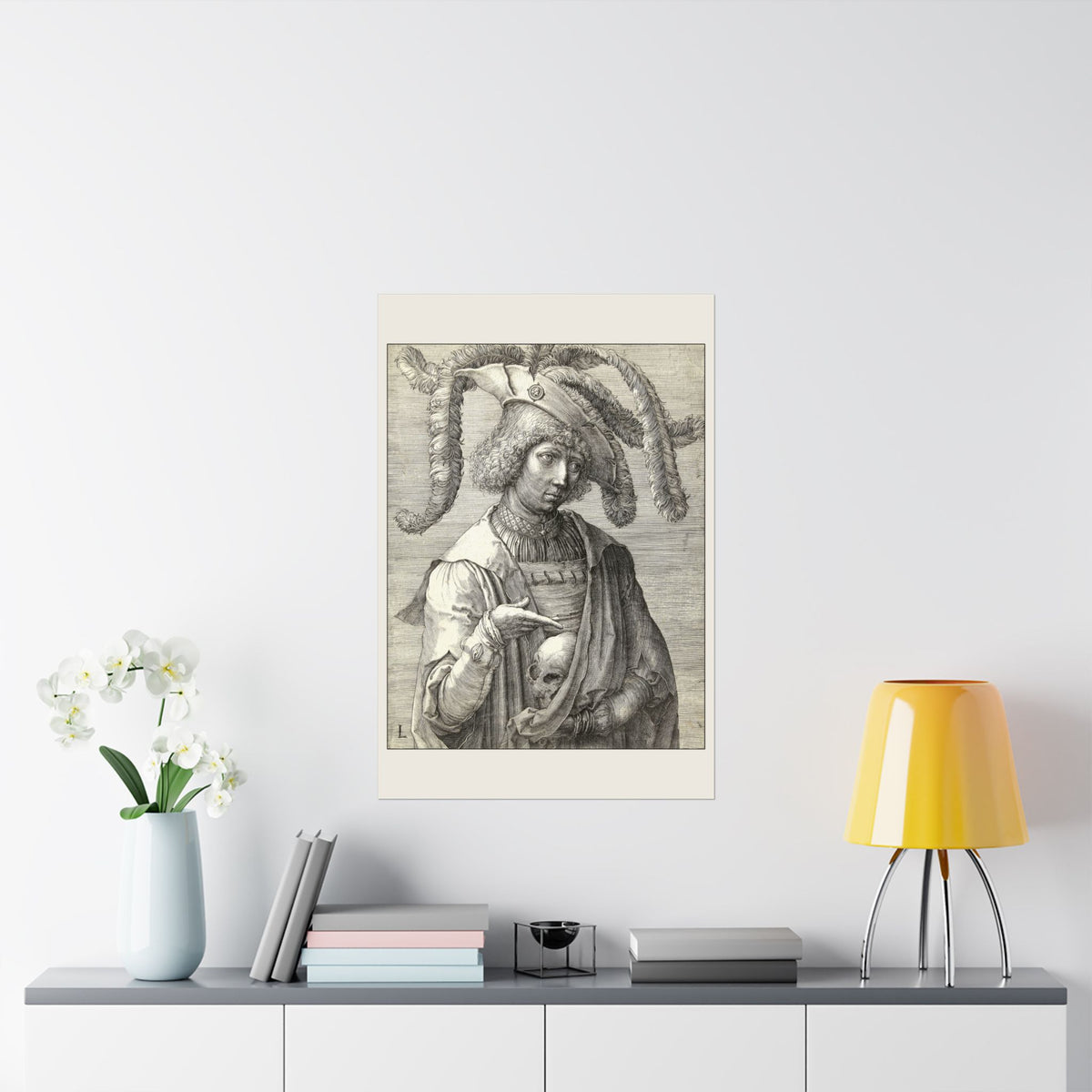
A human skull emerges from the folds of a young man's cloak, introducing an unexpected reminder of death into an otherwise elegant Renaissance portrait. Wearing a fashionable hat adorned with ostrich feathers, the figure holds the skull partly concealed against his body. Created between 1517 and 1521 by Dutch artist Lucas van Leyden (1494–1533), this intriguing engraving juxtaposes youthful refinement with the stark reality of mortality, offering a subtle interpretation of the traditional Memento Mori theme.
The engraving depicts a young man dressed in fashionable early sixteenth-century clothing, holding a human skull partially concealed within his cloak.
An elaborate hat decorated with ostrich feathers adds a sense of elegance and social distinction, contrasting with the unsettling presence of the skull.
Rather than displaying death openly through a skeleton or elaborate allegorical arrangement, the artist incorporates its symbol into the young man's clothing, creating a more intimate and contemplative composition.
The carefully rendered folds of fabric, delicate engraved lines, and attention to facial features demonstrate Lucas van Leyden's remarkable skill as an early Northern Renaissance printmaker.
The engraving incorporates several themes associated with Memento Mori imagery:
-
Human skull: The inevitability of death and the mortality shared by all humanity.
-
Young man: Youth, vitality, and the temporary nature of physical beauty.
-
Ostrich-feather hat: Fashion, worldly elegance, and social distinction.
-
Partially concealed skull: A reminder that mortality remains present even when hidden beneath the outward appearances of everyday life.
-
Elaborate cloak: Material comfort, status, and the impermanence of earthly possessions.
-
Contrast between youth and death: The central tension between the promise of life and its inevitable conclusion.
Together, these elements communicate the central message of Memento Mori: outward beauty, youth, and worldly status cannot prevent the passage of time or the certainty of death.
Created between 1517 and 1521, this engraving is the work of Lucas van Leyden, one of the most accomplished printmakers of the Northern Renaissance.
Born in Leiden in 1494, Lucas became celebrated for his intricate engravings, expressive figures, and sophisticated treatment of religious, allegorical, and everyday subjects.
His works frequently explored human behavior, morality, and the relationship between earthly experience and spiritual concerns.
The engraving reflects the Renaissance tradition of Memento Mori — Latin for "Remember that you must die" — which encouraged viewers to contemplate mortality and the temporary nature of earthly existence.
Unlike more elaborate Vanitas compositions featuring hourglasses, candles, and other symbolic objects, Lucas van Leyden presents the theme through a single figure holding a skull.
The fashionable clothing and ostrich-feather hat create a distinctive contrast between Renaissance elegance and the universal reality of death.
With its unusual portrait-like composition, intricate historical costume, and understated mortality symbolism, this reproduction complements libraries, studies, reading rooms, Gothic interiors, and collections devoted to Renaissance portraiture, historical engraving, and the macabre.
- Historical Young Man Holding Skull engraving by Lucas van Leyden
- Original artwork dated approximately 1517–1521
- Elegant Renaissance figure holding a human skull partially concealed within his cloak
- Ornate hat decorated with ostrich feathers
- Detailed early sixteenth-century clothing, expressive facial features, and delicate engraved linework
- Traditional Memento Mori symbolism exploring mortality and the impermanence of youth and beauty
- Historical Northern Renaissance printmaking from the Low Countries
- Reproduced with the intricate engraved details and aged appearance of the historical artwork
- Giclée printing on archival paper
- Smooth matte finish
- Available in multiple sizes
- Suitable for indoor wall display
- Supplied unframed
- Slight production size tolerance of approximately ±1/16 inch
Handle with clean, dry hands. Avoid prolonged exposure to direct sunlight and moisture. Gently remove surface dust with a clean, dry cloth.