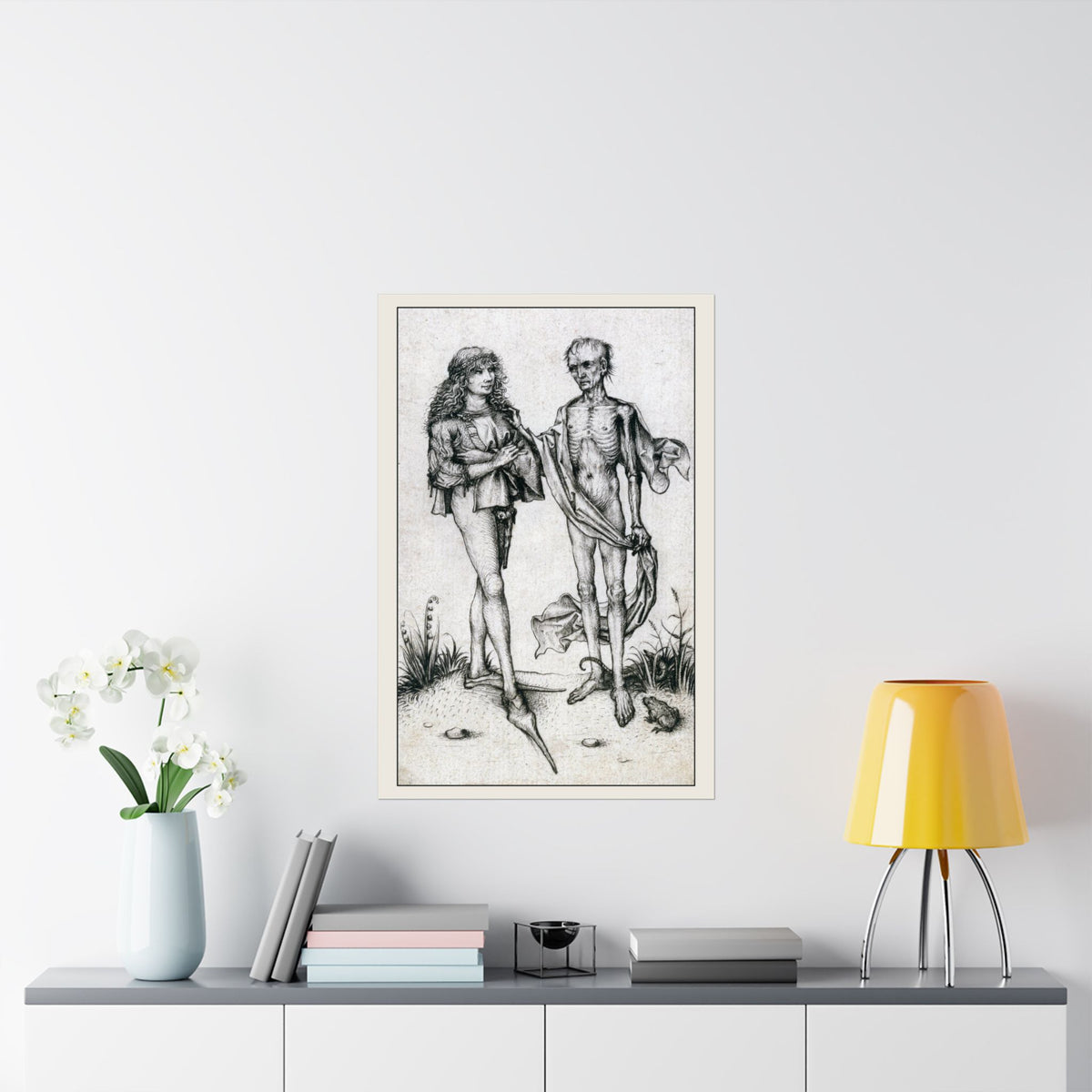
Elegance offers little protection against the inevitable. In this remarkable late fifteenth-century German engraving, a fashionably dressed young man encounters Death, represented not as a skeleton but as a gaunt, emaciated figure draped in loose fabric. A toad and serpent appear near their feet, introducing unsettling details into an otherwise restrained scene. Created between 1485 and 1490 by the Master of the Amsterdam Cabinet, the artwork presents a powerful contrast between youthful beauty, worldly appearance, and the unavoidable reality of mortality.
The composition depicts an elegantly dressed young man standing beside a thin, corpse-like personification of Death.
The young man wears elaborate late medieval clothing, including fashionable pointed shoes, fitted garments, and long, carefully rendered curls. His youthful appearance contrasts sharply with the exposed ribs, sunken features, and skeletal limbs of the figure beside him.
Death reaches toward the young man, creating a direct encounter between the living and the dead.
At their feet, a toad and serpent occupy the sparse landscape, adding symbolic elements to the scene.
Fine engraved lines, intricate crosshatching, and carefully observed details of anatomy, hair, and clothing demonstrate the technical sophistication of early German printmaking.
The engraving incorporates several traditional elements of Memento Mori imagery:
-
Elegant young man: Youth, beauty, fashionable appearance, and the temporary pleasures of earthly life.
-
Emaciated figure of Death: The physical reality of mortality and the inevitable decay of the human body.
-
Pointed shoes and elaborate clothing: Worldly fashion, social distinction, and the impermanence of material status.
-
Toad: Traditionally associated with decay, corruption, and death in medieval symbolism.
-
Serpent: A possible reference to temptation, sin, and humanity's fallen condition.
-
Encounter between the figures: A reminder that youth, beauty, and social standing cannot prevent death.
Together, these elements communicate the central message of Memento Mori: earthly distinctions are temporary, and death ultimately comes for everyone.
Created between 1485 and 1490, this engraving is attributed to the Master of the Amsterdam Cabinet, an anonymous German artist also known as the Master of the Housebook.
Active during the late fifteenth century, the artist is celebrated for exceptionally refined engravings depicting courtly life, religious subjects, allegorical scenes, and everyday activities.
His work is particularly associated with the development of drypoint engraving, a technique capable of producing delicate, expressive lines and subtle tonal effects.
The artwork reflects the late medieval European fascination with death and the fleeting nature of earthly existence. During this period, images of mortality frequently appeared in religious manuscripts, devotional prints, and allegorical compositions.
Memento Mori, Latin for "Remember that you must die," encouraged reflection upon human mortality regardless of age, wealth, or social position.
Rather than presenting Death as an abstract symbol, the artist depicts a direct encounter between a fashionable young man and the physical embodiment of human decay.
With its unusual personification of Death, elaborate medieval clothing, and carefully rendered animal symbolism, this reproduction complements libraries, studies, Gothic interiors, and collections devoted to medieval art, historical engraving, mortality symbolism, and the macabre.
- Historical Young Man and Death engraving by the Master of the Amsterdam Cabinet
- Original artwork dated approximately 1485–1490
- Elegant young man standing beside an emaciated personification of Death
- Toad and serpent incorporated into the composition
- Detailed late medieval clothing, pointed shoes, and anatomical features
- Traditional Memento Mori symbolism exploring mortality and the impermanence of youth and beauty
- Historical German printmaking from the late fifteenth century
- Reproduced with the intricate engraved details and aged appearance of the historical artwork
- Giclée printing on archival paper
- Smooth matte finish
- Available in multiple sizes
- Vertical portrait composition
- Suitable for indoor wall display
- Supplied unframed
- Slight production size tolerance of approximately ±1/16 inch
Handle with clean, dry hands. Avoid prolonged exposure to direct sunlight and moisture. Gently remove surface dust with a clean, dry cloth.