Vanitas Woman with Mirror Jester & Cat 1600 Dutch Satirical Engraving Art Print
Vanitas Woman with Mirror Jester & Cat 1600 Dutch Satirical Engraving Art Print
Couldn't load pickup availability
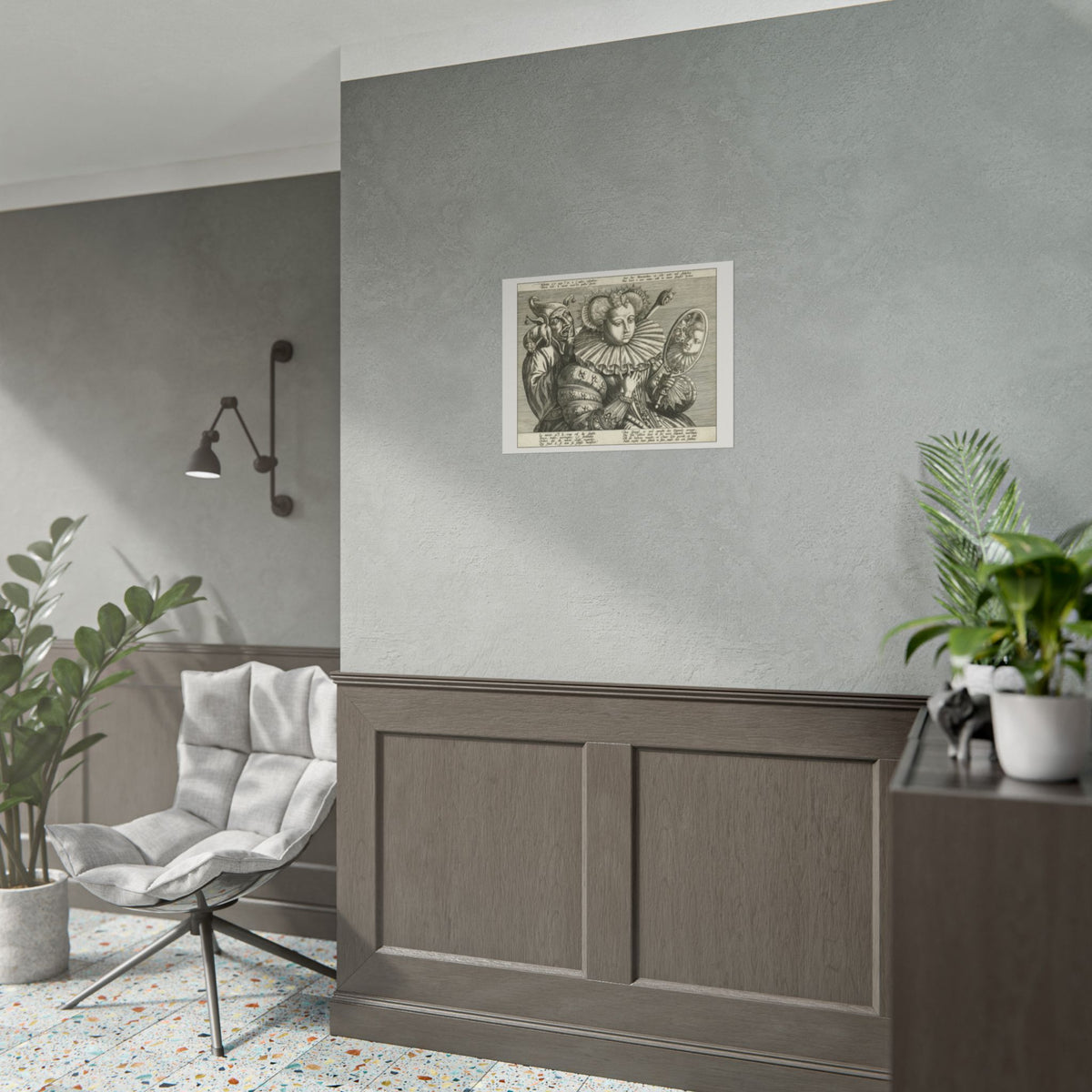
A magnificent ruff, elaborate jewelry, and an expensive gown proclaim the wealth and refinement of a fashionable woman. Yet the mirror she holds reveals something considerably less flattering: the face of a fool staring back alongside her own reflection. Behind her, a grotesque jester grins beneath a mischievous cat, turning this luxurious portrait into a biting satire of vanity and fashionable excess. Created in the Low Countries between 1600 and 1624, this anonymous engraving mocks the extravagance of early seventeenth-century dress and the foolishness of excessive self-admiration.
The engraving depicts an elegantly dressed woman wearing an enormous, stiffly pleated ruff, an extravagant fashion associated with wealth and social distinction around 1600.
Her elaborate gown is decorated with floral patterns, while earrings, bracelets, and a ring complete her fashionable appearance.
Holding an ornate hand mirror, she examines her reflection. Within the mirror, however, she sees not only her own face but also the grotesque features of the jester standing behind her.
The fool wears a traditional jester's cap and carries a marotte, a mock scepter topped with a small head. A cat perched upon his shoulder presents its hindquarters toward the viewer, adding a deliberately vulgar element to the satire.
Original inscriptions in Dutch and French appear above and beneath the illustration, reinforcing the artwork's ridicule of vanity, extravagant hairstyles, and fashionable pretensions.
The detailed engraving combines expressive caricature, intricate historical costume, and carefully rendered ornamental details.
The composition incorporates several elements associated with Vanitas, folly, and moral satire:
- Fashionable woman: Pride, social ambition, and excessive concern with outward appearance.
- Large pleated ruff: Wealth, status, and the extravagance of fashionable clothing.
- Hand mirror: Vanity, self-admiration, and the deceptive nature of appearances.
- Jester: Human foolishness, ridicule, and the failure to recognize one's own vanity.
- Reflection of the fool: The suggestion that excessive self-admiration reveals foolishness rather than beauty.
- Marotte: A traditional emblem of folly and the jester's mocking authority.
- Cat displaying its hindquarters: A deliberately crude gesture emphasizing the satirical and irreverent character of the print.
- Jewelry and elaborate dress: Material luxury and the desire for admiration and social distinction.
Together, these elements expose the absurdity of excessive vanity, using humor and grotesque imagery rather than the skulls and hourglasses more commonly associated with Memento Mori.
Created by an anonymous printmaker in the Low Countries between 1600 and 1624, this engraving belongs to the tradition of Dutch and Flemish satirical prints.
During the late sixteenth and early seventeenth centuries, extravagant pleated collars, elaborate hairstyles, and luxurious clothing became prominent expressions of wealth and social ambition.
Such fashions also attracted criticism from moralists and satirists, who regarded excessive ornamentation as evidence of vanity, pride, and misplaced priorities.
The engraving reflects this criticism through an exaggerated confrontation between a fashionable woman and a grotesque fool.
The original Dutch and French inscriptions mock the woman's appearance and suggest that her mirror reveals foolishness rather than the beauty she expects to see.
The composition also relates to the broader tradition of Vanitas, which warned against excessive attachment to physical beauty, wealth, and earthly pleasures.
Unlike conventional mortality allegories, this print uses theatrical caricature and deliberately coarse humor to communicate its moral message.
Original inscriptions (top)
Marotte & moy l'vn à l'autre resemblons.
Tourne vous: le miroir monstre quelles soyons (French.)
Siet hoe Marotteken en icke zeer wel ghelycken
Dus keert v eens omme, wilt in onsen Spieghel kycken (Dutch.)
English translation (top)
"My fool’s wand and I resemble one another.
Turn yourself around: the mirror shows what kind of people we are."
"See how little Marotte and I look very much alike,
So turn yourself around, and look into our mirror."
Original inscriptions (bottom)
Le miroir est le vray cul du diable.
Frases, toufes, perruques, & semblable
Ordure qui au miroir veult regarder,
Que faict il, si non sa sotisse monstrer? (French.)
Den Spieghel is wel oprecht des Duyuels eersgat;
Die syn lobben daer in set, wert sduyuels weerdinne
Oft die bofkens maeckt, en t'haer leyt gecrolt, en plat
Sulck meynt haer seluen te sien, maer siet een Sottinne. (Dutch.)
English translation (bottom)
"The mirror is truly the Devil's backside.
Ruffs, hair-tufts, wigs, and similar filth—
Whoever wishes to gaze at themselves in the mirror,
What do they do but display their own foolishness?"
"The mirror is quite genuinely the Devil’s arsehole;
She who adjusts her ruff ruffles in it becomes the Devil’s hostess,
Or she who puffs herself up, with her hair curled and flat—
Such a woman thinks she sees herself, but she sees a fool."
With its extravagant historical costume, grotesque jester, unusual mirror imagery, and satirical inscriptions, this reproduction complements libraries, studies, Gothic interiors, and collections devoted to early modern fashion, historical caricature, European satire, and the macabre.
- Historical Dutch and Flemish satirical engraving dating from approximately 1600–1624
- Original artwork by an anonymous printmaker from the Low Countries
- Fashionably dressed woman admiring herself in an ornate hand mirror
- Grotesque jester wearing a fool's cap and carrying a marotte
- Cat perched on the jester's shoulder, contributing to the composition's irreverent humor
- Elaborate early seventeenth-century gown, oversized pleated ruff, and decorative jewelry
- Original Dutch and French satirical inscriptions preserved within the composition
- Traditional Vanitas themes exploring vanity, luxury, foolishness, and self-deception
- Detailed historical costume engraving with expressive caricature and intricate linework
- Reproduced with the fine engraved details and historical appearance of the original artwork
- Giclée printing on archival paper
- Smooth matte finish
- Available in multiple sizes
- Artwork proportionally scaled to preserve the original composition, with printed margins that may vary by size
- Supplied unframed
- Slight production size tolerance of approximately ±1/16 inch
Handle with clean, dry hands. Avoid prolonged exposure to direct sunlight and moisture. Gently remove surface dust with a clean, dry cloth.