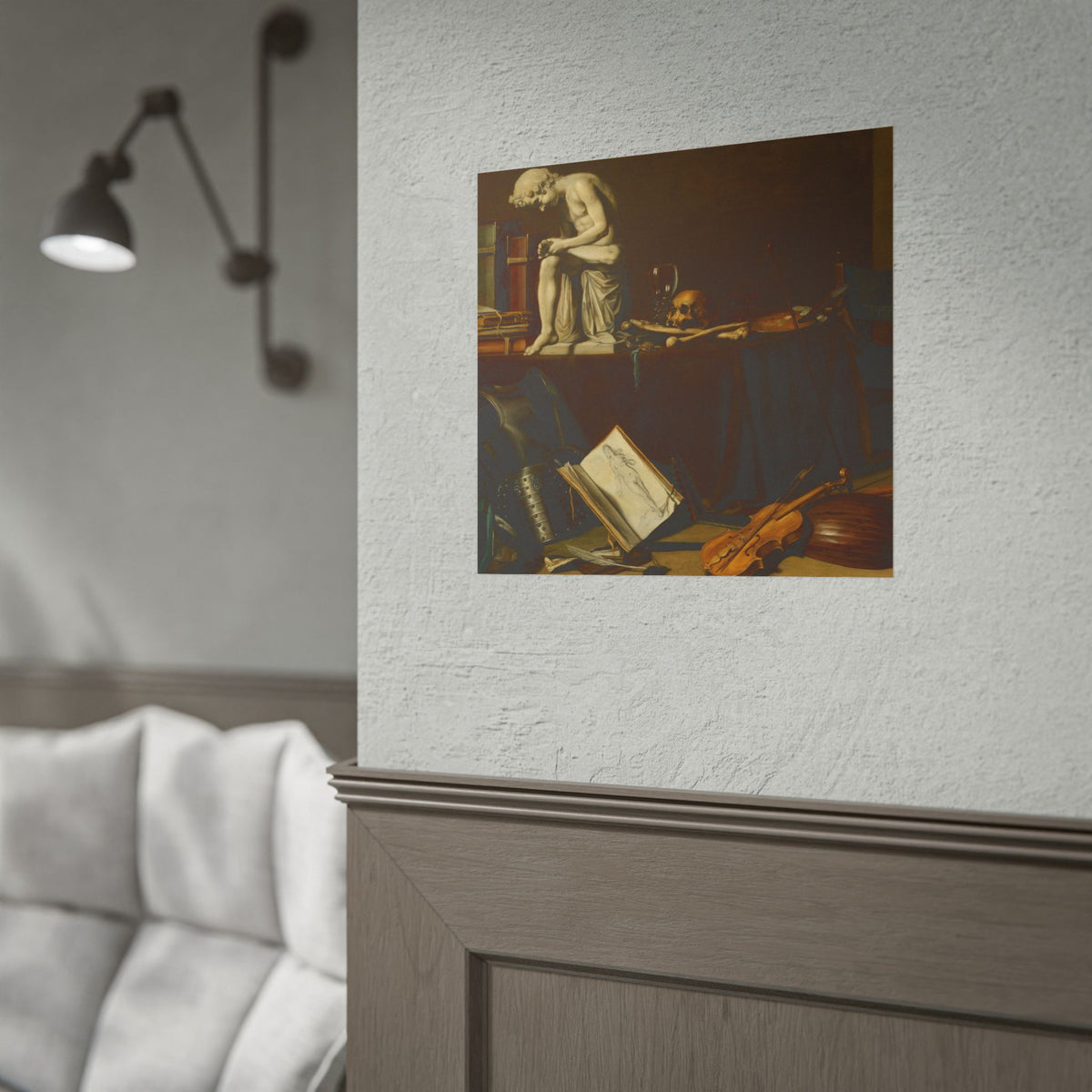
Vanitas Still Life with Spinario Skull & Musical Instruments Pieter Claesz 1628 Art Print
Vanitas Still Life with Spinario Skull & Musical Instruments Pieter Claesz 1628 Art Print
Couldn't load pickup availability
A classical sculpture stands among the remnants of human ambition in this extraordinary 1628 Vanitas painting by Pieter Claesz. Surrounding the plaster figure of the Spinario are a human skull, musical instruments, books, armor, and objects associated with art and learning. Each carefully arranged detail represents an aspect of earthly achievement destined to fade with time. Combining classical antiquity, Dutch Golden Age realism, and powerful Memento Mori symbolism, this historical reproduction makes a distinctive addition to libraries, studies, Gothic interiors, and collections of Old Master paintings.
The painting presents an elaborate arrangement of objects associated with art, music, scholarship, wealth, and mortality.
At the center stands a plaster cast of the Spinario, also known as the Thorn Puller, a celebrated classical sculpture depicting a seated youth removing a thorn from his foot.
Nearby are a human skull and bones, a drinking glass known as a roemer, a watch, books, scattered papers, and an extinguished oil lamp.
An artist's palette and brushes reference painting and creative achievement, while musical instruments—including a lute, violin, and flute-like instrument—rest on the floor.
To the left, a suit of armor and helmet suggest military power and worldly glory. An open art book displays a drawing of a nude woman, introducing another reference to artistic study and the human form.
The original artist's monogram and date, PC 1628, appear on a book in the lower-left portion of the painting.
The painting incorporates numerous traditional elements of Vanitas and Memento Mori imagery:
- Human skull and bones: The inevitability of death and the mortality shared by all humanity.
- Spinario sculpture: Classical beauty, artistic achievement, and the enduring pursuit of aesthetic perfection, contrasted with the brevity of human life.
- Watch: The relentless passage of time and the limited duration of earthly existence.
- Extinguished oil lamp: The end of life and the disappearance of earthly pleasures.
- Books and scattered papers: Knowledge, scholarship, and intellectual accomplishments that cannot overcome mortality.
- Artist's palette and brushes: Creative ambition, artistic talent, and the pursuit of lasting recognition.
- Lute, violin, and flute: Music, entertainment, and pleasures that vanish as quickly as the sounds they produce.
- Armor and helmet: Military power, honor, and worldly glory.
- Roemer drinking glass: Hospitality, material enjoyment, and the pleasures of earthly life.
- Open art book: Artistic learning, classical ideals, and the study of human beauty.
Together, these objects express the central message of Vanitas: artistic brilliance, intellectual accomplishment, physical beauty, and worldly power are ultimately subject to time and mortality.
Painted in 1628 by Pieter Claesz (c. 1597–1660), this artwork belongs to the Dutch Golden Age tradition of Vanitas still-life painting.
Claesz was one of the leading still-life painters of seventeenth-century Haarlem, particularly celebrated for his subtle treatment of light, restrained colors, and carefully arranged objects.
During this period, Dutch artists developed elaborate symbolic compositions that encouraged viewers to contemplate the brevity of life and the impermanence of earthly success.
The term Vanitas derives from the biblical Book of Ecclesiastes and reflects the fleeting nature of worldly possessions, pleasures, and achievements.
Closely associated with Memento Mori — Latin for "Remember that you must die" — these paintings transformed familiar objects into philosophical reflections on human existence.
The inclusion of the Spinario makes this composition particularly distinctive. By placing an admired classical sculpture alongside a skull, armor, musical instruments, and artistic tools, Claesz contrasts humanity's creative and cultural accomplishments with the certainty of death.
The original painting is preserved in the Rijksmuseum collection, where it is catalogued as Vanitas Still Life with the Spinario (SK-A-3930).
With its remarkable combination of classical sculpture, skull imagery, musical instruments, and historical symbolism, this reproduction complements libraries, studies, reading rooms, traditional interiors, and collections devoted to Dutch Golden Age painting, classical art, and macabre imagery.
- Reproduction of Vanitas Still Life with the Spinario by Pieter Claesz
- Original Dutch Golden Age painting dated 1628
- Classical Spinario sculpture surrounded by a human skull, bones, books, and artistic objects
- Lute, violin, flute-like instrument, artist's palette, and brushes
- Historical armor, helmet, roemer drinking glass, watch, and extinguished oil lamp
- Open art book featuring a drawing of a nude woman
- Original artist's monogram and date preserved within the composition
- Traditional Vanitas and Memento Mori symbolism exploring mortality and earthly achievements
- Rich historical details, restrained colors, and atmospheric Dutch still-life composition
- Original artwork held in the Rijksmuseum collection
- Reproduced with the colors, textures, and historical character of the original painting
- Giclée printing on archival paper
- Smooth matte finish
- Available in multiple sizes
- Artwork proportionally scaled to preserve the original composition
- Suitable for indoor wall display
- Supplied unframed
- Slight production size tolerance of approximately ±1/16 inch
Handle with clean, dry hands. Avoid prolonged exposure to direct sunlight and moisture. Gently remove surface dust with a clean, dry cloth.