Vanitas Still Life Skull Violin Hourglass & Candle Stevers 17th Century Art Matte Canvas
Vanitas Still Life Skull Violin Hourglass & Candle Stevers 17th Century Art Matte Canvas
Couldn't load pickup availability
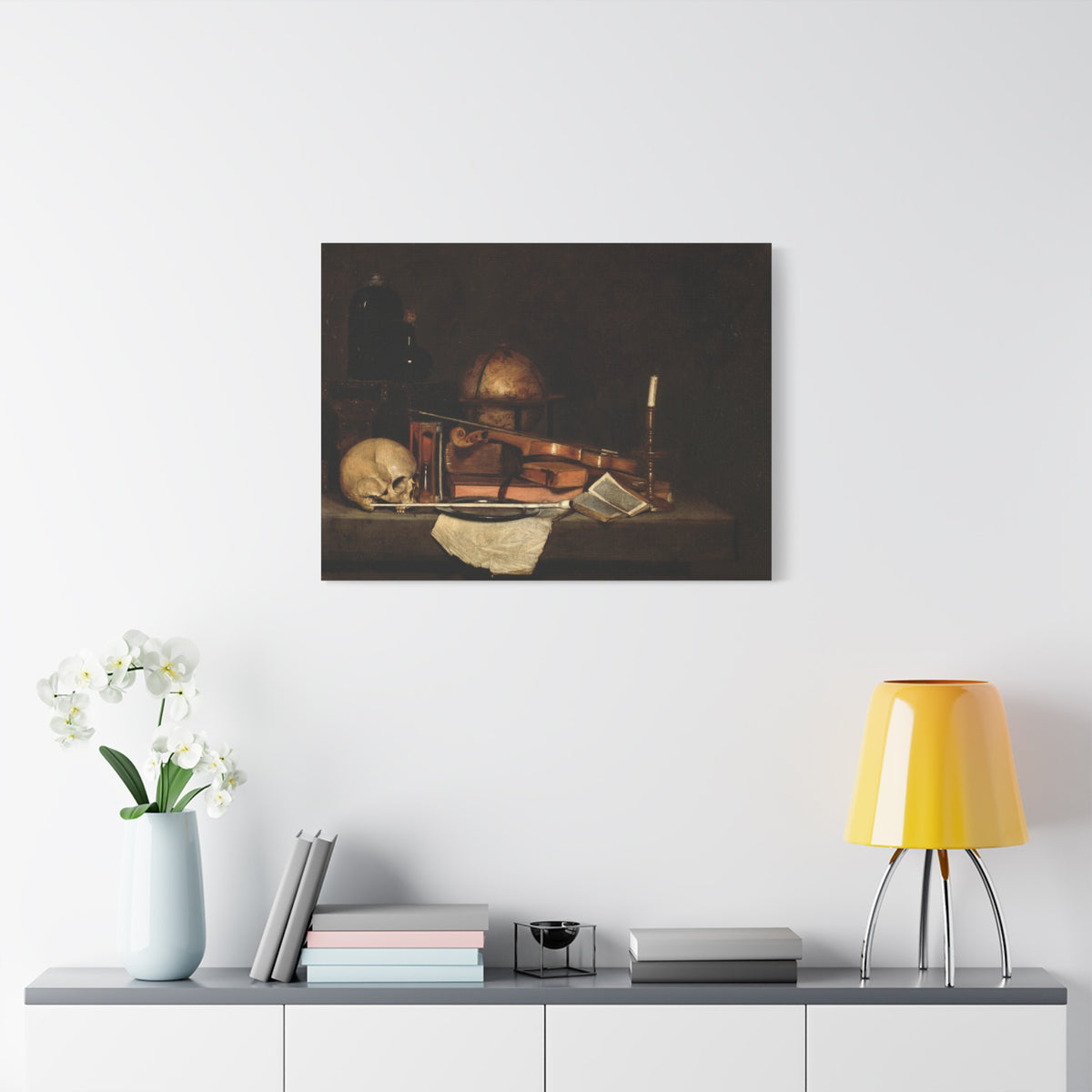
An assortment of objects devoted to music, learning, and everyday life becomes a meditation on mortality in this seventeenth-century Vanitas still-life painting by Stevers. Created between 1630 and 1660, the composition brings together a human skull, violin, Dutch clay pipe, hourglass, candle, and books, contrasting earthly pleasures with the inevitable passage of time. The painting's subdued palette, carefully arranged objects, and evocative symbolism make this historical reproduction particularly suited to libraries, studies, Gothic interiors, and collections of Dutch Golden Age art.
The painting depicts a carefully arranged collection of objects gathered at the corner of a wooden table, combining musical instruments, scholarly possessions, and traditional symbols of mortality.
A human skull rests among a violin, books, a Gouda-style clay tobacco pipe, an hourglass, and a candle in a candlestick.
A small box and two bottles complete the arrangement, introducing additional references to material possessions and everyday life.
The composition relies on the contrasting shapes and textures of these objects, transforming an ordinary tabletop scene into a reflection on human existence.
The artist's original signature, Stevers, identifies the painter.
The painting incorporates several traditional elements of Vanitas and Memento Mori imagery:
- Human skull: The inevitability of death and the mortality shared by all humanity.
- Violin: Music, artistic accomplishment, and the fleeting pleasures of earthly life.
- Hourglass: The continuous passage of time and the limited duration of human existence.
- Candle and candlestick: The fragility of life and its eventual extinguishing.
- Books: Knowledge, learning, and the temporary nature of intellectual achievements.
- Dutch clay pipe: Tobacco, sensory enjoyment, and the passing pleasures of earthly existence.
- Small box: Material possessions, personal belongings, and worldly attachments.
- Two bottles: Everyday comforts and the temporary satisfactions of material life.
Together, these objects communicate the central message of Vanitas: knowledge, artistic achievement, pleasure, and worldly possessions cannot prevent the passage of time or the certainty of death.
Painted between 1630 and 1660 by Stevers, this artwork belongs to the seventeenth-century Dutch tradition of Vanitas still-life painting.
During the Dutch Golden Age, artists frequently combined skulls, musical instruments, books, candles, hourglasses, and everyday possessions into carefully composed scenes exploring mortality and the temporary nature of earthly existence.
The term Vanitas derives from the biblical Book of Ecclesiastes and refers to the fleeting character of worldly pleasures, accomplishments, and ambitions.
Closely associated with Memento Mori — Latin for "Remember that you must die" — these paintings transformed ordinary objects into visual reminders of the brevity of human life.
The inclusion of a Gouda-style clay pipe is particularly characteristic of Dutch material culture, while the violin, books, and hourglass connect the composition to broader European traditions of allegorical still-life painting.
Stevers' arrangement emphasizes the contrast between earthly enjoyment and mortality through a restrained selection of familiar objects.
The original painting is preserved in the Rijksmuseum collection, where it is catalogued as Vanitas Still Life.
With its musical imagery, historical tobacco pipe, scholarly objects, and traditional mortality symbolism, this reproduction complements libraries, reading rooms, studies, traditional interiors, and collections devoted to Dutch Golden Age painting, music history, and Gothic art.
Product features
- Matte cotton-polyester canvas stretched over a radiata pine frame
- High-quality imagery printed with Greenguard Gold-certified latex inks
- Frame wood sourced from FSC-certified renewable forests
- Soft rubber corner dots help keep the canvas stable when hung
Care instructions
- If the canvas does gather any dust, you may wipe it off gently with a clean, damp cloth.