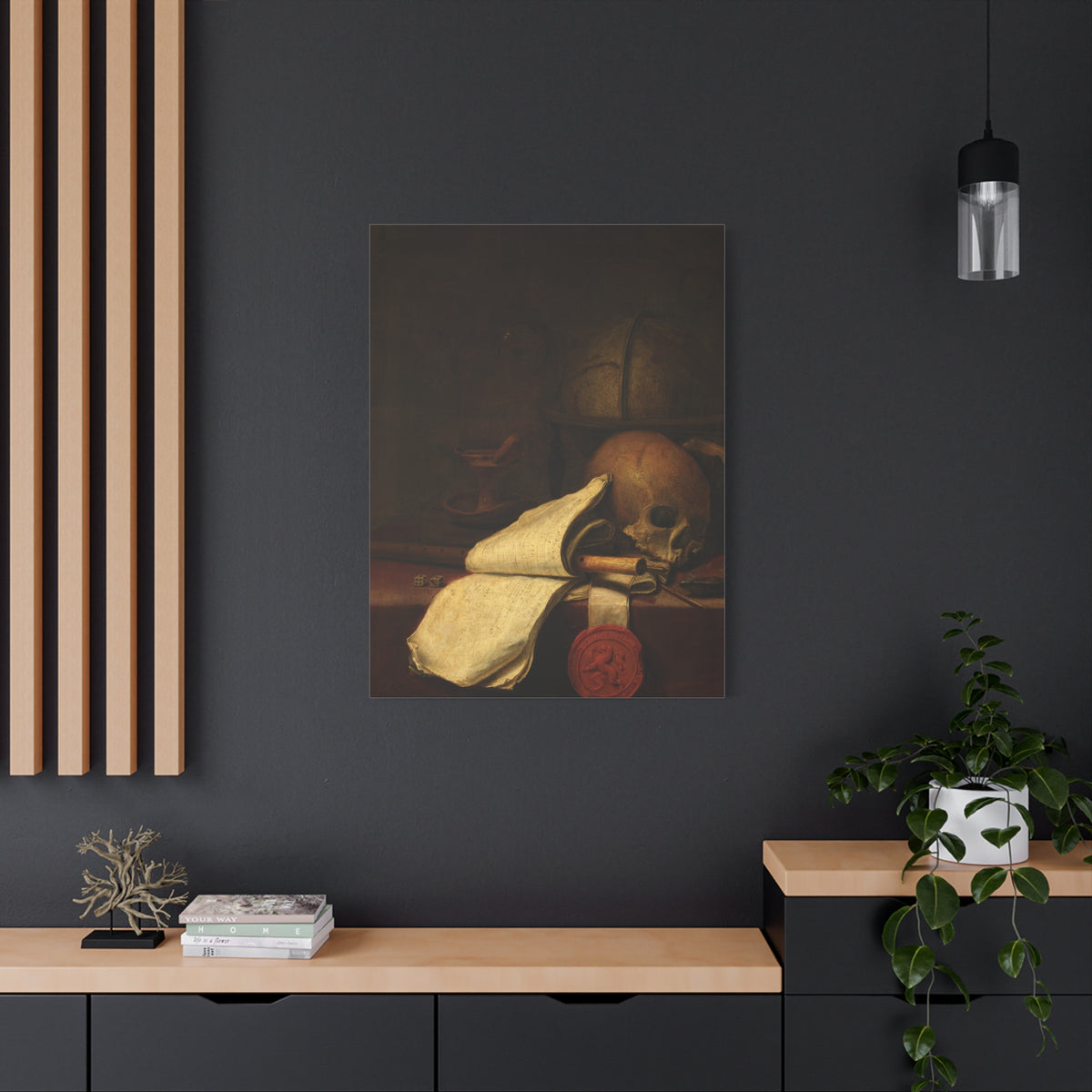
A skull, a globe, scattered dice, and delicate soap bubbles share a tabletop in this atmospheric Dutch Golden Age painting by Pieter Symonsz Potter (1597–1652). Painted in 1646, the composition brings together objects associated with knowledge, music, chance, and the fleeting pleasures of life. Its subdued colors, carefully rendered details, and traditional Vanitas symbolism make this historical reproduction a distinctive choice for libraries, studies, Gothic interiors, and collections of seventeenth-century art.
The painting presents an arrangement of symbolic objects resting upon a table, including a human skull, a songbook, a flute, a globe, dice, soap bubbles, and a small oil lamp.
A document bearing a large seal decorated with the Dutch lion adds a reference to worldly authority and official affairs.
The objects are carefully arranged to create a balanced still life, with subtle lighting and restrained colors emphasizing their different shapes, textures, and meanings.
The artist's original signature and date, P. Potter ƒ. 1646, appear in the lower-left portion of the painting.
The artwork incorporates several traditional elements of Vanitas and Memento Mori imagery:
-
Human skull: The inevitability of death and the fragility of human existence.
-
Globe: Worldly knowledge, exploration, and earthly ambitions.
-
Dice: Chance, uncertainty, and the unpredictable course of life.
-
Soap bubbles: The fleeting nature of existence, associated with Homo Bulla — "Man is a Bubble."
-
Flute and songbook: Music, entertainment, and pleasures that disappear as quickly as they are experienced.
-
Oil lamp: The temporary light of life and its eventual extinguishing.
-
Sealed document: Earthly authority, legal affairs, and worldly accomplishments.
Together, these objects express the central message of Vanitas: knowledge, power, pleasure, and material achievements are temporary in the face of mortality.
Painted in 1646 by Pieter Symonsz Potter, this artwork belongs to the Dutch Golden Age tradition of Vanitas still-life painting.
During the seventeenth century, Dutch artists frequently combined skulls, musical instruments, books, globes, candles, and other everyday objects to explore the passage of time and the impermanence of earthly life.
The theme is closely associated with Memento Mori — Latin for "Remember that you must die" — and the biblical concept of Vanitas, which emphasizes the fleeting nature of worldly pursuits.
Potter's carefully arranged composition transforms familiar objects into a philosophical reflection on mortality, human ambition, and the uncertainty of existence.
The original painting is preserved in the Rijksmuseum collection, where it is catalogued as Vanitas Still Life (SK-C-204).
With its distinctive combination of skull imagery, scientific instruments, musical objects, and historical symbolism, this reproduction complements libraries, studies, reading rooms, traditional interiors, and collections devoted to Dutch Golden Age painting and macabre art.
Product features
- Matte cotton-polyester canvas stretched over a radiata pine frame
- High-quality imagery printed with Greenguard Gold-certified latex inks
- Frame wood sourced from FSC-certified renewable forests
- Soft rubber corner dots help keep the canvas stable when hung
Care instructions
- If the canvas does gather any dust, you may wipe it off gently with a clean, damp cloth.