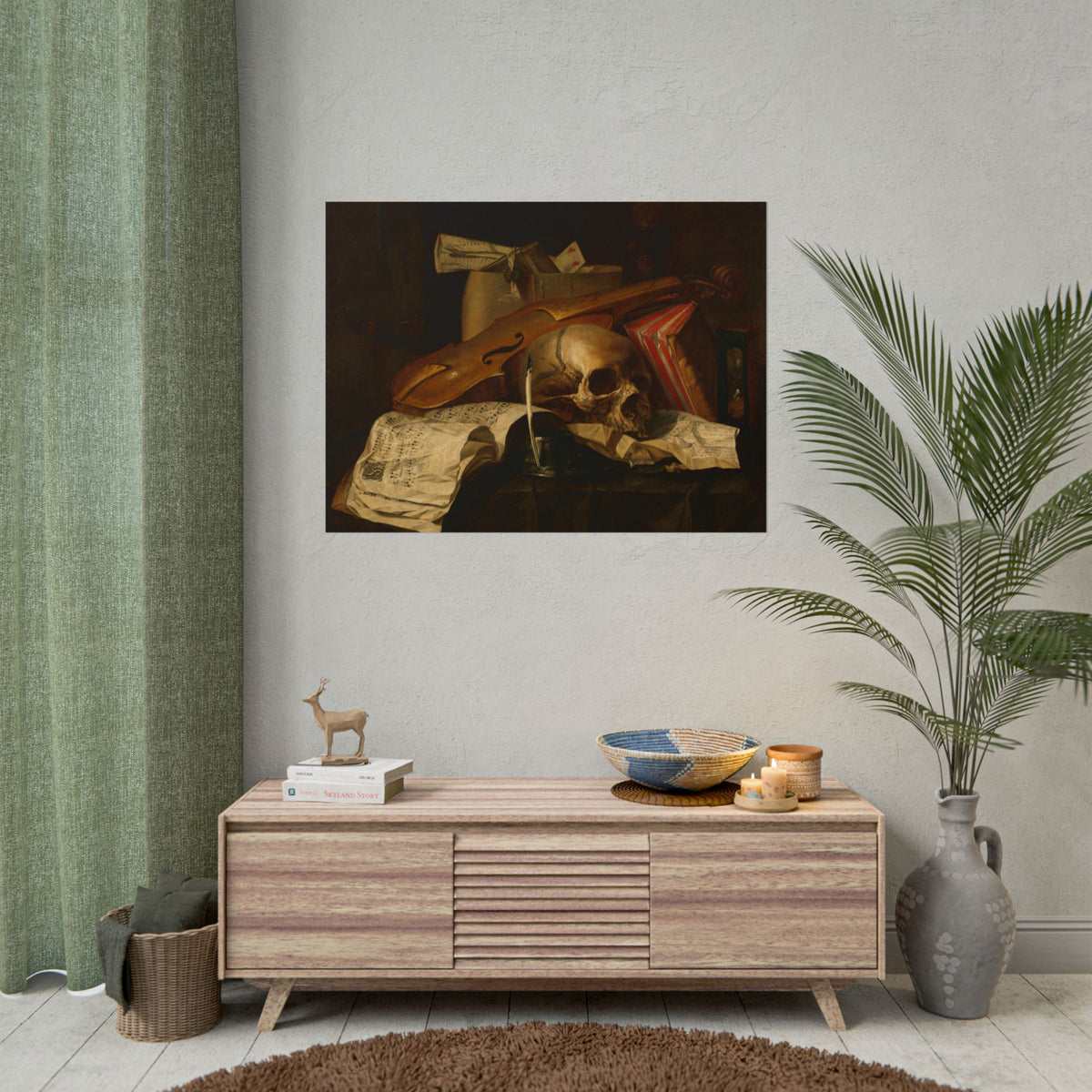
A violin lies silent beside a human skull, while scattered books, an hourglass, and abandoned documents suggest the passing of a life once filled with music, knowledge, and worldly concerns. This atmospheric 1660 still-life painting by N.L. Peschier captures the haunting beauty of Dutch Vanitas art. Its carefully arranged objects, subdued colors, and dramatic contrasts create a sophisticated historical composition, ideal for libraries, studies, Gothic interiors, and collections of macabre and Old Master art.
The painting presents an arrangement of objects associated with music, learning, and mortality, gathered upon a tabletop.
A human skull rests among a violin, an open songbook, books, an inkstand, a crumpled sealed letter, an hourglass, and a bag containing documents.
A smoldering oil lamp mounted on the wall adds another reminder of the passage of time.
The composition combines carefully observed textures, subtle lighting, and shadow to create a contemplative atmosphere characteristic of seventeenth-century still-life painting.
The artist's original signature and date, Peschier: fecit. 1660., are preserved within the composition.
The painting incorporates several traditional elements of Vanitas and Memento Mori imagery:
-
Human skull: The inevitability of death and the mortality shared by all humanity.
-
Violin: Music, artistic accomplishment, and the fleeting pleasures of earthly life.
-
Songbook: Entertainment, creativity, and the temporary nature of human enjoyment.
-
Hourglass: The continuous passage of time and the limited duration of human existence.
-
Books: Knowledge, learning, and intellectual achievements.
-
Inkstand: Writing, scholarship, and human ambition.
-
Crumpled sealed letter: Worldly correspondence, personal affairs, and the impermanence of human concerns.
-
Bag of documents: Material responsibilities, possessions, and earthly accomplishments.
-
Smoldering oil lamp: The fading light of life and its eventual extinguishing.
Together, these objects communicate the central message of Vanitas: knowledge, art, pleasure, and worldly achievements cannot prevent the passage of time or the certainty of death.
Painted in 1660 by N.L. Peschier, this artwork belongs to the seventeenth-century Dutch tradition of Vanitas still-life painting.
During the Dutch Golden Age, artists frequently combined skulls, musical instruments, books, hourglasses, and everyday possessions into compositions exploring mortality and the temporary nature of earthly existence.
The term Vanitas derives from the biblical Book of Ecclesiastes and reflects the fleeting nature of worldly pleasures and accomplishments.
Closely associated with Memento Mori — Latin for "Remember that you must die" — these paintings transformed familiar objects into powerful reminders of human mortality.
Peschier's composition is especially appealing for its combination of musical instruments, scholarly objects, and traditional mortality symbolism.
The original painting is preserved in the Rijksmuseum collection, where it is catalogued as Vanitas Still Life (SK-A-1686).
With its historical character, intricate details, and contemplative atmosphere, this reproduction complements libraries, reading rooms, studies, traditional interiors, and collections devoted to Dutch Golden Age painting, music history, and Gothic art.
- Reproduction of Vanitas Still Life by N.L. Peschier
- Original Dutch Golden Age painting dated 1660
- Human skull, violin, songbook, books, hourglass, and historical writing implements
- Crumpled sealed letter, document bag, and smoldering oil lamp
- Original artist's signature and date preserved within the artwork
- Traditional Vanitas and Memento Mori symbolism exploring mortality, music, and the passage of time
- Historical still-life composition with subdued colors and carefully rendered details
- Original artwork held in the Rijksmuseum collection
- Reproduced with the colors, textures, and historical appearance of the original painting
- Giclée printing on archival paper
- Smooth matte finish
- Available in multiple sizes
- Suitable for indoor wall display
- Supplied unframed
- Slight production size tolerance of approximately ±1/16 inch
-
Handle with clean, dry hands. Avoid prolonged exposure to direct sunlight and moisture. Gently remove surface dust with a clean, dry cloth.