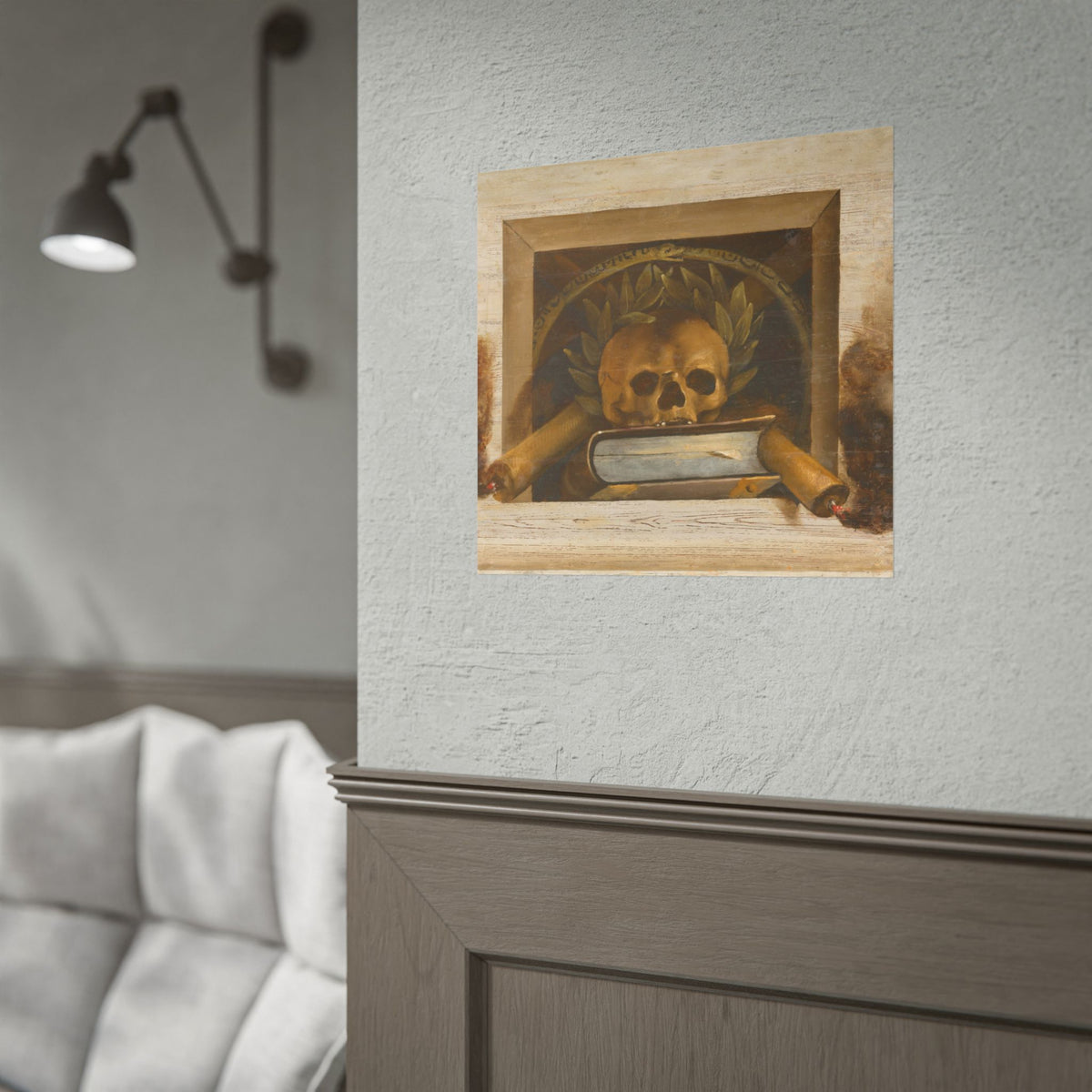
Vanitas Still Life Skull Laurel Wreath & Burning Candles Jacob van Campen 1645 Art Print
Vanitas Still Life Skull Laurel Wreath & Burning Candles Jacob van Campen 1645 Art Print
Couldn't load pickup availability
A human skull crowned with a laurel wreath rests beside a book and two burning candles in this striking seventeenth-century Vanitas painting by Jacob van Campen. Created between 1645 and 1650, the composition combines symbols of mortality, intellectual achievement, and worldly honor in a restrained yet powerful meditation on the passing of human life. Originally conceived as part of a decorative ensemble for a Dutch country residence, the painting brings together the solemn imagery of Memento Mori with the elegance of Dutch Golden Age interior decoration. This historical reproduction is particularly suited to libraries, studies, traditional interiors, and collections of allegorical and Old Master art.
The painting depicts a carefully composed arrangement of symbolic objects centered on a human skull adorned with a laurel wreath.
A book accompanies the skull, introducing a reference to scholarship, learning, and the written preservation of human knowledge.
Two burning candles complete the arrangement, their flames contrasting with the lifeless skull and emphasizing the fragile, temporary nature of human existence.
The laurel wreath is particularly significant, transforming the skull into a reflection on fame, achievement, and the ultimate limitations of earthly recognition.
Unlike elaborate tabletop still lifes crowded with numerous objects, Van Campen's composition conveys its message through a small number of familiar symbols.
The painting originally formed part of a nine-part decorative painting ensemble created for Beekhoven, later known as the Hoogerhuis, near Randenbroek in Amersfoort, the country residence of Jacob van Campen.
The artwork incorporates several traditional elements of Vanitas and Memento Mori imagery:
- Human skull: The inevitability of death and the mortality shared by all humanity.
- Laurel wreath: Victory, honor, artistic distinction, and worldly fame, all ultimately subject to mortality.
- Book: Knowledge, scholarship, learning, and the preservation of intellectual achievements.
- Two burning candles: The temporary flame of human life and the passage of time.
- Candlelight: The contrast between life and death, illumination and darkness.
- Restrained composition: The universality of mortality, expressed through a small group of recognizable objects.
Together, these elements communicate the central message of Vanitas: even the greatest honors, intellectual accomplishments, and personal achievements cannot overcome the certainty of death.
The laurel-crowned skull offers a particularly direct reminder that fame and distinction do not grant immortality.
Created between 1645 and 1650 by Jacob van Campen (1596–1657), this painting belongs to the Dutch Golden Age tradition of allegorical and Vanitas art.
Van Campen was an influential Dutch painter and architect, celebrated for his contributions to Dutch Classicism and monumental architectural design.
The artwork originally formed part of a nine-piece decorative ensemble commissioned for the country house Beekhoven, later called the Hoogerhuis, near Randenbroek in Amersfoort.
Its original function as an architectural decoration distinguishes it from smaller, independent Vanitas paintings intended for private collections.
During the seventeenth century, Dutch artists frequently employed skulls, books, candles, flowers, and symbols of worldly accomplishment to encourage contemplation of mortality and the impermanence of earthly life.
The term Vanitas derives from the biblical Book of Ecclesiastes and refers to the fleeting nature of human ambition, material possessions, and personal glory.
Closely associated with Memento Mori — Latin for "Remember that you must die" — this artistic tradition reminded viewers that all earthly distinctions eventually disappear.
The laurel wreath adds a classical dimension to the composition. Traditionally associated with victory, literary accomplishment, and public honor, it becomes an ironic emblem when placed upon a human skull.
Van Campen's painting combines this classical symbolism with the moral reflections characteristic of seventeenth-century Dutch art, creating an image that is both decorative and philosophical.
The original painting is preserved in the Rijksmuseum collection, where it is catalogued as Vanitas Still Life with Skull with Laurel Wreath, Book and Two Burning Candles (SK-A-4254-3).
With its distinctive laurel-crowned skull, burning candles, and historical association with Dutch country-house decoration, this reproduction complements libraries, reading rooms, studies, classical interiors, and collections devoted to Dutch Golden Age painting, allegorical art, and mortality symbolism.
- Reproduction of Vanitas Still Life with Skull with Laurel Wreath, Book and Two Burning Candles by Jacob van Campen
- Original Dutch Golden Age painting dated approximately 1645–1650
- Human skull adorned with a classical laurel wreath
- Book and two burning candles symbolizing knowledge, life, and mortality
- Traditional Vanitas and Memento Mori symbolism
- Allegorical themes of worldly honor, intellectual achievement, and the impermanence of human existence
- Originally part of a nine-piece decorative painting ensemble for the country house Beekhoven near Amersfoort
- Historical Dutch Classicist composition with restrained symbolism
- Original artwork held in the Rijksmuseum collection
- Reproduced with the colors, details, and historical appearance of the original painting
- Giclée printing on archival paper
- Smooth matte finish
- Available in multiple sizes
- Artwork proportionally scaled to preserve the original composition
- Suitable for indoor wall display
- Supplied unframed
- Slight production size tolerance of approximately ±1/16 inch
Handle with clean, dry hands. Avoid prolonged exposure to direct sunlight and moisture. Gently remove surface dust with a clean, dry cloth.