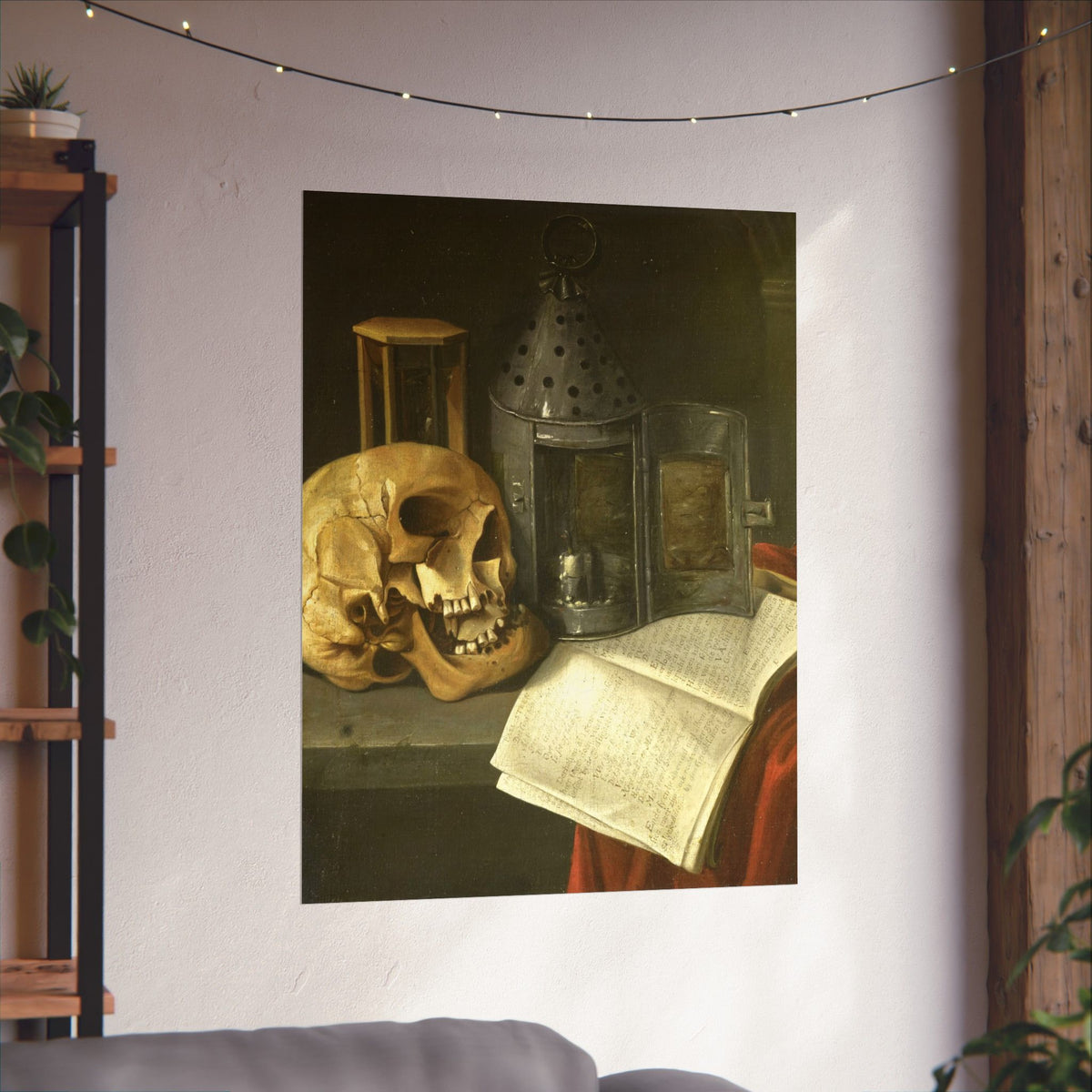
A human skull rests beside a candlelit lantern, an hourglass, and an open book in this late seventeenth-century Vanitas still-life painting by B. Schaak. Created between 1675 and 1700, the composition brings together four powerful reminders of mortality, the passage of time, and the limits of human existence. The book, bearing the title Pael-Steen, introduces a literary and moral dimension to the scene, while the restrained arrangement of objects reflects the contemplative character of Dutch Memento Mori painting. This historical reproduction is particularly suited to libraries, studies, Gothic interiors, and collections of philosophical and allegorical art.
The painting depicts a carefully arranged group of objects resting upon a wooden table: a human skull, a lantern containing a candle, an hourglass, and an open book.
The skull occupies a central place in the composition, serving as an unmistakable reminder of death and the transience of human life.
Beside it, the hourglass measures the passage of time, while the lantern and candle introduce the imagery of light, life, and their eventual extinguishing.
The open book contains printed text and verses under the title Pael-Steen, adding a written reflection to the painting's visual meditation on mortality.
The artist's signature, B. Schaak f., identifies the painter.
The artwork incorporates several traditional elements of Vanitas and Memento Mori imagery:
-
Human skull: The inevitability of death and the fragility of human existence.
-
Hourglass: The relentless passage of time and the limited duration of earthly life.
-
Candle: The temporary nature of life, which may be extinguished at any moment.
-
Lantern: Illumination, awareness, and the contrast between light and darkness.
-
Open book: Knowledge, reflection, and the written contemplation of human mortality.
-
Pael-Steen verses: A textual element reinforcing the composition's moral and contemplative character.
-
Wooden table: An ordinary earthly setting that contrasts with the painting's universal message about death.
Together, these objects express the central message of Vanitas: human life is temporary, time cannot be recovered, and even the greatest knowledge and accomplishments cannot prevent mortality.
Painted between 1675 and 1700 by B. Schaak, this artwork belongs to the late seventeenth-century Dutch tradition of Vanitas still-life painting.
During the Dutch Golden Age, artists frequently assembled skulls, hourglasses, candles, books, flowers, and other symbolic objects to explore mortality, the passage of time, and the impermanence of earthly existence.
The theme is closely associated with Memento Mori — Latin for "Remember that you must die" — and the broader tradition of Vanitas, which emphasizes the fleeting nature of worldly possessions, pleasures, and achievements.
The inclusion of an open book titled Pael-Steen distinguishes Schaak's painting from more elaborate still lifes, introducing an explicitly literary element into its meditation on death and time.
Rather than relying on an abundance of objects, the artist uses a restrained composition to communicate a direct philosophical message through familiar symbols.
The original painting is preserved in the Rijksmuseum collection, where it is catalogued as Vanitas Still Life (SK-A-844).
With its striking skull imagery, hourglass, candlelit lantern, and historical book, this reproduction complements libraries, studies, reading rooms, traditional interiors, and collections devoted to Dutch Golden Age painting, Gothic art, and the history of mortality symbolism.
- Reproduction of Vanitas Still Life by B. Schaak
- Original Dutch painting dated approximately 1675–1700
- Human skull, candlelit lantern, hourglass, and open book
- Historical book containing verses titled Pael-Steen
- Original artist's signature preserved within the composition
- Traditional Vanitas and Memento Mori symbolism
- Allegorical themes of mortality, passing time, and the fragility of human existence
- Restrained Dutch still-life composition with atmospheric lighting
- Original artwork held in the Rijksmuseum collection
- Reproduced with the fine details and historical appearance of the original painting
- Giclée printing on archival paper
- Smooth matte finish
- Available in multiple sizes
- Artwork proportionally scaled to preserve the original composition
- Supplied unframed
- Slight production size tolerance of approximately ±1/16 inch
Handle with clean, dry hands. Avoid prolonged exposure to direct sunlight and moisture. Gently remove surface dust with a clean, dry cloth.