Vanitas Still Life Crown Globes Books & Watch Edwaert Collier 1662 Art Print
Vanitas Still Life Crown Globes Books & Watch Edwaert Collier 1662 Art Print
Couldn't load pickup availability
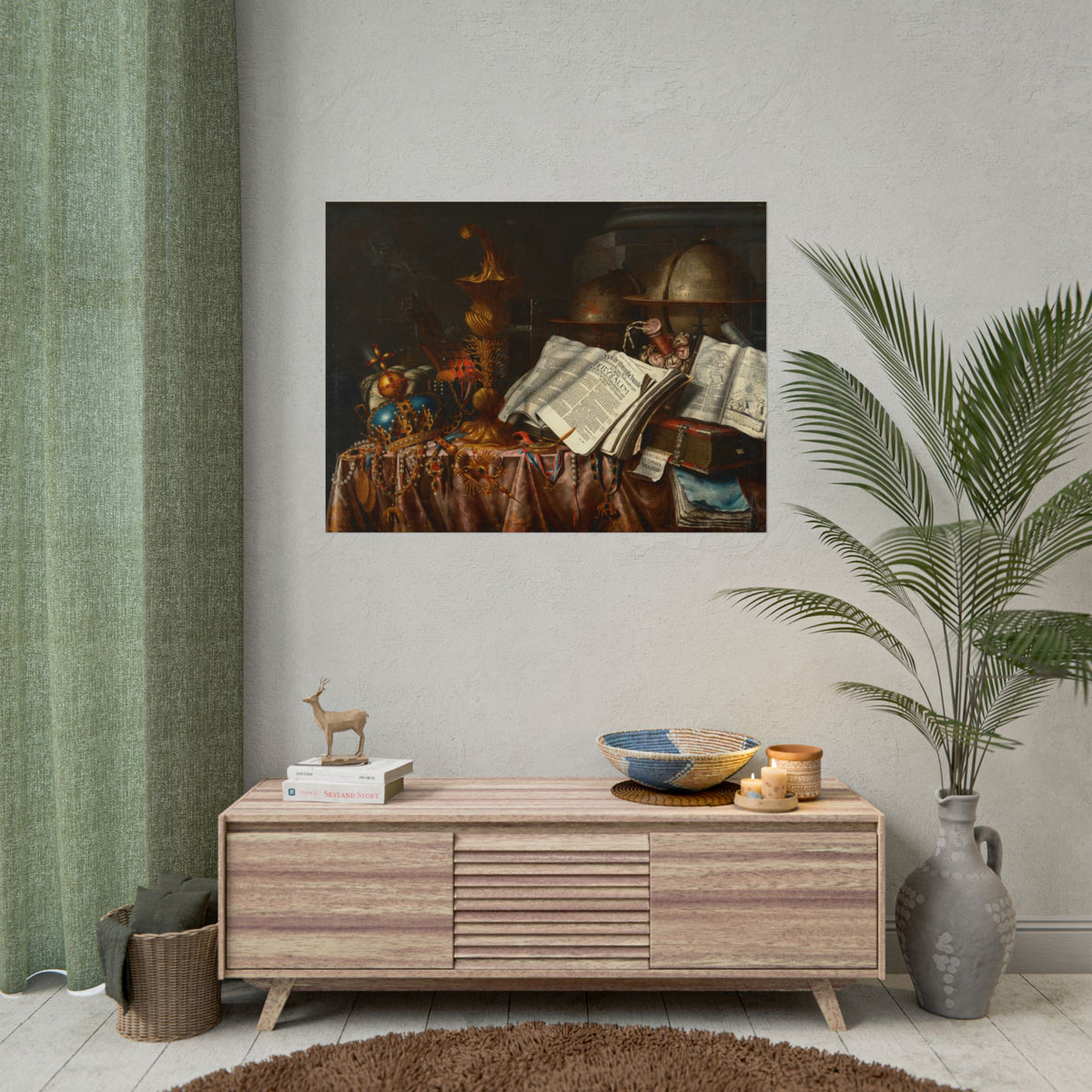
A crown, two globes, scholarly books, and symbols of wealth and distinction occupy a richly detailed tabletop in this 1662 Vanitas still-life painting by Edwaert Collier. Rather than depicting mortality through a human skull, the artist explores the fleeting nature of earthly power, intellectual achievement, and material success. Scientific instruments, travel accounts, a money purse, and a finely crafted ceremonial cup evoke the ambitions of an age fascinated by discovery, prosperity, and status. This historical reproduction offers a distinctive example of Dutch Golden Age allegorical painting, particularly suited to libraries, studies, traditional interiors, and collections of philosophical art.
The painting presents an elaborate arrangement of objects displayed upon a table beside a classical column, combining symbols of scholarship, scientific discovery, wealth, and worldly authority.
Numerous books, travel accounts, and scientific treatises are scattered across the tabletop, some opened to reveal their printed contents.
A terrestrial globe and a celestial globe represent geographical exploration, astronomy, and the expanding intellectual horizons of seventeenth-century Europe.
A crown, money purse, decorative insignia, watch, and ornate ceremonial cup introduce references to political power, wealth, social distinction, and the measurement of time.
The composition brings together these carefully rendered objects to illustrate the accomplishments and ambitions of human civilization while questioning their lasting significance.
The artist's original signature and date, E. Collier 1662, are preserved within the composition.
The painting incorporates several traditional elements of Vanitas allegory:
- Crown: Political authority, worldly power, and the temporary nature of human rule.
- Terrestrial globe: Geography, exploration, worldly knowledge, and earthly ambition.
- Celestial globe: Astronomy, scientific discovery, and humanity's desire to understand the universe.
- Books and scientific treatises: Learning, scholarship, and intellectual accomplishments.
- Travel accounts: Exploration, discovery, and the pursuit of knowledge beyond familiar boundaries.
- Money purse: Wealth, commerce, and material prosperity.
- Decorative insignia: Honors, recognition, and the fleeting nature of social distinction.
- Watch: The relentless passage of time and the limited duration of earthly existence.
- Ornate ceremonial cup: Luxury, prestige, and the pleasures associated with wealth and status.
- Classical column: A setting suggestive of enduring architectural and cultural achievement, contrasting with the impermanence of human affairs.
Together, these objects express the central message of Vanitas: political authority, wealth, knowledge, and personal accomplishments remain subject to time and cannot guarantee lasting significance.
Painted in 1662 by Edwaert Collier (c. 1640–1708), this artwork belongs to the Dutch Golden Age tradition of Vanitas still-life painting.
Collier became particularly associated with meticulously arranged compositions featuring books, documents, instruments, objects of luxury, and symbols of worldly achievement.
During the seventeenth century, the Dutch Republic experienced remarkable developments in international commerce, maritime exploration, publishing, science, and the arts.
The accumulation of valuable objects and scholarly materials reflected the prosperity and intellectual ambitions of the period. At the same time, Vanitas paintings reminded viewers that such achievements were temporary.
The term Vanitas derives from the biblical Book of Ecclesiastes and expresses the transitory nature of earthly existence and human accomplishment.
Closely related to Memento Mori — Latin for "Remember that you must die" — the tradition invited contemplation of mortality, time, and the limitations of worldly ambition.
Collier's painting is especially notable for its emphasis on political authority, scientific inquiry, geographical discovery, and material prosperity, communicating its moral message without relying on the conventional image of a skull.
The original painting is preserved in the Rijksmuseum collection, where it is catalogued as Vanitas Still Life (SK-A-3471).
With its elaborate scholarly objects, terrestrial and celestial globes, royal crown, and historical symbolism, this reproduction complements libraries, reading rooms, studies, traditional interiors, and collections devoted to Dutch Golden Age painting, scientific history, cartography, and philosophical art.
- Reproduction of Vanitas Still Life by Edwaert Collier
- Original Dutch Golden Age painting dated 1662
- Royal crown, terrestrial globe, celestial globe, books, and scientific treatises
- Historical travel accounts, money purse, decorative insignia, watch, and ceremonial cup
- Original artist's signature and date preserved within the composition
- Traditional Vanitas symbolism exploring earthly power, knowledge, wealth, and the passage of time
- Elaborate seventeenth-century still-life composition with carefully rendered historical objects
- Themes of scientific discovery, geographical exploration, scholarship, and political authority
- Original artwork held in the Rijksmuseum collection
- Reproduced with the colors, textures, and historical appearance of the original painting
- Giclée printing on archival paper
- Smooth matte finish
- Available in multiple sizes
- Artwork proportionally scaled to preserve the original composition
- Suitable for indoor wall display
- Supplied unframed
- Slight production size tolerance of approximately ±1/16 inch
Handle with clean, dry hands. Avoid prolonged exposure to direct sunlight and moisture. Gently remove surface dust with a clean, dry cloth.