Vanitas Still Life Armor Musical Instruments & Crown Cornelis Brisé 1665 Art Print
Vanitas Still Life Armor Musical Instruments & Crown Cornelis Brisé 1665 Art Print
Couldn't load pickup availability
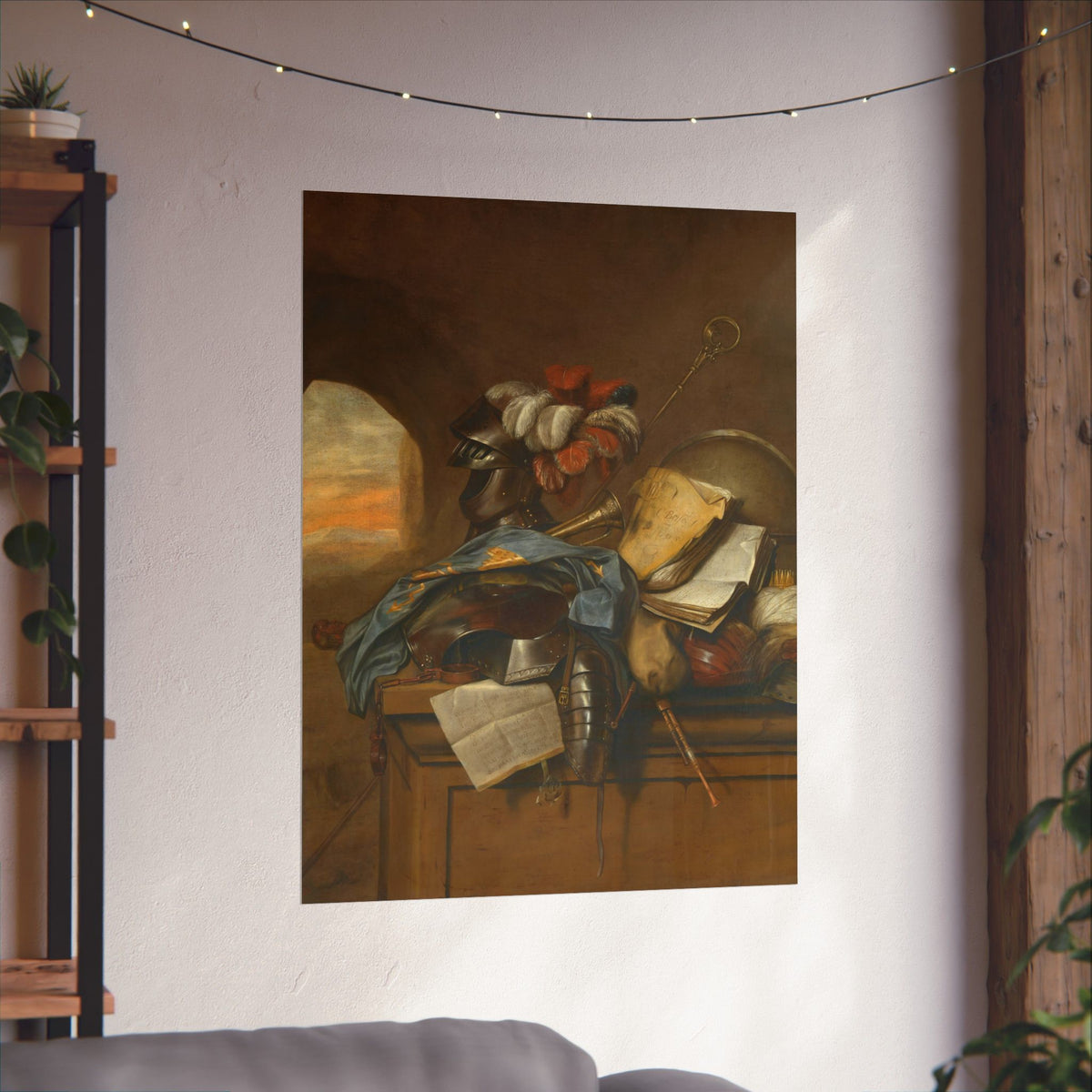
A bishop's staff, a crowned turban, military armor, musical instruments, and the tools of ordinary labor are brought together in this remarkable 1665 Vanitas still-life painting by Cornelis Brisé. At the heart of the composition is a Dutch verse declaring that death makes all people equal, regardless of wealth, occupation, learning, or social rank. The carefully assembled objects represent the many pursuits and distinctions of earthly life, from religious authority and military power to music and scholarship. This unusual Dutch Golden Age painting offers a compelling reflection on mortality and the ultimate equality of humanity, making it particularly suitable for libraries, studies, traditional interiors, and collections of philosophical and allegorical art.
The painting presents an elaborate arrangement of objects representing different occupations, social ranks, and forms of worldly achievement.
A plumed helmet and breastplate evoke military power, while a banner and trumpet suggest ceremony, authority, and public distinction.
A lute and bagpipe introduce the pleasures of music and entertainment. Books represent scholarship and intellectual accomplishment, while a globe refers to geographical knowledge and the wider world.
A bishop's staff symbolizes ecclesiastical authority, while a shovel recalls physical labor and the work of the gravedigger.
A crowned turban represents royal status, and a pair of handcuffs introduces the contrasting imagery of confinement and the loss of personal freedom.
Among these objects lies a sheet of paper bearing a Dutch verse and a seal. The poem provides the key to understanding the composition, explaining that death ultimately erases the distinctions separating the powerful from the powerless, the educated from the uneducated, and the wealthy from the poor.
The artist's signature, C. Brise. f., appears within the painting.
The artwork incorporates several traditional elements of Vanitas and Memento Mori allegory:
- Plumed helmet and breastplate: Military strength, worldly power, and the temporary nature of martial glory.
- Trumpet and banner: Public honor, ceremony, and the fleeting recognition of earthly achievements.
- Lute and bagpipe: Music, entertainment, and the passing pleasures of human existence.
- Books: Scholarship, intellectual accomplishment, and the limitations of earthly knowledge.
- Globe: Geographical discovery, worldly ambition, and humanity's pursuit of knowledge.
- Bishop's staff: Religious authority and ecclesiastical rank.
- Shovel: Manual labor, burial, and the shared destination of all human lives.
- Crowned turban: Royal power, sovereignty, and the impermanence of political authority.
- Handcuffs: Captivity, punishment, and the unequal circumstances of earthly existence.
- Written verse: The central moral message that death makes no distinction between social classes, professions, or degrees of wealth.
Together, these objects illustrate a fundamental principle of Memento Mori: regardless of occupation, rank, or accomplishment, all people eventually share the same fate.
Painted in 1665 by Cornelis Brisé, this artwork belongs to the seventeenth-century Dutch tradition of Vanitas still-life painting.
During the Dutch Golden Age, artists frequently assembled symbolic objects to explore mortality, the passage of time, and the impermanence of earthly achievements.
While many Vanitas paintings feature skulls, hourglasses, and extinguished candles, Brisé develops the theme through objects associated with different professions, social positions, and forms of authority.
The painting's Dutch inscription makes its meaning unusually explicit. Its opening lines declare:
De doot stelt hoogh en laagh gelyk:
En 't middelbaar en Arm en Ryk.
Translated into modern English:
"Death makes high and low equal, the middle ranks, the poor, and the rich."
The poem continues by comparing learning, entertainment, religious authority, royal status, and the labor of the gravedigger, concluding that all worldly activity eventually comes to a standstill.
The work reflects the broader tradition of Memento Mori — Latin for "Remember that you must die" — and the biblical concept of Vanitas, which emphasizes the fleeting nature of human accomplishments and possessions.
Brisé's composition is particularly distinctive for its extensive collection of objects representing society as a whole. Rather than focusing on a single individual's mortality, the painting presents death as the ultimate equalizer of social and political distinctions.
The original painting is preserved in the Rijksmuseum collection, where it is catalogued as Vanitas Still Life (SK-A-1281).
With its historical military equipment, musical instruments, religious symbols, royal insignia, and remarkable Dutch verse, this reproduction complements libraries, reading rooms, studies, traditional interiors, and collections devoted to Dutch Golden Age painting, social history, and philosophical art.
- Reproduction of Vanitas Still Life by Cornelis Brisé
- Original Dutch Golden Age painting dated 1665
- Plumed military helmet, breastplate, trumpet, banner, lute, and bagpipe
- Bishop's staff, crowned turban, handcuffs, shovel, globe, and historical books
- Original Dutch verse exploring death and the equality of all social ranks
- Artist's original signature preserved within the composition
- Traditional Vanitas and Memento Mori symbolism
- Allegorical themes of mortality, worldly authority, social status, and the impermanence of human accomplishments
- Distinctive seventeenth-century Dutch still-life composition with numerous historical objects
- Original artwork held in the Rijksmuseum collection
- Reproduced with the colors, details, and historical appearance of the original painting
- Giclée printing on archival paper
- Smooth matte finish
- Available in multiple sizes
- Artwork proportionally scaled to preserve the original composition
- Suitable for indoor wall display
- Supplied unframed
- Slight production size tolerance of approximately ±1/16 inch
Handle with clean, dry hands. Avoid prolonged exposure to direct sunlight and moisture. Gently remove surface dust with a clean, dry cloth.