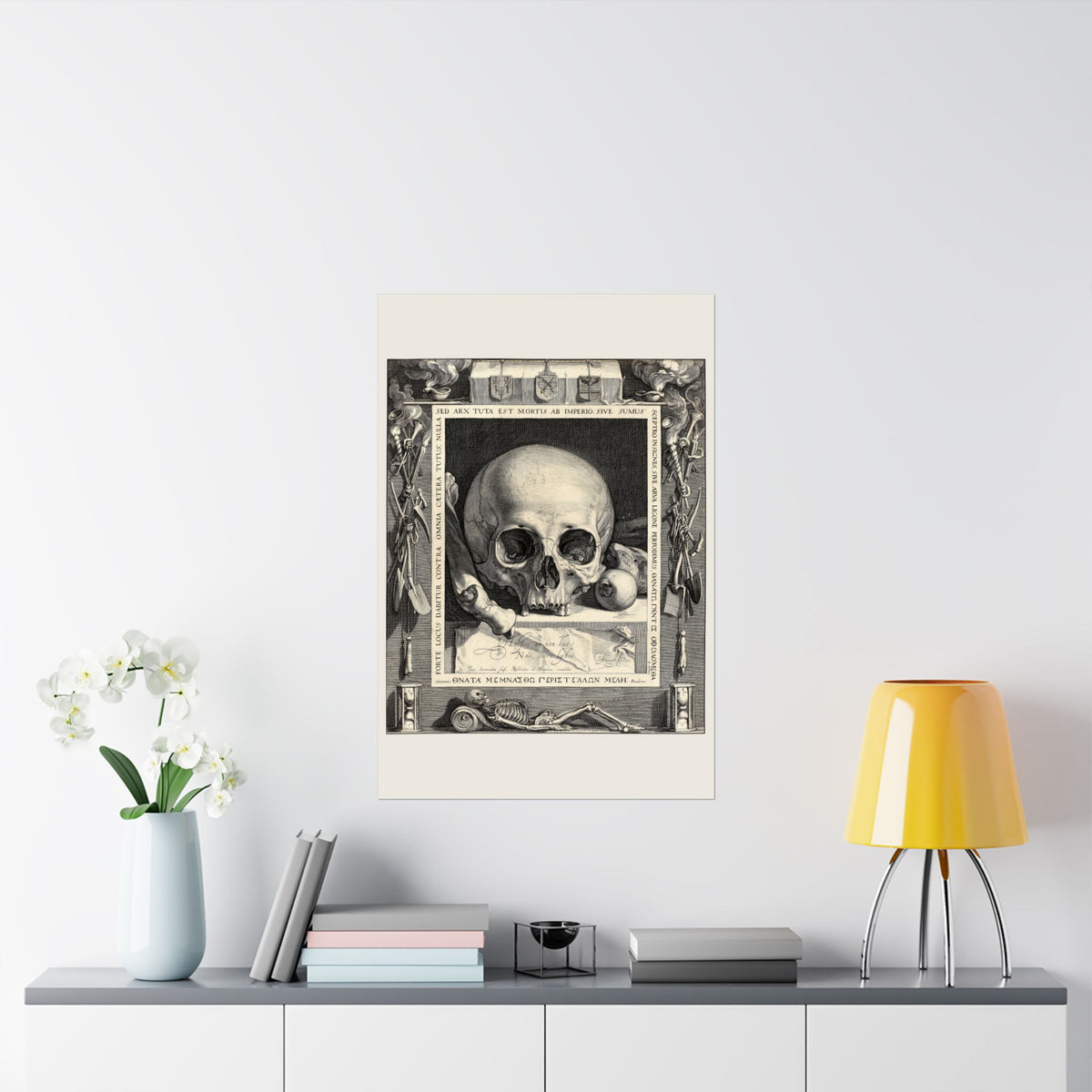
A human skull occupies the center of an elaborate allegorical composition in this historical Vanitas engraving by Jan Saenredam (1565–1607), after a design by Abraham Bloemaert (1566–1651). Created between 1575 and 1607 and published by Robert de Baudous, the artwork transforms an arrangement of objects and symbolic imagery into a meditation on mortality, the passage of time, and the impermanence of earthly life.
The composition presents a human skull surrounded by objects associated with mortality and the transience of earthly existence. An elaborate architectural and decorative framework incorporates additional symbolic imagery, while Latin and Greek inscriptions contribute to the work's philosophical character.
The detailed engraving combines intricate crosshatching, carefully modeled light and shadow, and ornamental elements characteristic of Northern European printmaking.
The artwork incorporates several elements associated with the traditions of Vanitas and Memento Mori:
-
Human skull: The inevitability of death and the fragility of human existence.
-
Bones and skeletal remains: The physical fate shared by all humanity.
-
Hourglasses: The passage of time and the limited duration of earthly life.
-
Decorative emblems: Reminders that worldly power, distinction, and achievement are temporary.
-
Latin and Greek inscriptions: Reflections upon mortality, human limitations, and the uncertainty of life.
-
Architectural framing: An elaborate visual setting that transforms the still life into a formal allegory.
Together, these elements encourage viewers to contemplate the brevity of human existence and the futility of placing lasting importance upon earthly accomplishments.
Engraved by Jan Saenredam after Abraham Bloemaert and published by Robert de Baudous, the work belongs to the tradition of Northern European allegorical printmaking during the late Renaissance.
Memento Mori, Latin for "Remember that you must die," encouraged reflection upon mortality and preparation for the afterlife. Closely related Vanitas imagery emphasized the impermanence of beauty, wealth, authority, and worldly pleasures.
The detailed linework, symbolic composition, and ornamental treatment reflect the artistic sophistication of Dutch and Flemish engraving around the turn of the seventeenth century.
With its skull imagery, historical symbolism, and antique appearance, this reproduction complements libraries, studies, reading rooms, Gothic interiors, and collections devoted to Renaissance art, religious allegory, and the macabre.
- Historical Vanitas engraving by Jan Saenredam
- Based on a design by Abraham Bloemaert
- Published by Robert de Baudous
- Dating from approximately 1575–1607
- Allegorical composition featuring a human skull and symbols of mortality
- Original Latin and Greek inscriptions
- Traditional Memento Mori symbolism
- Reproduced with the intricate engraved details and aged appearance of the historical artwork
- Giclée printing on archival paper
- Smooth matte finish
- Available in multiple sizes
- Suitable for indoor wall display
- Supplied unframed
- Slight production size tolerance of approximately ±1/16 inch
Handle with clean, dry hands. Avoid prolonged exposure to direct sunlight and moisture. If necessary, gently remove surface dust with a clean, dry cloth.