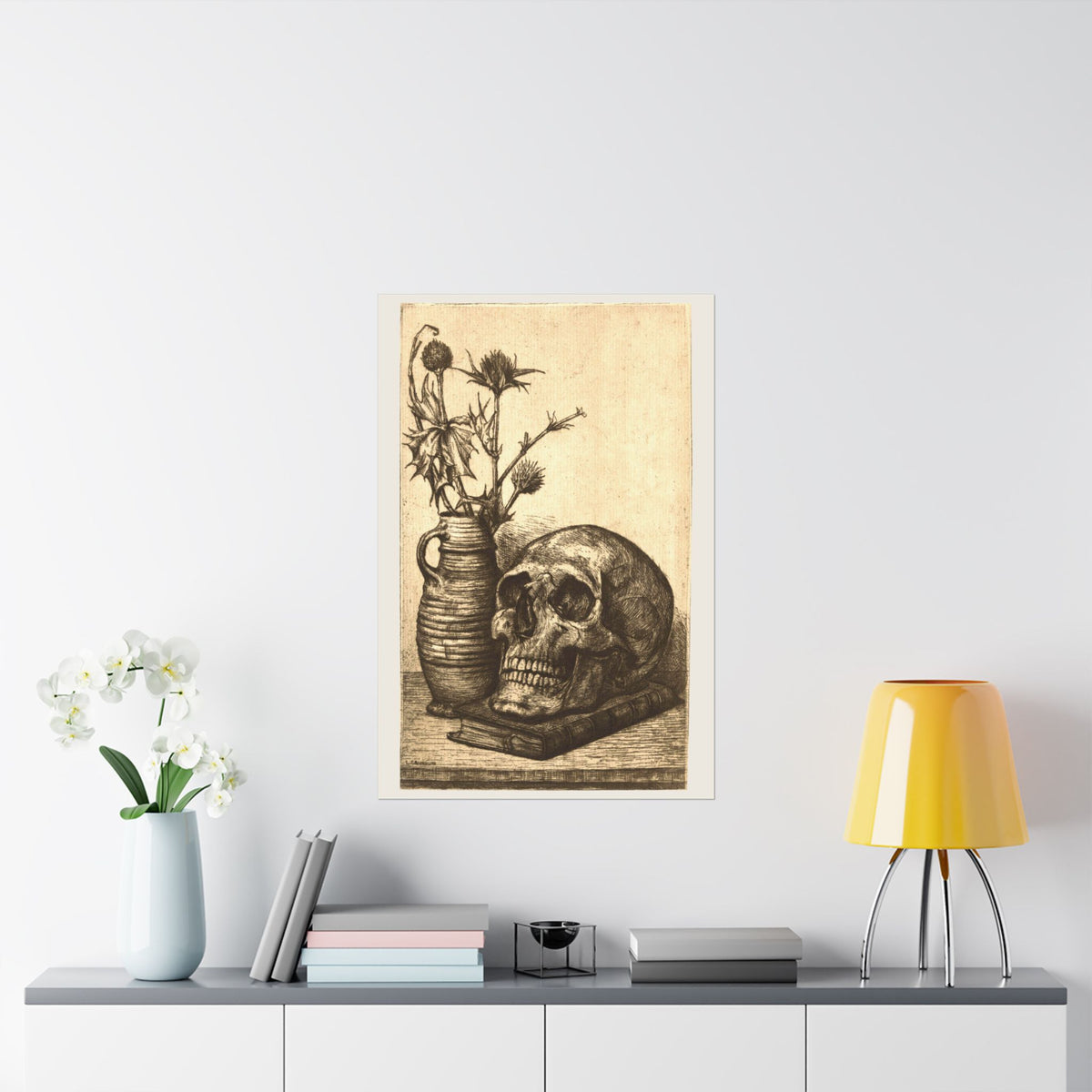
Beauty fades, knowledge endures only so long, and death ultimately claims them both. In this atmospheric still life by Dutch artist Lou Asperslagh, a weathered human skull rests upon a closed book beside a ceramic vase filled with dried thistles. Rendered in delicate brown tones against an aged-paper background, the composition combines botanical detail, anatomical precision, and the quiet melancholy of traditional Vanitas art.
The composition presents a human skull resting on a closed book, positioned beside a ribbed ceramic vase containing withered thistles.
The skull is depicted in three-quarter view, revealing its hollow eye sockets, exposed teeth, and carefully modeled anatomical features. The dried thistles rise above the arrangement, their thorny leaves and fading flower heads creating a striking contrast with the smooth contours of the skull.
Fine engraved lines, delicate crosshatching, and carefully controlled shadows give the composition depth and texture, while the restrained arrangement emphasizes the relationship between the objects.
The artist's printed signature, L. E. Asperslagh, appears in the lower-left portion of the artwork.
The still life incorporates several traditional elements associated with Vanitas and Memento Mori imagery:
-
Human skull: The inevitability of death and the fragility of human existence.
-
Closed book: Knowledge, intellectual achievement, and the limitations of earthly learning.
-
Withered thistles: The passing of life, decay, and the temporary beauty of nature.
-
Thorns and dried leaves: Hardship, suffering, and the vulnerability of living things.
-
Ceramic vase: A vessel preserving the remains of once-living flowers, reinforcing the contrast between permanence and decay.
-
Restrained composition: A quiet reflection on mortality without the elaborate symbolism of traditional Baroque still lifes.
Together, these elements convey the central message of Memento Mori: human life, beauty, and worldly accomplishments are temporary.
Created by Lou Asperslagh sometime between approximately 1903 and 1935, this print is titled Stilleven (Still Life).
The artwork reflects the enduring influence of Dutch Vanitas painting and printmaking, a tradition particularly associated with the seventeenth century. These compositions frequently combined skulls, books, flowers, candles, and other symbolic objects to explore the passage of time and the impermanence of earthly existence.
Asperslagh's interpretation is notably restrained. Rather than presenting an elaborate arrangement of allegorical objects, the artist concentrates on three simple elements: a skull, a book, and dried flowers.
The result is an intimate, contemplative composition that connects historical mortality symbolism with the expressive qualities of early twentieth-century printmaking.
With its finely detailed skull, botanical imagery, and warm antique appearance, this reproduction complements libraries, studies, reading rooms, Gothic interiors, and collections devoted to historical art, botanical illustration, and the macabre.
- Historical Vanitas still-life print by Lou Asperslagh
- Original artwork dated approximately 1903–1935
- Human skull resting on a closed book beside a vase of withered thistles
- Detailed botanical elements, anatomical features, and delicate crosshatching
- Original printed artist's signature preserved within the composition
- Traditional Memento Mori symbolism exploring mortality and the passage of time
- Reproduced with the intricate details, warm brown tones, and aged appearance of the historical artwork
- Giclée printing on archival paper
- Smooth matte finish
- Available in multiple sizes
- Suitable for indoor wall display
- Supplied unframed
- Slight production size tolerance of approximately ±1/16 inch
Handle with clean, dry hands. Avoid prolonged exposure to direct sunlight and moisture. Gently remove surface dust with a clean, dry cloth.