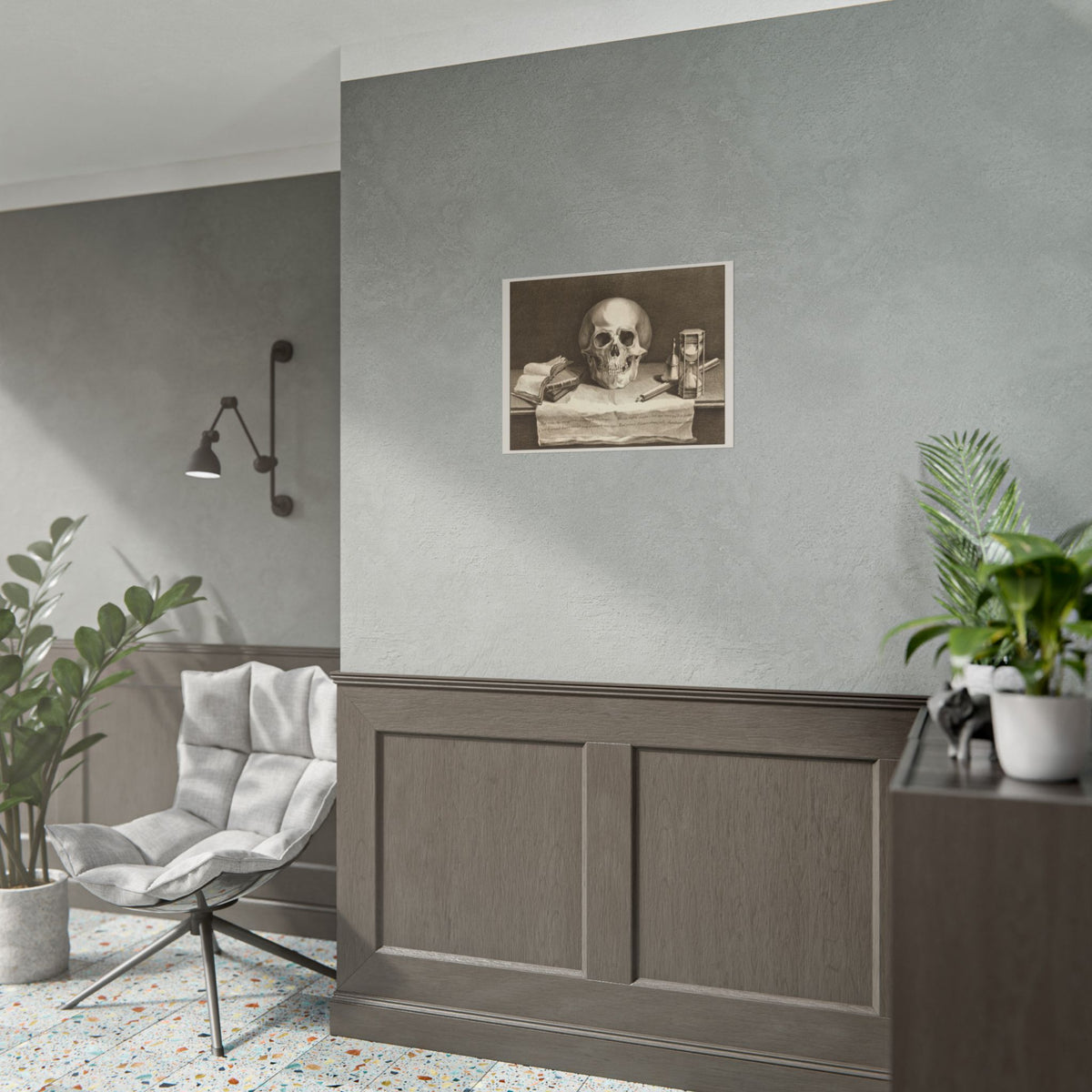
A human skull surrounded by books, an hourglass, and a burning candle forms the centerpiece of this elaborate eighteenth-century French engraving by Jean Aubert, after a drawing by Edme Bouchardon (1698–1762). Published in Paris by Gabriel Huquier, the composition brings together familiar symbols of mortality, knowledge, and the passage of time in a traditional Vanitas still life.
Original French inscription
J'ai vécu; tu mourras; contemple ton image;
C'est le grand livre ouvert pour former le vrai sage.
Vois ce sable coulant, c'est ton sort qu'il te peint;
Tout passe, l'heure sonne, et le flambeau s'éteint.
English translation
I have lived; you shall die; behold your own reflection;
Here lies the great book, opened to teach true wisdom.
Behold the flowing sand, for it reveals your fate;
All things pass, the hour strikes, and the flame goes out..
The skull occupies the center of a table covered with a draped cloth. To the left, an open book rests upon additional volumes, while a burning candle, an hourglass, and a rolled document complete the arrangement on the right.
The detailed engraving combines delicate crosshatching, carefully modeled shadows, and contrasting textures. The dark background emphasizes the pale skull and surrounding objects, giving the composition a dramatic yet restrained appearance.
The objects represent several traditional elements of Vanitas and Memento Mori imagery:
-
Human skull: The inevitability of death and the fragility of human existence.
-
Hourglass: The continuous passage of time and the limited duration of life.
-
Burning candle: The gradual consumption of life and its eventual extinguishing.
-
Books: Human knowledge, learning, and intellectual accomplishments, all temporary in the face of mortality.
-
Rolled document: Earthly achievements, records, and the impermanence of human affairs.
Together, these symbols remind viewers that neither knowledge, wealth, nor worldly accomplishments can prevent the passage of time.
The engraving belongs to the European tradition of Vanitas, a form of allegorical art exploring the transience of earthly life. Closely related to Memento Mori — Latin for "Remember that you must die" — these compositions encouraged reflection upon mortality through arrangements of symbolic objects.
Created after a drawing by Edme Bouchardon, the print reflects eighteenth-century French artistic traditions, combining classical composition with the intricate techniques of historical copperplate engraving.
With its skull imagery, scholarly objects, and antique appearance, this reproduction complements libraries, studies, reading rooms, Gothic interiors, and collections devoted to historical art, philosophical symbolism, and the macabre.
- Historical French Vanitas engraving by Jean Aubert
- Based on an original drawing by Edme Bouchardon
- Published by Gabriel Huquier in Paris
- Allegorical still life featuring a skull, books, hourglass, candle, and rolled document
- Traditional Memento Mori symbolism representing mortality and the passage of time
- Reproduced with the intricate engraved details and aged appearance of the historical artwork
- Giclée printing on archival paper
- Smooth matte finish
- Available in multiple sizes in a horizontal landscape format
- Supplied unframed
Handle with clean, dry hands. Avoid prolonged exposure to direct sunlight and moisture. Gently remove surface dust with a clean, dry cloth.