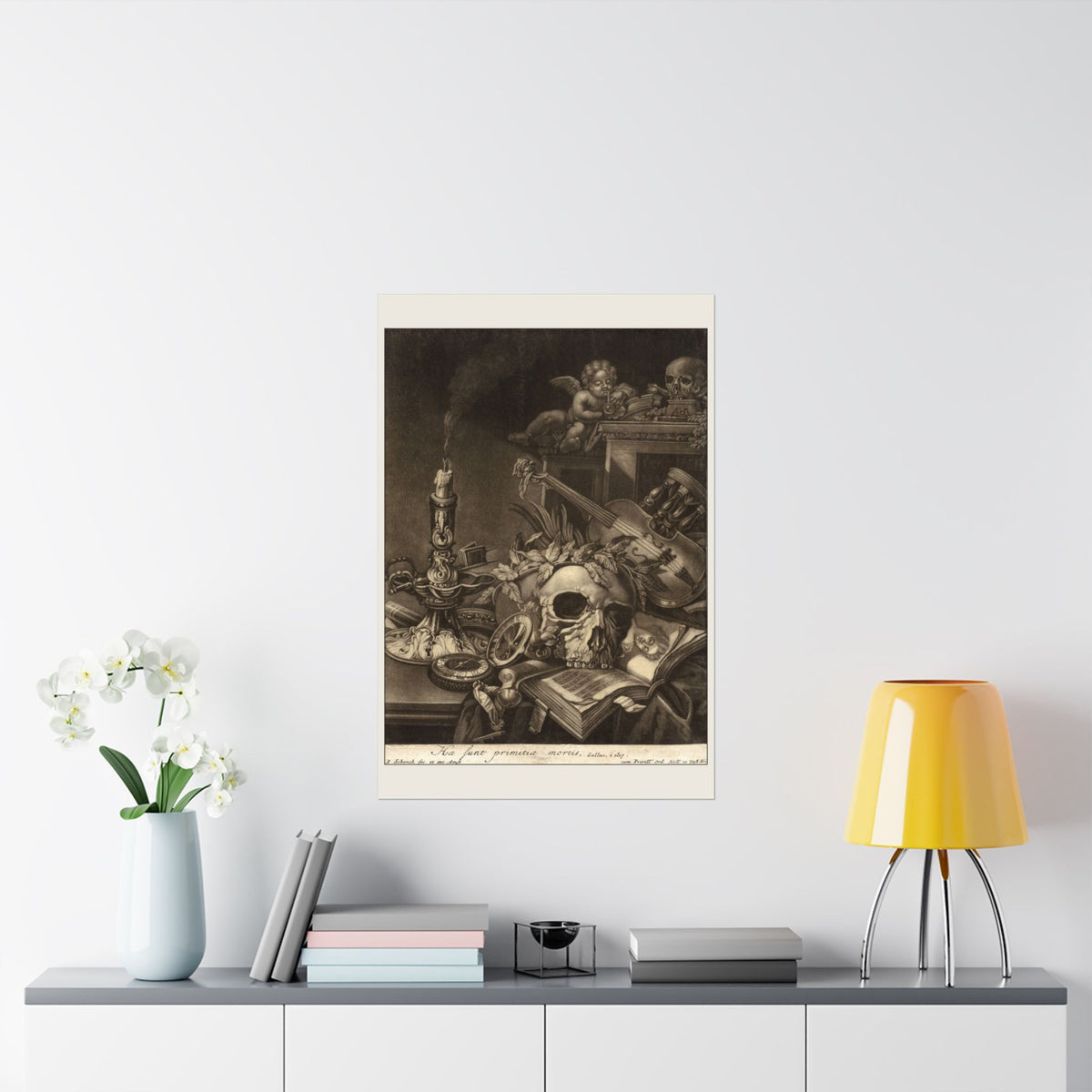
A violin lies silent, a candle burns toward its end, and a richly decorated clock marks the passing hours. Beneath these reminders of time and transience, a flower-crowned skull becomes the centerpiece of an elaborate Dutch Vanitas composition by Pieter Schenk I (1660–1711). Created using mezzotint and engraving techniques, this dramatic artwork combines musical instruments, luxurious objects, books, and mortality symbolism in a richly detailed reflection on the fleeting nature of earthly pleasures.
The composition presents an elaborate still life dominated by a human skull crowned with foliage, surrounded by objects representing music, knowledge, wealth, and the passage of time.
A violin rests diagonally across the arrangement, while an ornate candlestick holds a nearly extinguished candle, its delicate trail of smoke rising into the dark background.
An elaborate timepiece, open books, and a portrait album contribute to the scholarly and luxurious atmosphere. Above the arrangement, a small winged cherub appears beside a clock and another skull, reinforcing the composition's allegorical character.
The rich tonal contrasts, soft transitions, and intricate engraved details demonstrate the distinctive qualities of mezzotint, a printmaking technique particularly suited to dramatic effects of light and shadow.
A Latin inscription appears beneath the composition, completing its philosophical message.
The artwork incorporates several traditional elements associated with Vanitas and Memento Mori imagery:
-
Flower-crowned skull: The inevitability of death and the fleeting nature of beauty and earthly glory.
-
Violin: Music, artistic accomplishment, and pleasures that vanish as quickly as they are experienced.
-
Nearly extinguished candle: The brevity of human life and its approaching conclusion.
-
Clock and timepiece: The continuous passage of time and the limited duration of earthly existence.
-
Books and portrait album: Knowledge, memory, personal identity, and human achievements that cannot prevent mortality.
-
Ornate candlestick: Wealth, luxury, and worldly possessions whose value is temporary.
-
Winged cherub: A possible reference to the spiritual dimension of human existence and the relationship between earthly life and eternity.
Together, these objects express the central message of Memento Mori: beauty, music, wealth, knowledge, and earthly accomplishments eventually yield to time.
Created by Dutch printmaker and publisher Pieter Schenk I in Amsterdam, this artwork is dated between 1670 and 1713 by the Rijksmuseum.
Schenk was known for his engravings, mezzotints, portraits, and publishing activities during the Dutch Golden Age.
The print belongs to the European tradition of Vanitas still-life imagery, particularly associated with seventeenth-century Dutch art. These compositions frequently combined skulls, musical instruments, books, candles, flowers, and expensive objects to remind viewers of the impermanence of earthly pleasures.
Memento Mori, Latin for "Remember that you must die," encouraged reflection upon mortality and the passage of time.
The artwork's dramatic mezzotint technique, elaborate arrangement of symbolic objects, and rich brown tonalities create a distinctive example of Baroque-era mortality imagery.
With its striking skull, musical instruments, historical Latin inscription, and atmospheric appearance, this reproduction complements libraries, studies, music rooms, Gothic interiors, and collections devoted to historical art, Dutch printmaking, and the macabre.
- Historical Vanitas still-life print by Pieter Schenk I
- Original artwork dated between 1670 and 1713
- Published in Amsterdam
- Human skull crowned with foliage, violin, ornate candlestick, clock, books, and portrait album
- Winged cherub and additional skull incorporated into the upper composition
- Original Latin inscription preserved beneath the artwork
- Traditional Memento Mori symbolism exploring mortality and the passage of time
- Original created using mezzotint and engraving techniques
- Reproduced with the rich tonal contrasts, intricate details, and aged appearance of the historical artwork
- Giclée printing on archival paper
- Smooth matte finish
- Available in multiple sizes
- Suitable for indoor wall display
- Supplied unframed
- Slight production size tolerance of approximately ±1/16 inch
Handle with clean, dry hands. Avoid prolonged exposure to direct sunlight and moisture. Gently remove surface dust with a clean, dry cloth.