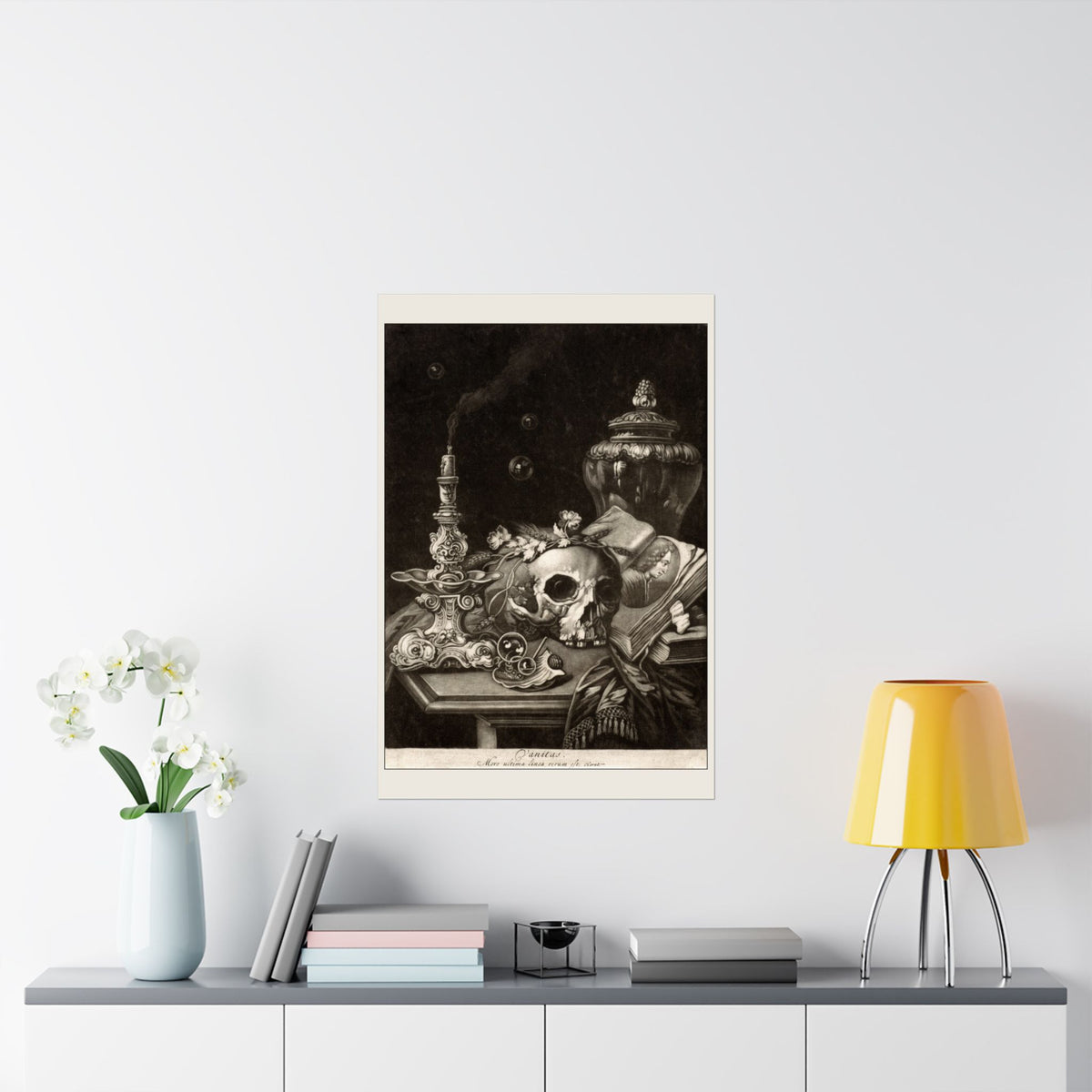
A flower-crowned human skull surrounded by objects of wealth, knowledge, and earthly pleasure forms the centerpiece of this elaborate Vanitas engraving by Dutch printmaker and publisher Pieter Schenk I (1660–1711). Created between 1670 and 1713, the composition presents a meditation on mortality through a richly detailed arrangement of symbolic objects. An extinguished candle, delicate soap bubbles, precious vessels, and an open portrait album serve as reminders that beauty, accomplishment, and worldly possessions are ultimately temporary.
At the center of the composition rests a human skull adorned with flowers, their fragile blossoms contrasting with the permanence of death. Nearby stands an ornate candlestick holding an extinguished candle, while several soap bubbles float through the darkened background.
An open portrait album, a decorated vessel, and other carefully arranged objects complete the still life, suggesting the pleasures, achievements, and material comforts of earthly existence.
The inscription beneath the image includes a quotation attributed to the Roman poet Horace:
Mors ultima linea rerum est.
"Death is the final boundary of all things."
The composition incorporates several traditional elements of Vanitas and Memento Mori imagery:
-
Flower-crowned skull: The contrast between earthly beauty and inevitable mortality.
-
Extinguished candle: The end of life and the passing of time.
-
Soap bubbles: The fragility and brief duration of human existence, associated with the concept Homo Bulla — "Man is a Bubble."
-
Portrait album: Human memory, reputation, and the desire to preserve one's earthly identity.
-
Ornate candlestick and vessel: Material wealth, luxury, and possessions that cannot prevent death.
-
Flowers: The transient nature of youth, beauty, and prosperity.
Together, these objects illustrate the central message of Vanitas: all earthly things, regardless of their beauty or value, are subject to decay and disappearance.
Created during the Dutch Golden Age and its aftermath, this engraving reflects the European tradition of Vanitas still-life imagery, particularly prominent in seventeenth-century Dutch art.
Closely associated with Memento Mori — Latin for "Remember that you must die" — these compositions encouraged contemplation of mortality through symbolic arrangements of everyday objects.
Pieter Schenk's detailed engraving combines intricate crosshatching, carefully modeled light and shadow, and elaborate decorative elements. The contrast between the illuminated skull and objects in the foreground and the dark background creates a dramatic composition characteristic of historical Dutch printmaking.
With its combination of skull imagery, floral symbolism, and antique objects, this reproduction complements libraries, studies, reading rooms, Gothic interiors, and collections devoted to historical art, philosophical allegory, and the macabre.
- Historical Vanitas engraving by Pieter Schenk I, dating from 1670–1713
- Allegorical still life featuring a flower-crowned skull, extinguished candle, soap bubbles, books, and decorative objects
- Original Latin inscription quoting the Roman poet Horace
- Traditional Memento Mori symbolism of mortality and the passage of time
- Reproduced with the intricate engraved details and aged appearance of the historical artwork
- Giclée printing on archival paper
- Smooth matte finish
- Available in multiple sizes
- Suitable for indoor wall display
- Supplied unframed
- Slight production size tolerance of approximately ±1/16 inch
Handle with clean, dry hands. Avoid prolonged exposure to direct sunlight and moisture. If necessary, gently remove surface dust with a clean, dry cloth.