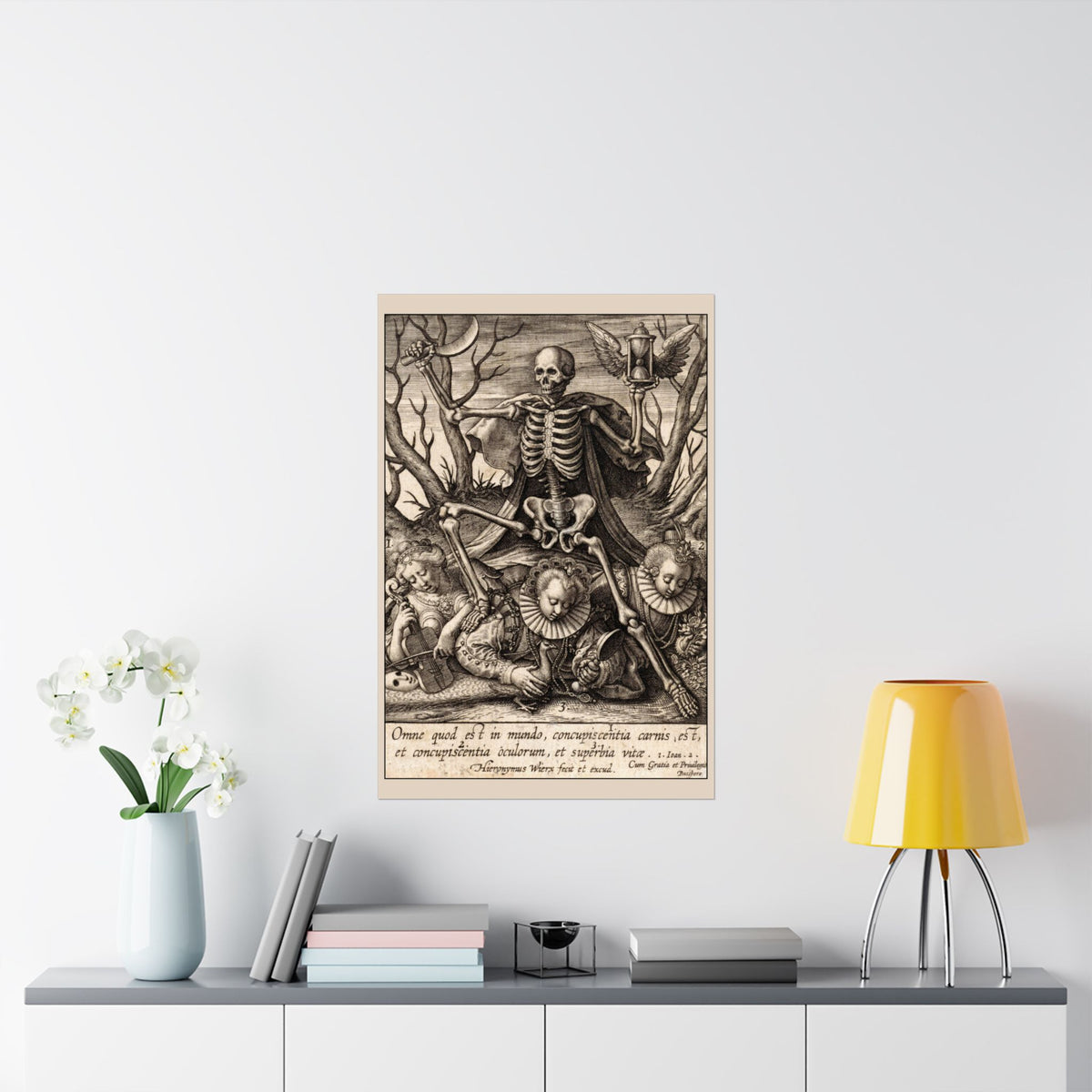
Death appears as a crowned sovereign of the grave in this dramatic allegorical engraving by Flemish artist and printmaker Hieronymus Wierix (1553–1619). Armed with a scythe and holding a winged hourglass, a skeletal figure towers over three richly dressed women representing the temptations of earthly existence: desire, wealth, and pride. The scene presents a powerful meditation on the inevitable triumph of death over worldly pleasures and human ambition.
The central skeleton, draped in flowing fabric and surrounded by barren trees, dominates the composition. Its raised scythe symbolizes the sudden and indiscriminate arrival of death, while the winged hourglass represents the relentless passage of time. Beneath its feet, the three women lie defeated, their elaborate garments, jewelry, and fashionable collars emphasizing the worldly status and vanity that cannot protect them from mortality.
Each woman personifies a different aspect of human temptation. Together, they represent the desires of the flesh, the attraction of material possessions, and the arrogance of earthly achievement. Their contrasting expressions and carefully rendered clothing add a dramatic human element to the allegory, while the surrounding landscape reinforces the atmosphere of decay and impermanence.
The engraving belongs to the European traditions of Vanitas and Memento Mori, which encouraged reflection upon the brevity of human life and the futility of worldly pursuits. Beneath the illustration appears a Latin quotation from the First Epistle of John (1 John 2:16), referring to the lust of the flesh, the lust of the eyes, and the pride of life. This biblical reference establishes the religious meaning of the three fallen figures and connects the composition to Christian teachings on temptation and mortality.
Through its elaborate crosshatching, expressive figures, detailed Renaissance costumes, and symbolic imagery, the artwork demonstrates the technical sophistication of Flemish engraving. The contrast between the imposing skeleton and the richly adorned women creates a striking example of religious allegory, combining moral instruction with the unsettling beauty of early European printmaking.
With its dramatic skeletal imagery, biblical symbolism, and historical detail, this reproduction complements libraries, studies, reading rooms, Gothic interiors, and collections devoted to Renaissance art, religious allegory, and the macabre. It also makes an unusual gift for collectors of memento mori imagery, historical engravings, Christian symbolism, and artistic curiosities.
Original Latin inscription
Omne quod est in mundo, concupiscentia carnis est,
et concupiscentia oculorum, et superbia vitae.
1. Ioan. 2.
English translation
All that is in the world is the lust of the flesh,
and the lust of the eyes, and the pride of life.
1 John 2:16
Product Features
- Historical Vanitas engraving by Hieronymus Wierix
- Allegorical depiction of Death overcoming three women representing desire, wealth, and pride
- Skeleton holding a scythe and winged hourglass
- Original Latin biblical inscription referencing 1 John 2:16
- Traditional Memento Mori symbolism of mortality and the passage of time
- Reproduced with the aged appearance and intricate engraved details of the historical artwork
- Giclée printing on archival paper
- Smooth matte finish
- Suitable for indoor wall display
- Supplied unframed
- Slight production size tolerance of approximately ±1/16 inch
Care Instructions
Handle with clean, dry hands. Avoid prolonged exposure to direct sunlight and moisture. If necessary, gently remove surface dust with a clean, dry cloth.