Speculum Propriae Vilitatis Skull Mirror Skeletons & Serpents Theodoor Galle 1610 Memento Mori Art Print
Speculum Propriae Vilitatis Skull Mirror Skeletons & Serpents Theodoor Galle 1610 Memento Mori Art Print
Couldn't load pickup availability
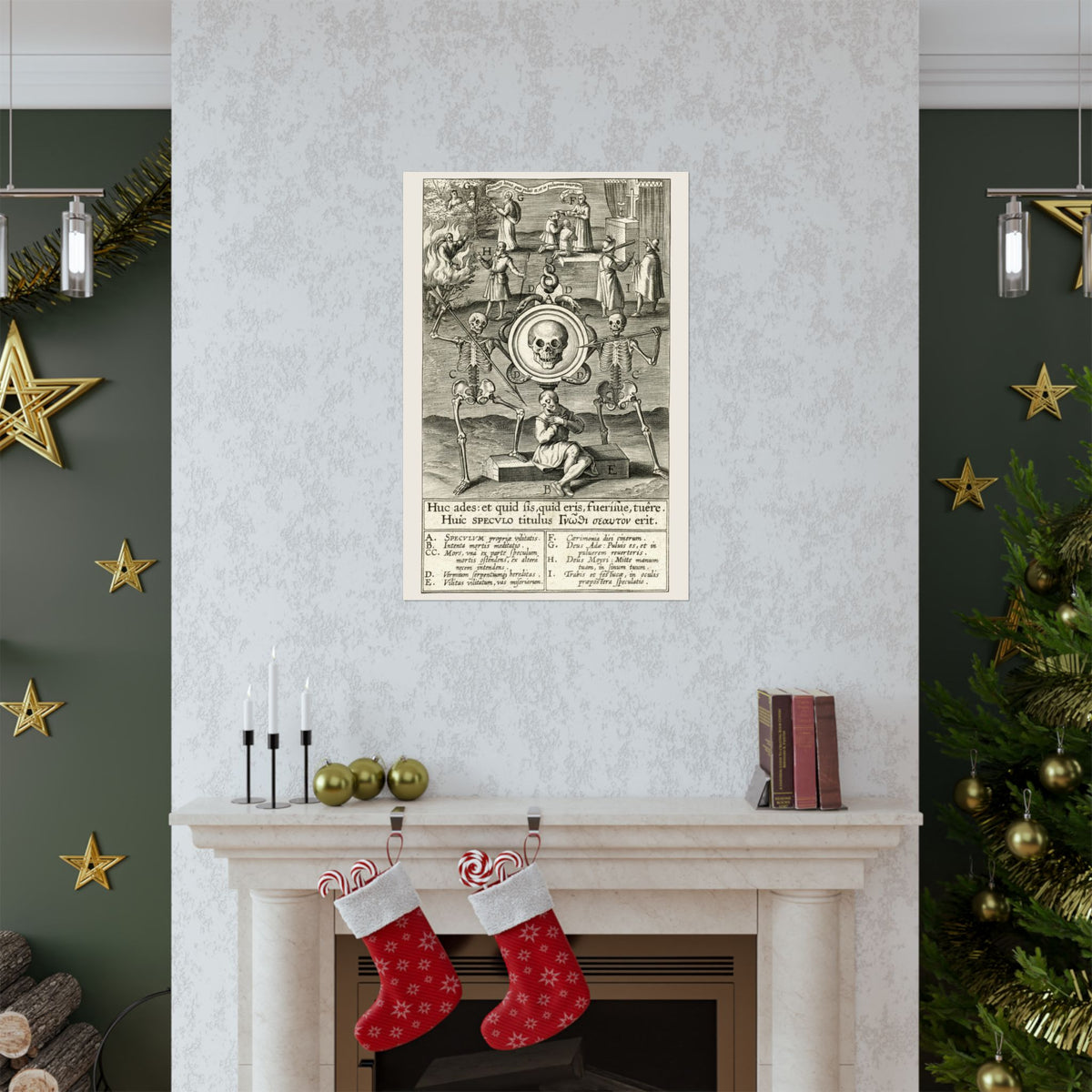
What do you see when you confront your own mortality? In this extraordinary 1610 engraving by Theodoor Galle (1571–1633), a human skull appears within a mirror surrounded by serpents, while two skeletons threaten a contemplative figure seated upon a coffin. Behind this unsettling arrangement, biblical scenes illustrate humanity's fallen condition and the possibility of spiritual redemption. Titled Speculum Propriae Vilitatis — "Mirror of One's Own Wretchedness" — the artwork transforms the familiar Memento Mori tradition into an elaborate examination of death, sin, and self-knowledge.
At the center of the composition stands a large circular mirror containing a human skull. Four serpents surround the mirror, representing original sin and humanity's fallen nature.
Two skeletons stand on either side, directing their arrows toward a contemplative figure seated upon a coffin beneath the mirror.
The background contains several biblical scenes, including:
- Moses and the Burning Bush: The encounter between Moses and God.
- Adam and Eve in Paradise: Humanity's original disobedience and the introduction of sin.
- Religious blessing: A priest blessing two kneeling believers.
- The Speck and the Beam: A biblical scene illustrating hypocrisy and the failure to recognize one's own faults.
Additional figures and symbolic details reinforce the composition's religious and philosophical character.
Beneath the illustration appears an extensive Latin inscription, accompanied by an alphabetically organized explanatory legend identifying the principal scenes and symbols.
The intricate engraving combines carefully rendered skeletal anatomy, architectural details, biblical narratives, and elaborate allegorical imagery.
The artwork incorporates several traditional elements of Christian Memento Mori symbolism:
- Skull within a mirror: Self-examination and recognition of one's own mortality.
- Two skeletons: The inevitability of death and its power over human existence.
- Arrows: Death's threat and the vulnerability of earthly life.
- Four serpents: Original sin, temptation, and humanity's fallen condition.
- Seated figure: Personal contemplation of death and the spiritual condition of the soul.
- Coffin: The certainty of death and the temporary nature of earthly existence.
- Moses and the Burning Bush: Divine revelation and the presence of God.
- Adam and Eve: Original sin and humanity's separation from divine perfection.
- Religious blessing: Faith, repentance, and the pursuit of salvation.
- The Speck and the Beam: Hypocrisy, moral blindness, and the importance of examining one's own faults.
Together, these elements present mortality as both a physical certainty and a spiritual invitation to self-examination.
Created in 1610 by Flemish engraver Theodoor Galle, this print is the sixth illustration in the twelve-part series Duodecim Specula Deum — "Twelve Mirrors of God."
The series explores twelve symbolic mirrors through which humanity attempts to understand God, human nature, and the spiritual condition of the soul.
The accompanying text was written by Jan David, a Jesuit author known for his religious and devotional writings.
The engraving was published in Antwerp by Theodoor Galle and Johannes Moretus II, connecting the work to the important Flemish tradition of illustrated religious literature.
The Latin inscription beneath the composition invites viewers to contemplate what they are, what they have been, and what they will become. It also incorporates the ancient Greek maxim Gnōthi Seauton — "Know Thyself."
Closely associated with Memento Mori — Latin for "Remember that you must die" — the artwork combines mortality symbolism with Christian teachings concerning sin, repentance, and salvation.
Unlike conventional Vanitas still lifes, this engraving presents an extensive theological allegory in which the mirror becomes an instrument of spiritual reflection rather than physical vanity.
With its unusual skull mirror, skeletal figures, serpents, biblical scenes, and extensive Latin inscriptions, this reproduction complements libraries, studies, Gothic interiors, religious collections, and displays devoted to historical Christian art, Renaissance engraving, and philosophical symbolism.
Original inscriptions
Memento homo, quia pulvis es; et in pulverem reuerteris. Gen: 3.
Huc ades: et quid sis, quid eris, fuerisve, tuere.
Huic SPECVLO titulus Γνῶθι σεαυτὸν erit.
A. SPECVLVM propriae vilitatis.
B. Intenta mortis meditatio.
CC. Mors, una ex parte speculum mortis ostendens, ex altera necem intendens.
D. Vermium serpentiumq(ue) hereditas.
E. Vilitas vilitatum, vas miseriarum.
F. Cerimonia diei cinerum.
G. Deus Adae: Pulvis es, et in pulverem reuerteris.
H. Deus Moysi: Mitte manum tuam, in sinum tuum.
I. Trabis et festucae, in oculis praepostera speculatio.
English translations
"Remember man, that you are dust; and unto dust you shall return. Genesis 3."
"Come here: and behold what you are, what you will be, or what you have been.
The title of this MIRROR will be 'Know Thyself'."
A. "The mirror of one's own worthlessness."
B. "Focused meditation on death."
CC. "Death, showing a mirror of mortality on one side, and aiming destruction from the other."
D. "The inheritance of worms and serpents."
E. "Worthlessness of worthlessnesses, a vessel of miseries."
F. "The ceremony of Ash Wednesday."
G. "God to Adam: You are dust, and to dust you shall return."
H. "God to Moses: Put your hand into your bosom."
I. "The distorted observation of the beam and the speck in the eyes."
- Historical Speculum Propriae Vilitatis engraving by Theodoor Galle
- Original artwork dated 1610
- Sixth print in the twelve-part Duodecim Specula Deum series
- Human skull within a mirror surrounded by four serpents
- Two skeletons threatening a contemplative figure seated upon a coffin
- Biblical scenes featuring Moses, Adam and Eve, religious blessing, and the Speck and the Beam
- Original Latin inscriptions and explanatory legend preserved within the composition
- Religious text associated with Jesuit author Jan David
- Traditional Christian Memento Mori symbolism exploring mortality, original sin, and self-knowledge
- Detailed Flemish engraving with intricate linework and historical lettering
- Reproduced with the fine engraved details and historical appearance of the original artwork
- Giclée printing on archival paper
- Smooth matte finish
- Available in multiple sizes
- Artwork proportionally scaled to preserve the original composition, with printed margins that may vary by size
- Supplied unframed
- Slight production size tolerance of approximately ±1/16 inch
Handle with clean, dry hands. Avoid prolonged exposure to direct sunlight and moisture. Gently remove surface dust with a clean, dry cloth.