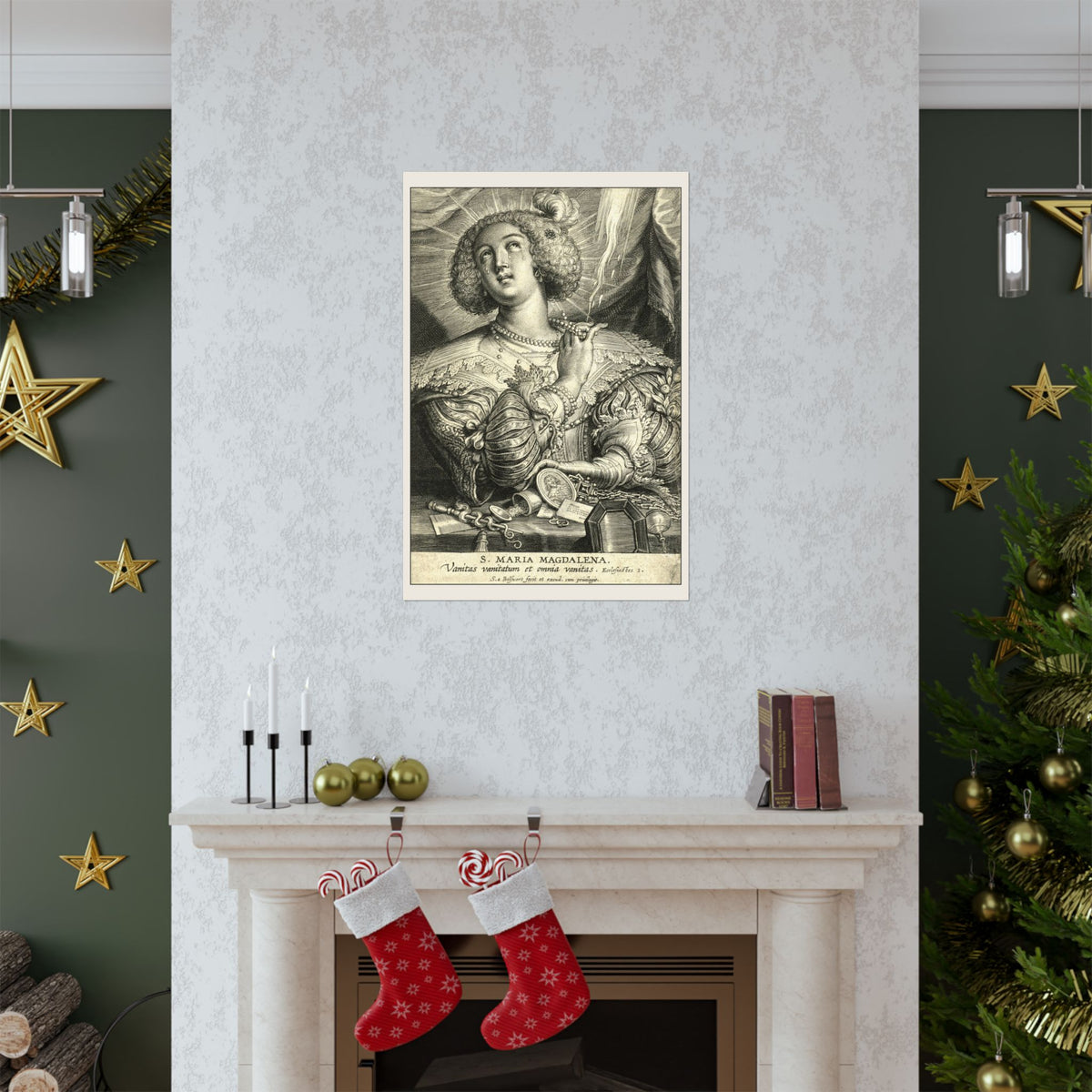
Pearls, perfume, and precious possessions lie within reach, yet Mary Magdalene turns away from them in a moment of profound spiritual transformation. Tears fill her eyes as she looks toward Heaven, removing her pearl necklace and rejecting the luxurious objects surrounding her. Engraved by Schelte Adamsz. Bolswert (c. 1586–1659) after a design by Peter Paul Rubens (1577–1640), this dramatic Baroque composition explores repentance, the vanity of worldly riches, and the pursuit of spiritual redemption.
The engraving depicts Saint Mary Magdalene richly dressed and seated beside a table covered with luxurious possessions, including jewelry, a perfume bottle, and a mirror.
With tears upon her face and her gaze directed upward, Magdalene removes her pearl necklace while pushing away the objects associated with her former life.
Her elaborate clothing, expressive gestures, and emotional expression create a striking contrast between material luxury and spiritual awakening.
The composition reflects Rubens's characteristic Baroque style, combining dramatic movement, expressive figures, and richly detailed textures.
Beneath the image appears a biblical reference to Ecclesiastes 1, emphasizing the vanity and impermanence of earthly things.
The artwork incorporates several elements associated with Christian repentance and Vanitas imagery:
-
Mary Magdalene: Repentance, spiritual transformation, and devotion to Christ.
-
Pearl necklace: Wealth, luxury, and worldly attachments that Magdalene willingly abandons.
-
Mirror: Vanity, physical beauty, and the temporary nature of earthly appearances.
-
Perfume bottle: Luxury and personal adornment, with additional associations to Magdalene's traditional role in Christian devotional imagery.
-
Discarded possessions: The rejection of material wealth in favor of spiritual fulfillment.
-
Tearful expression: Remorse, repentance, and emotional transformation.
-
Upward gaze: Faith, divine forgiveness, and the hope of salvation.
-
Ecclesiastes inscription: A biblical reminder of the transience of earthly accomplishments and possessions.
Together, these elements present a Christian interpretation of Vanitas, emphasizing that spiritual redemption holds greater value than material riches.
This engraving was created by Schelte Adamsz. Bolswert, a prominent Flemish printmaker who reproduced numerous paintings and designs by Peter Paul Rubens.
Rubens was one of the leading artists of the Flemish Baroque, renowned for his expressive figures, dramatic compositions, and religious subjects.
The image of Mary Magdalene renouncing her wealth belongs to a longstanding European artistic tradition portraying the saint as a model of repentance and spiritual renewal.
Although the biblical accounts do not explicitly describe Magdalene discarding jewelry and luxurious possessions, such imagery developed through later Christian traditions and artistic interpretations.
The inscription referencing Ecclesiastes 1 connects the composition to the concept of Vanitas — the recognition that earthly wealth, beauty, and pleasures are temporary.
Unlike traditional Memento Mori prints featuring skulls and hourglasses, this engraving explores the impermanence of worldly things through an intensely personal moment of religious conversion.
With its richly detailed historical costume, luxurious objects, expressive figure, and religious symbolism, this reproduction complements libraries, studies, traditional interiors, religious collections, and displays devoted to Baroque art, Christian history, and Vanitas imagery.
- Historical engraving of Saint Mary Magdalene renouncing worldly wealth
- Engraved by Schelte Adamsz. Bolswert after a design by Peter Paul Rubens
- Richly dressed Magdalene removing her pearl necklace and rejecting luxurious possessions
- Jewelry, mirror, and perfume bottle representing worldly vanity
- Biblical reference to Ecclesiastes 1 beneath the composition
- Christian symbolism exploring repentance, spiritual transformation, and redemption
- Traditional Flemish Baroque engraving with intricate linework and detailed textures
- Reproduced with the fine engraved details and historical appearance of the original artwork
- Giclée printing on archival paper
- Smooth matte finish
- Available in multiple sizes
- Suitable for indoor wall display
- Supplied unframed
- Slight production size tolerance of approximately ±1/16 inch
Handle with clean, dry hands. Avoid prolonged exposure to direct sunlight and moisture. Gently remove surface dust with a clean, dry cloth.