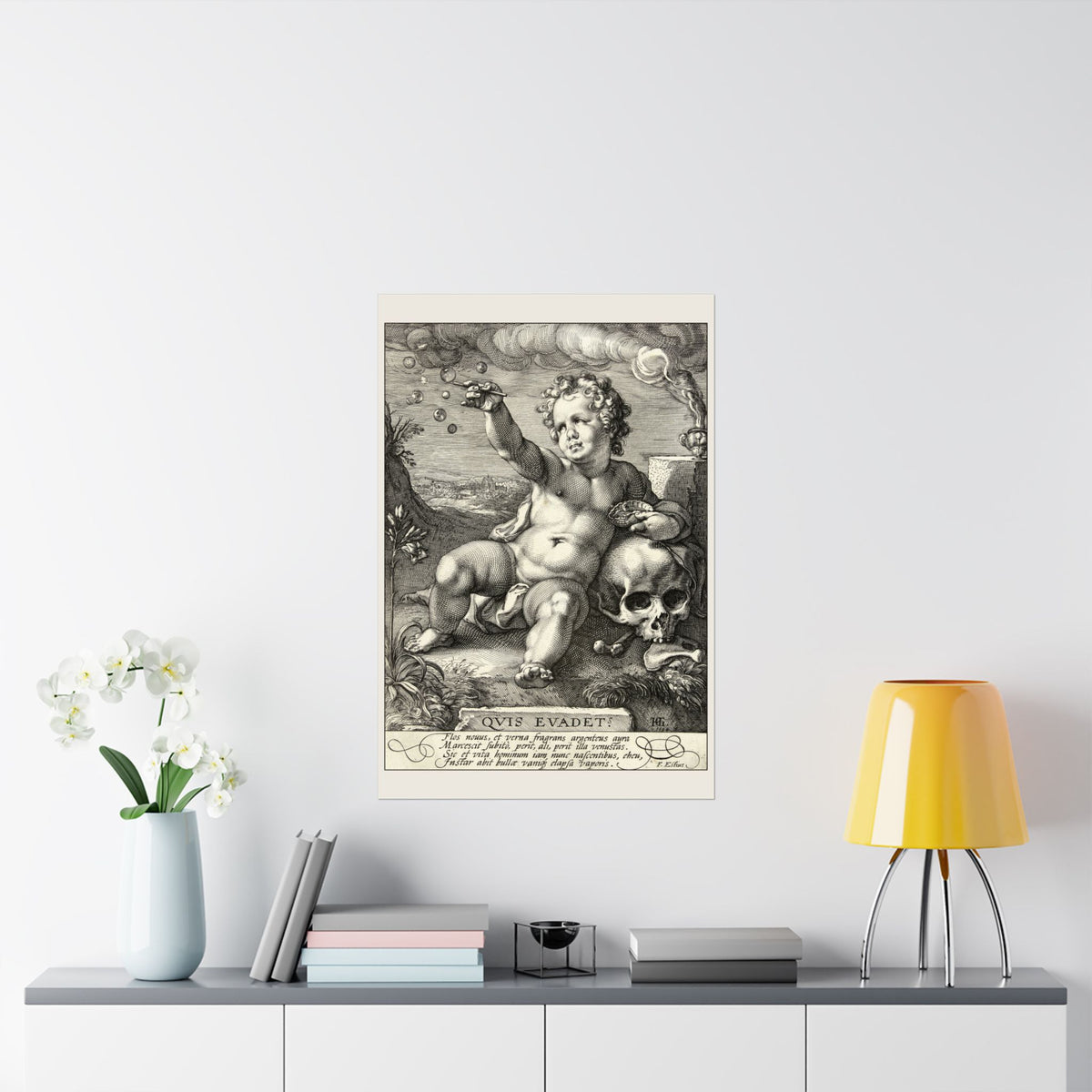
A child's innocent game becomes a haunting reflection on the brevity of human existence in this 1594 engraving by Hendrick Goltzius (1558–1617). Leaning against a human skull, a young putto holds a bubble-blowing pipe and a seashell, while delicate bubbles drift through the air and smoke rises behind him. Titled Quis Evadet? — "Who Shall Escape?" — the composition illustrates Homo Bulla, the ancient philosophical comparison of human life to a fragile soap bubble.
The engraving depicts a young putto leaning against a human skull. In his right hand, he holds a small pipe used to blow soap bubbles, while his left hand holds a seashell containing the liquid.
Behind the figure stands a small vessel from which smoke rises, reinforcing the atmosphere of transience and impermanence.
The words QVIS EVADET? appear beneath the composition, followed by four lines of Latin verse attributed to Franco Estius.
The artist's monogram and the date 1594 are incorporated into the original engraving.
Through delicate linework, carefully modeled shadows, and detailed anatomical features, Goltzius creates a compelling contrast between childhood innocence and the inevitability of death.
The composition incorporates several traditional elements of Memento Mori and Vanitas imagery:
-
Young putto: Childhood, innocence, and the vulnerability of human life.
-
Human skull: The inevitability of death and the mortality shared by all humanity.
-
Soap bubbles: The fragility and fleeting duration of existence, expressed through the concept Homo Bulla — "Man is a Bubble."
-
Bubble-blowing pipe: The temporary pleasures and delicate nature of earthly life.
-
Seashell: The vessel used for the child's game, emphasizing the contrast between innocent play and mortality.
-
Rising smoke: The disappearance of earthly existence and the passing of time.
-
Quis Evadet? inscription: Latin for "Who Shall Escape?" — a reminder that no one can avoid death.
Together, these elements transform a simple childhood activity into an allegory of life's impermanence.
Created in 1594 by Dutch artist Hendrick Goltzius and published in Haarlem, this engraving belongs to the Northern Renaissance tradition of moralizing and allegorical prints.
Goltzius was among the most accomplished engravers of his period, celebrated for his intricate linework, technical precision, and sophisticated compositions.
The artwork reflects the Homo Bulla tradition, which compares human existence to a soap bubble — beautiful, delicate, and destined to disappear.
The accompanying Latin verses by Franco Estius reinforce the theme of mortality, comparing the fleeting nature of human life to transient elements of the natural world.
Closely associated with Memento Mori — Latin for "Remember that you must die" — this imagery became especially prominent in European art during the sixteenth and seventeenth centuries.
With its unusual skull imagery, delicate bubbles, historical Latin inscription, and Renaissance craftsmanship, this reproduction complements libraries, studies, Gothic interiors, and collections devoted to historical engraving, philosophical symbolism, and the macabre.
- Historical Quis Evadet? / Homo Bulla engraving by Hendrick Goltzius
- Original artwork dated 1594
- Created and published by Hendrick Goltzius in Haarlem
- Young putto leaning against a human skull while holding a bubble-blowing pipe and seashell
- Rising smoke and soap bubbles symbolizing the fleeting nature of life
- Original Quis Evadet? inscription and four lines of Latin verse by Franco Estius
- Artist's monogram and original date preserved within the composition
- Traditional Memento Mori symbolism representing mortality and the passage of time
- Reproduced with the intricate engraved details and aged appearance of the historical artwork
- Giclée printing on archival paper
- Smooth matte finish
- Available in multiple sizes
- Suitable for indoor wall display
- Supplied unframed
- Slight production size tolerance of approximately ±1/16 inch
Handle with clean, dry hands. Avoid prolonged exposure to direct sunlight and moisture. Gently remove surface dust with a clean, dry cloth.