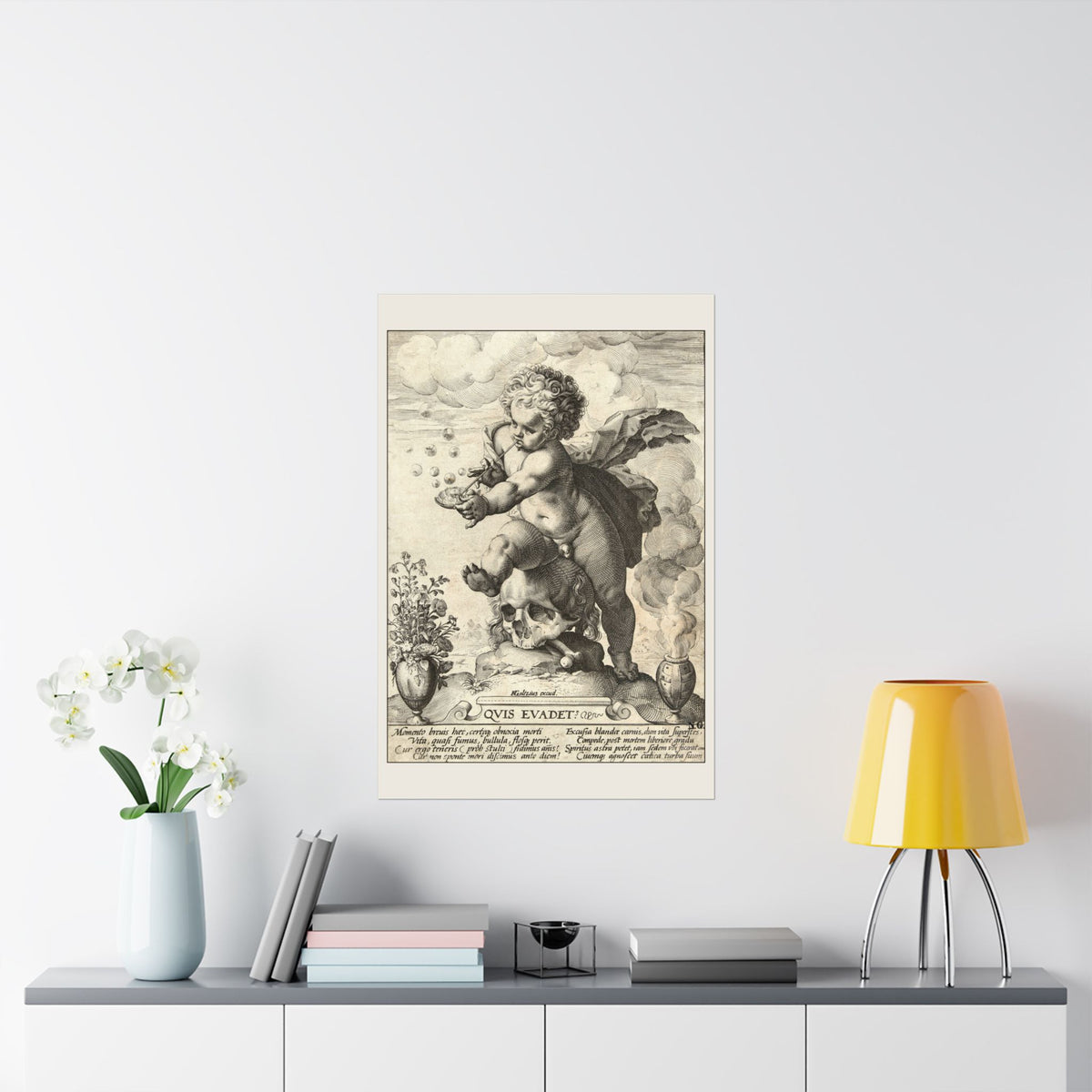
Who shall escape? The question Quis Evadet? appears beneath a young winged cherub perched upon a human skull, blowing delicate soap bubbles into the air. Published in 1590 by Hendrick Goltzius (1558–1617), this remarkable Renaissance engraving transforms a seemingly playful childhood activity into a meditation on the fragility of life. Combining innocence, mortality, flowers, and fleeting bubbles, the composition illustrates the philosophical concept of Homo Bulla — "Man is a Bubble."
The composition depicts a winged child, or putto, seated upon a human skull while blowing bubbles using liquid contained in a seashell.
To one side stands a vase filled with flowers, while a smoking vessel appears on the opposite side. These objects surround the central figure, creating an allegorical arrangement devoted to the passage of time and the impermanence of earthly existence.
The words QVIS EVADET? — "Who shall escape?" — appear within the composition, followed by eight lines of Latin verse beneath the image.
The carefully engraved details, delicate shading, and contrast between the playful child and the skull demonstrate the sophisticated visual symbolism of Northern Renaissance printmaking.
The engraving incorporates several traditional elements of Memento Mori and Vanitas imagery:
-
Winged cherub: Youth, innocence, and the fleeting nature of childhood.
-
Human skull: The inevitability of death and the mortality shared by all humanity.
-
Soap bubbles: The fragility and brief duration of human life, expressed through the ancient concept Homo Bulla.
-
Seashell: A vessel holding the liquid used to create bubbles, emphasizing their delicate and temporary existence.
-
Vase of flowers: Beauty, growth, and the inevitable fading of living things.
-
Smoking vessel: The passing of time and the disappearance of earthly existence, symbolized by dissipating smoke.
-
Quis Evadet? inscription: Latin for "Who shall escape?" — a direct reminder that death is universal.
Together, these elements convey the central message of Memento Mori: life is fragile, earthly pleasures are temporary, and no one can escape mortality.
Dated 1590, this engraving was produced by the workshop of Hendrick Goltzius and published by Goltzius in Haarlem, the Netherlands.
The design has also been tentatively associated with Italian artist Agostino Carracci (1557–1602), although this attribution remains uncertain.
Goltzius was one of the leading engravers and print publishers of the Northern Renaissance, celebrated for his technical mastery and elaborate compositions.
The artwork belongs to the Homo Bulla tradition, an allegorical theme comparing human life to a soap bubble — beautiful, delicate, and destined to disappear almost immediately.
Closely related to Vanitas and Memento Mori imagery, this symbolism became particularly prominent in European art during the sixteenth and seventeenth centuries.
With its unusual cherub seated upon a skull, delicate bubbles, botanical details, and Latin inscriptions, this reproduction complements libraries, studies, Gothic interiors, and collections devoted to Renaissance art, historical engraving, philosophical symbolism, and the macabre.
- Historical Quis Evadet? / Homo Bulla engraving dated 1590
- Produced by the workshop of Hendrick Goltzius
- Published by Hendrick Goltzius in Haarlem
- Design possibly after Agostino Carracci
- Winged cherub seated upon a human skull, blowing soap bubbles
- Seashell, vase of flowers, and smoking vessel incorporated into the allegorical composition
- Original Quis Evadet? inscription and eight lines of Latin verse
- Traditional Memento Mori symbolism representing mortality and the fragility of human life
- Reproduced with the intricate engraved details and aged appearance of the historical artwork
- Giclée printing on archival paper
- Smooth matte finish
- Available in multiple sizes
- Suitable for indoor wall display
- Supplied unframed
- Slight production size tolerance of approximately ±1/16 inch
Handle with clean, dry hands. Avoid prolonged exposure to direct sunlight and moisture. Gently remove surface dust with a clean, dry cloth.