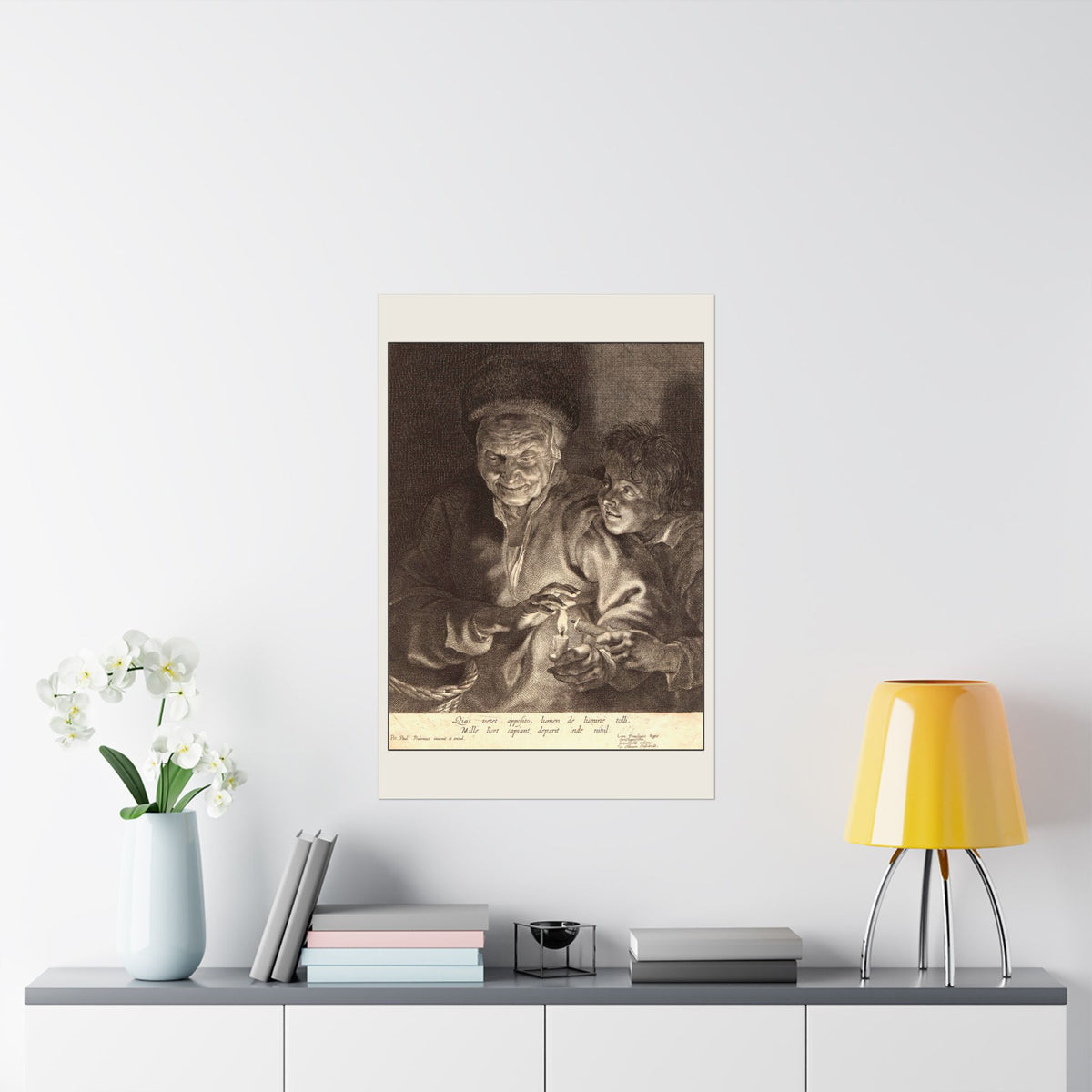
One flame passes from an aging hand to a younger generation in this evocative Baroque composition after Peter Paul Rubens (1577–1640). An elderly woman holds a burning candle while a young boy uses its flame to light his own, creating an intimate scene illuminated by a shared source of light. Attributed to engraver Paulus Pontius (1603–1658), the print captures a simple exchange between youth and old age, inviting reflection on the passage of time, the continuity of life, and the fleeting nature of human existence.
The engraving depicts an elderly woman holding a lit candle as a young boy brings his own candle toward the flame.
The interaction between the two figures forms the central focus of the composition, emphasizing the contrast between youth and old age.
The candlelight provides both the practical source of illumination and the principal symbolic element of the scene.
A two-line Latin inscription appears beneath the image, adding a literary dimension to the composition.
The expressive figures, carefully modeled features, and contrast between light and shadow reflect the dramatic qualities associated with Rubens and Flemish Baroque art.
Original Latin inscription
Quis vetet apposito, lumen de lumine tolli.
Mille licet capiant, deperit inde nihil.
English translation
"Who would forbid one light to be taken from a nearby light?"
"Though a thousand take from it, nothing thereof is lost."
The artwork invites several interpretations associated with the passage of time and the continuity of human life:
-
Elderly woman: Age, experience, and the wisdom accumulated over a lifetime.
-
Young boy: Youth, renewal, and the promise of the next generation.
-
Burning candles: Light, life, and the temporary nature of human existence.
-
Passing the flame: The transmission of knowledge, experience, and traditions between generations.
-
Shared candlelight: Human connection and the continuity of life despite individual mortality.
-
Contrast between youth and old age: The natural progression of time and the different stages of human existence.
Although less explicitly concerned with death than traditional skull-filled Vanitas compositions, the imagery lends itself to reflection on life's brevity and the passing of generations.
Produced between 1613 and 1658, this print is attributed to Paulus Pontius, after a painting by Peter Paul Rubens.
Rubens was among the most influential Flemish Baroque painters, celebrated for his expressive figures, dynamic compositions, and masterful treatment of light and movement.
Pontius was an accomplished Flemish engraver who reproduced works by Rubens and other prominent artists, helping circulate their compositions through printed images.
The print identifies Rubens as its publisher and bears a privilege associated with Isabella Clara Eugenia, Infanta of Spain, reflecting the artistic and publishing practices of the period.
The scene belongs to a broader European artistic tradition exploring the relationship between youth and old age, knowledge and experience, and the passage of time.
Its imagery also resonates with Memento Mori — Latin for "Remember that you must die" — through the symbolism of candlelight and the contrast between generations, although it is not an overt depiction of death.
With its intimate figures, historical candlelight imagery, and Baroque character, this reproduction complements libraries, studies, reading rooms, traditional interiors, and collections devoted to Flemish art, historical engraving, and philosophical symbolism.
- Historical Baroque print after a painting by Peter Paul Rubens
- Engraving attributed to Paulus Pontius
- Original artwork dated between 1613 and 1658
- Elderly woman sharing a candle flame with a young boy
- Symbolic imagery associated with youth, old age, and the passage of time
- Original two-line Latin inscription beneath the composition
- Historical Flemish Baroque artwork
- Reproduced with the intricate details and historical appearance of the original print
- Giclée printing on archival paper
- Smooth matte finish
- Available in multiple sizes
- Suitable for indoor wall display
- Supplied unframed
- Slight production size tolerance of approximately ±1/16 inch
Handle with clean, dry hands. Avoid prolonged exposure to direct sunlight and moisture. Gently remove surface dust with a clean, dry cloth.