Mors Omnia Aequat Sleeping Child Four Skulls & Hourglass Barthel Beham Memento Mori Art Print
Mors Omnia Aequat Sleeping Child Four Skulls & Hourglass Barthel Beham Memento Mori Art Print
Couldn't load pickup availability
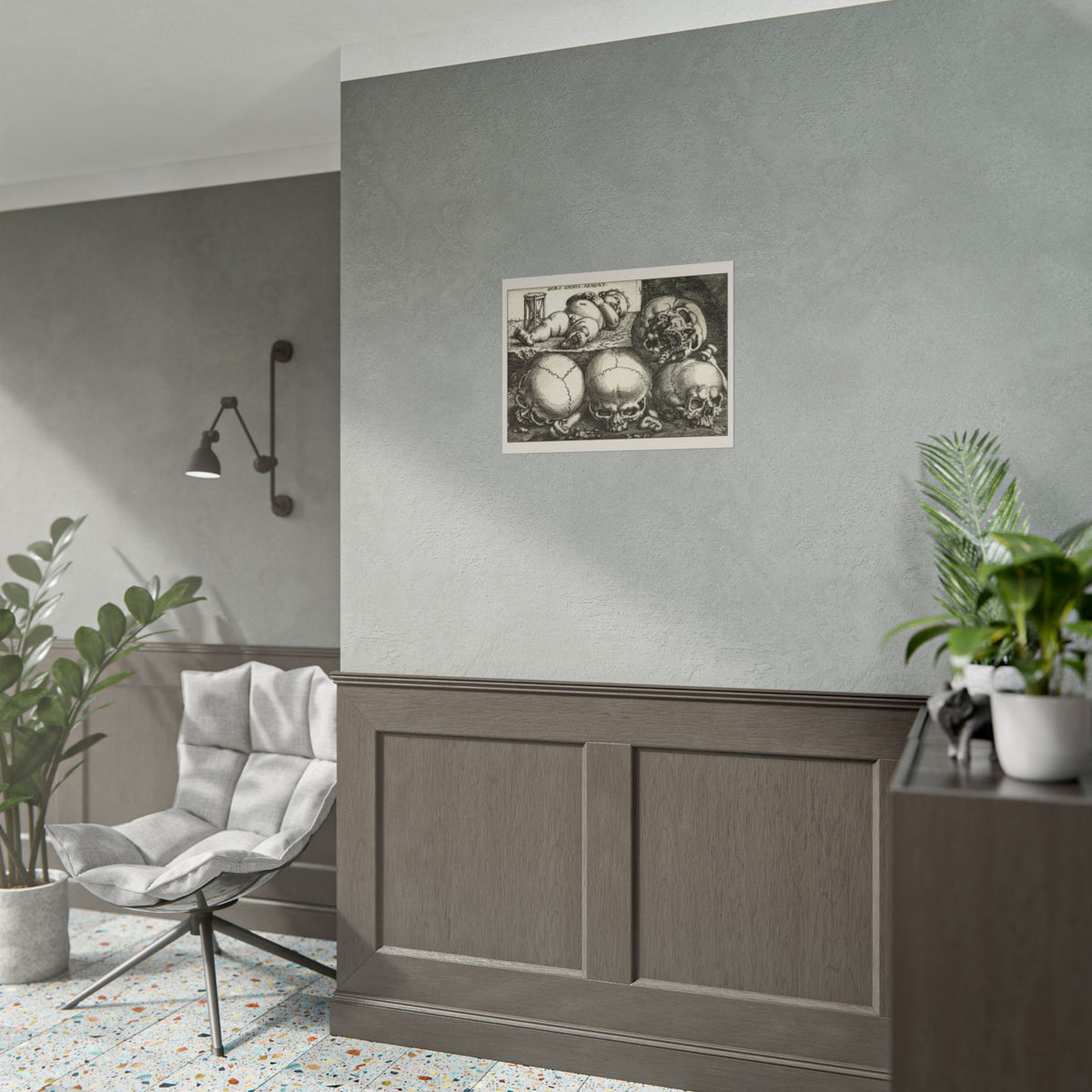
Death makes all equal. Neither youth, wealth, power, nor social standing can alter this universal truth, expressed through the Latin motto Mors Omnia Aeqvat. In this haunting German Renaissance engraving by Barthel Beham (1502–1540), a sleeping child appears beside four human skulls and an hourglass. The unsettling contrast between peaceful childhood and the symbols of death creates a memorable allegory of human equality in mortality.
The engraving depicts a sleeping child accompanied by four human skulls and an hourglass, arranged in a compact allegorical composition.
The child's peaceful appearance contrasts with the hollow skulls, while the hourglass introduces the passage of time as an essential element of the scene.
The Latin inscription Mors Omnia Aeqvat — "Death Makes All Equal" — provides the central message of the artwork.
Through delicate engraved lines, subtle shading, and carefully rendered anatomical details, Beham creates a powerful reflection on mortality within a remarkably small composition.
The artwork incorporates several traditional elements of Memento Mori and Vanitas imagery:
- Sleeping child: Innocence, vulnerability, and the fragility of human life.
- Four human skulls: The universality of death and the shared fate of humanity.
- Hourglass: The continuous passage of time and the limited duration of earthly existence.
- Sleep: A traditional metaphor for death and the temporary nature of life.
- Mors Omnia Aeqvat: A Latin reminder that death makes no distinction between rich and poor, powerful and powerless, young and old.
- Contrast between child and skulls: The relationship between life's beginning and its inevitable conclusion.
Together, these elements communicate a central principle of Memento Mori: all human beings are equal in the face of death.
Created by Barthel Beham, this engraving is dated broadly between 1512 and 1540 by the Rijksmuseum.
Beham was a German Renaissance engraver associated with the Little Masters, a group of artists celebrated for producing exceptionally detailed prints on a small scale.
His work frequently explored religious themes, mythology, human figures, and moral allegories, combining technical precision with philosophical symbolism.
The motto Mors Omnia Aeqvat, meaning "Death Makes All Equal," reflects a longstanding European tradition of contemplating mortality and the temporary nature of earthly distinctions.
Closely associated with Memento Mori — Latin for "Remember that you must die" — such imagery encouraged reflection upon the brevity of life and the inevitability of death.
The combination of a sleeping child, four skulls, and an hourglass makes this engraving a particularly direct expression of Renaissance mortality symbolism.
With its delicate linework, historical Latin motto, and unusual allegorical subject, this reproduction complements libraries, studies, reading rooms, Gothic interiors, and collections devoted to German Renaissance art, historical engraving, and the macabre.
- Historical Mors Omnia Aeqvat engraving by Barthel Beham
- Original artwork dated between 1512 and 1540
- Sleeping child accompanied by four human skulls and an hourglass
- Original Latin motto meaning "Death Makes All Equal"
- Traditional Memento Mori symbolism exploring mortality and human equality
- Detailed German Renaissance engraving with delicate linework and shading
- Associated with the sixteenth-century tradition of the German Little Masters
- Reproduced with the intricate engraved details and aged appearance of the historical artwork
- Giclée printing on archival paper
- Smooth matte finish
- Available in multiple sizes
- Suitable for indoor wall display
- Supplied unframed
- Slight production size tolerance of approximately ±1/16 inch
Handle with clean, dry hands. Avoid prolonged exposure to direct sunlight and moisture. Gently remove surface dust with a clean, dry cloth.