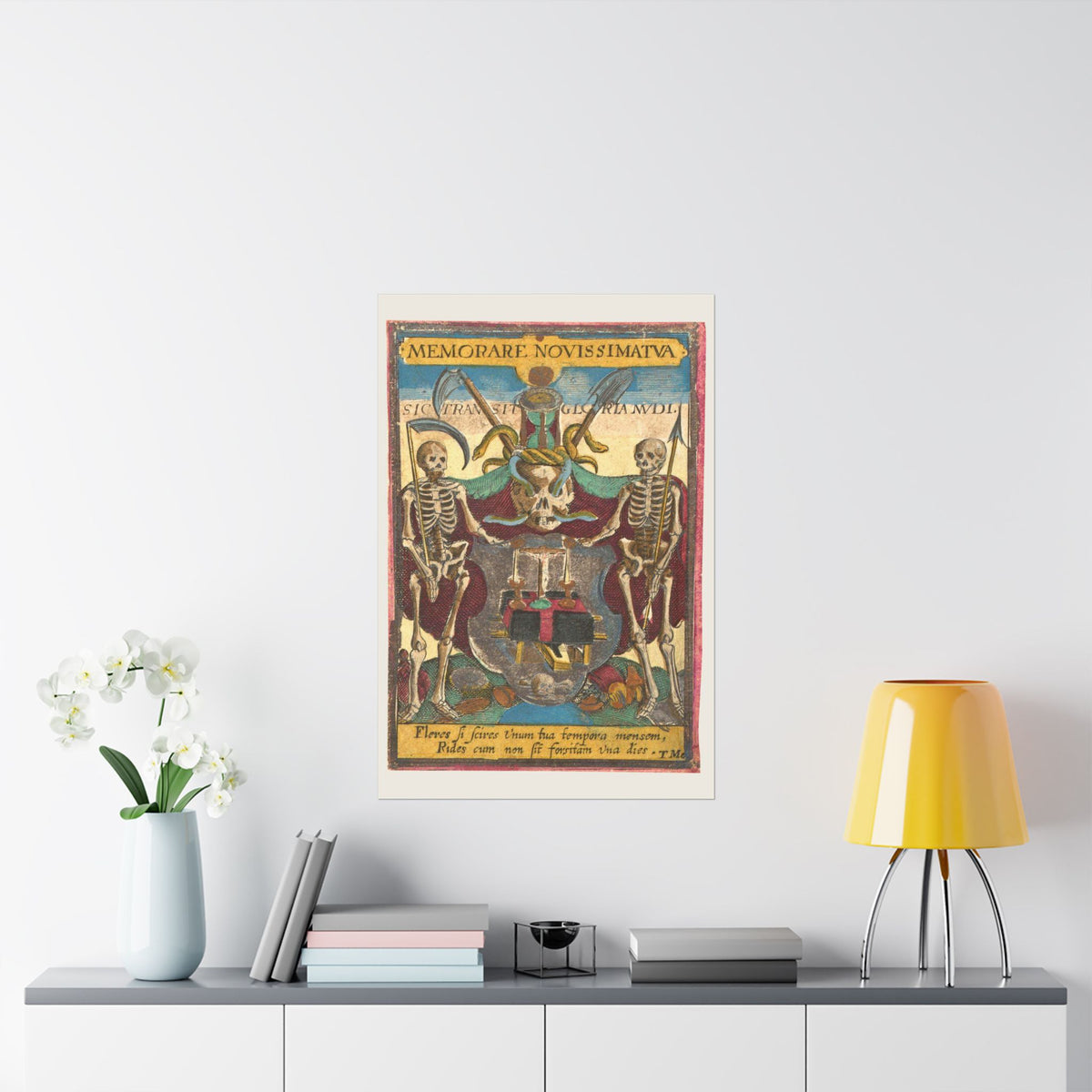
Remember your last things. This solemn warning, expressed through the Latin inscription Memorare Novissima Tua, lies at the heart of a remarkable seventeenth-century religious engraving. Two human skeletons stand on opposite sides of a symbolic arrangement featuring a skull, hourglass, and crucifix, bringing together the inevitability of death and the Christian promise of salvation. Originally hand-colored, the artwork reflects a period when images of mortality served as powerful reminders of faith, repentance, and preparation for eternity.
The composition features two standing human skeletons flanking a central arrangement of traditional mortality symbols.
A human skull, hourglass, and crucifix form the principal elements of the scene, combining the physical reality of death with the religious significance of Christ's sacrifice.
The symmetrical arrangement gives the engraving a formal, devotional character, while the detailed skeletal figures reinforce its direct message concerning the brevity of earthly existence.
Originally produced as a hand-colored engraving, the artwork reflects the distinctive appearance of seventeenth-century religious prints.
Original Latin inscriptions
MEMORARE NOVISSIMA TVA
SIC TRANSIT GLORIA MVNDI.
Fleres si scires unum tua tempora mensem,
Rides cum non sit forsitam una dies. - T. Mo.
English translations
"Be mindful of your last days."
"Thus passes the glory of the world."
"You would weep if you knew your time was but one month,
Yet you laugh when perhaps not even one day remains" (Sir Thomas More.)
The composition incorporates several traditional elements of Memento Mori and Christian devotional imagery:
-
Two skeletons: The universality of death and the fate shared by all humanity.
-
Human skull: The inevitability of mortality and the temporary nature of earthly existence.
-
Hourglass: The continuous passage of time and the limited duration of human life.
-
Crucifix: Christ's sacrifice, redemption, and the Christian hope of eternal life.
-
Memorare Novissima Tua: Latin for "Remember your last things," encouraging reflection upon death and eternity.
-
Symmetrical arrangement: A formal presentation emphasizing the relationship between human mortality and religious faith.
Together, these elements express a central theme of Christian Memento Mori: awareness of death should encourage spiritual reflection and preparation for the life to come.
Created between approximately 1650 and 1700, this anonymous engraving was produced after a print by Christoffel van Sichem II (1581–1658), a Dutch engraver known for his religious illustrations and devotional imagery.
The artwork belongs to the European tradition of Christian moralizing prints, which employed skulls, skeletons, hourglasses, and crucifixes to communicate religious teachings about mortality and salvation.
The Latin phrase Memorare Novissima Tua reflects the biblical instruction to remember one's final destiny, a theme closely associated with the Christian contemplation of the Four Last Things: Death, Judgment, Heaven, and Hell.
Memento Mori, Latin for "Remember that you must die," was an important element of European devotional art, particularly during the Renaissance and Baroque periods.
Unlike secular Vanitas still lifes emphasizing the transience of wealth and pleasure, this composition places mortality within an explicitly Christian framework, connecting the certainty of death with the promise of redemption through Christ.
With its unusual skeletal figures, crucifix, historical Latin inscription, and devotional symbolism, this reproduction complements libraries, studies, Gothic interiors, religious collections, and displays devoted to historical Christian art, mortality symbolism, and the macabre.
- Historical Christian Memento Mori engraving dating from approximately 1650–1700
- Anonymous printmaker, after a print by Christoffel van Sichem II
- Two standing skeletons surrounding a skull, hourglass, and crucifix
- Original Memorare Novissima Tua Latin inscription
- Christian symbolism exploring mortality, redemption, and eternal life
- Original artwork executed as a hand-colored engraving
- Traditional seventeenth-century religious and devotional imagery
- Reproduced with the intricate engraved details and historical character of the original artwork
- Giclée printing on archival paper
- Smooth matte finish
- Available in multiple sizes
- Vertical portrait composition
- Suitable for indoor wall display
- Supplied unframed
- Slight production size tolerance of approximately ±1/16 inch
Handle with clean, dry hands. Avoid prolonged exposure to direct sunlight and moisture. Gently remove surface dust with a clean, dry cloth.