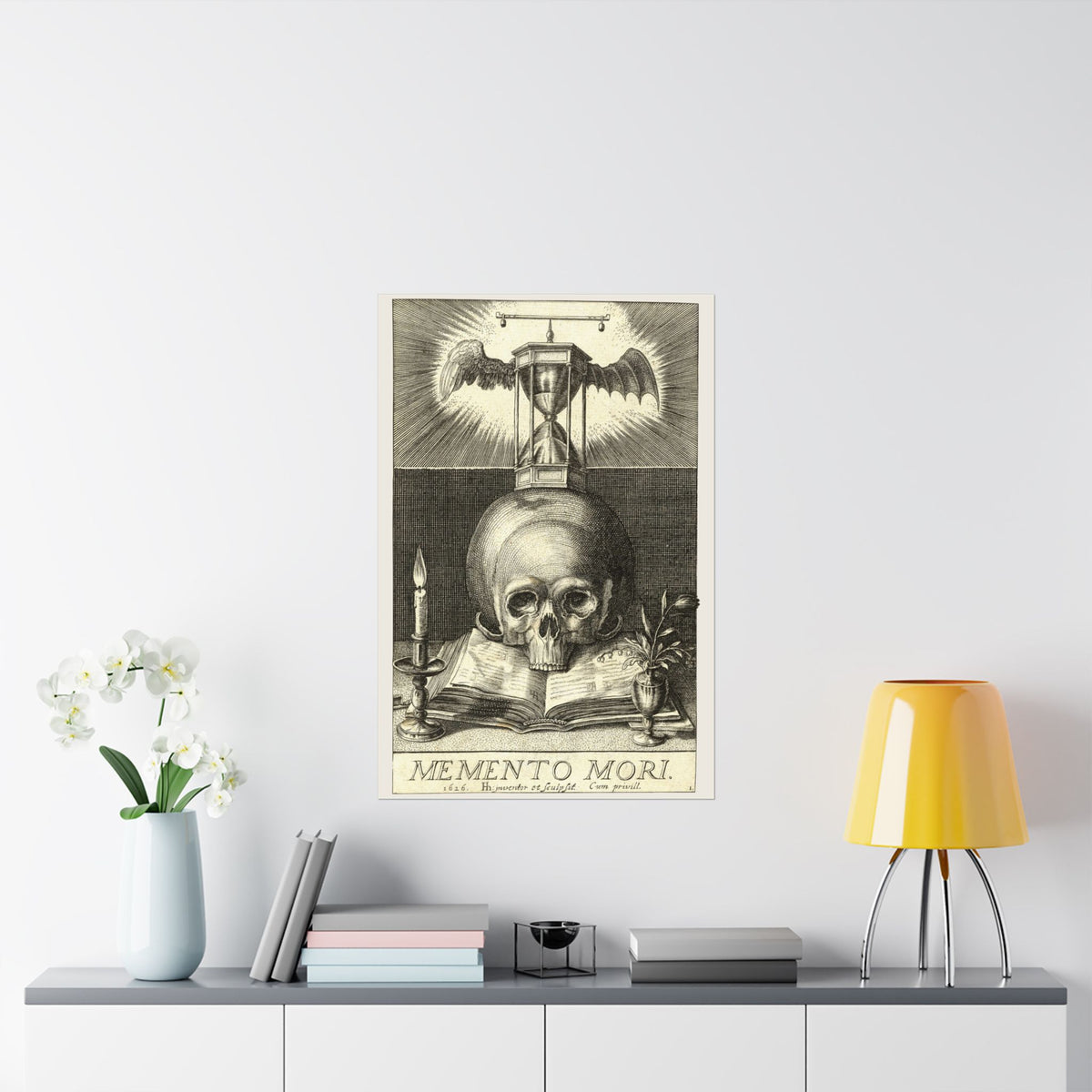
A winged hourglass rises above a human skull in this striking 1626 engraving by Dutch printmaker Hendrick Hondius I (1573–1650). Combining symbols of mortality, time, knowledge, and the fragility of life, the composition presents a powerful visual interpretation of Memento Mori — the Latin reminder to "Remember that you must die." The elaborate wings of the hourglass, one feathered and the other resembling a bat's wing, create a dramatic contrast between light and darkness, reinforcing the fleeting nature of human existence.
At the center of the composition, a large human skull rests upon an open book. Above it stands a winged hourglass surmounted by a balance, surrounded by radiating lines that emphasize the passage of time.
To the left, a burning candle stands in a simple candlestick, while a small flowering plant in a vase occupies the opposite side. Beneath the illustration appears the prominent Latin title MEMENTO MORI, accompanied by the artist's signature and the date 1626.
The engraving combines intricate crosshatching, carefully modeled shadows, and strong contrasts between illuminated and darkened areas, demonstrating the technical refinement of early seventeenth-century Dutch printmaking.
The composition incorporates several traditional elements of Vanitas and Memento Mori imagery:
-
Human skull: The inevitability of death and the fragility of human existence.
-
Winged hourglass: The rapid passage of time, emphasizing that every moment brings life closer to its conclusion.
-
Feathered and bat-like wings: Contrasting imagery suggesting opposing forces, often interpreted through associations with light and darkness.
-
Balance: A symbol of judgment, measurement, and the weighing of human actions.
-
Open book: Human knowledge, learning, and the limitations of earthly wisdom.
-
Burning candle: The temporary flame of human life, destined eventually to be extinguished.
-
Flowering plant: The brief beauty of earthly existence and the inevitability of decay.
Together, these objects create an allegory of mortality, reminding viewers that time continues to pass regardless of human ambition, knowledge, or achievement.
Created in 1626, this engraving serves as the title print for a series of 23 illustrations devoted to animal skeletons. Fifteen prints in the series were produced by Hendrick Hondius I, with the remaining plates executed by Andries Jacobsz. Stock and Simon Frisius.
The composition reflects the Northern European tradition of Memento Mori, which encouraged contemplation of mortality and preparation for the afterlife. Closely related Vanitas imagery emphasized the impermanence of beauty, wealth, knowledge, and worldly accomplishments.
Hondius combines anatomical subject matter with religious and philosophical symbolism, transforming a collection of skeletal studies into a meditation on life's transience.
With its striking skull imagery, winged hourglass, and historical symbolism, this reproduction complements libraries, studies, reading rooms, Gothic interiors, and collections devoted to historical engraving, anatomy, philosophical allegory, and the macabre.
- Historical Memento Mori engraving by Hendrick Hondius I, dated 1626
- Original title print from a series of 23 animal skeleton illustrations
- Allegorical composition featuring a human skull, winged hourglass, balance, candle, open book, and flowering plant
- Original Latin title MEMENTO MORI
- Traditional Vanitas symbolism representing mortality and the passage of time
- Reproduced with the intricate engraved details and aged appearance of the historical artwork
- Giclée printing on archival paper
- Smooth matte finish
- Available in multiple sizes
- Suitable for indoor wall display
- Supplied unframed
- Slight production size tolerance of approximately ±1/16 inch
Handle with clean, dry hands. Avoid prolonged exposure to direct sunlight and moisture. Gently remove surface dust with a clean, dry cloth.