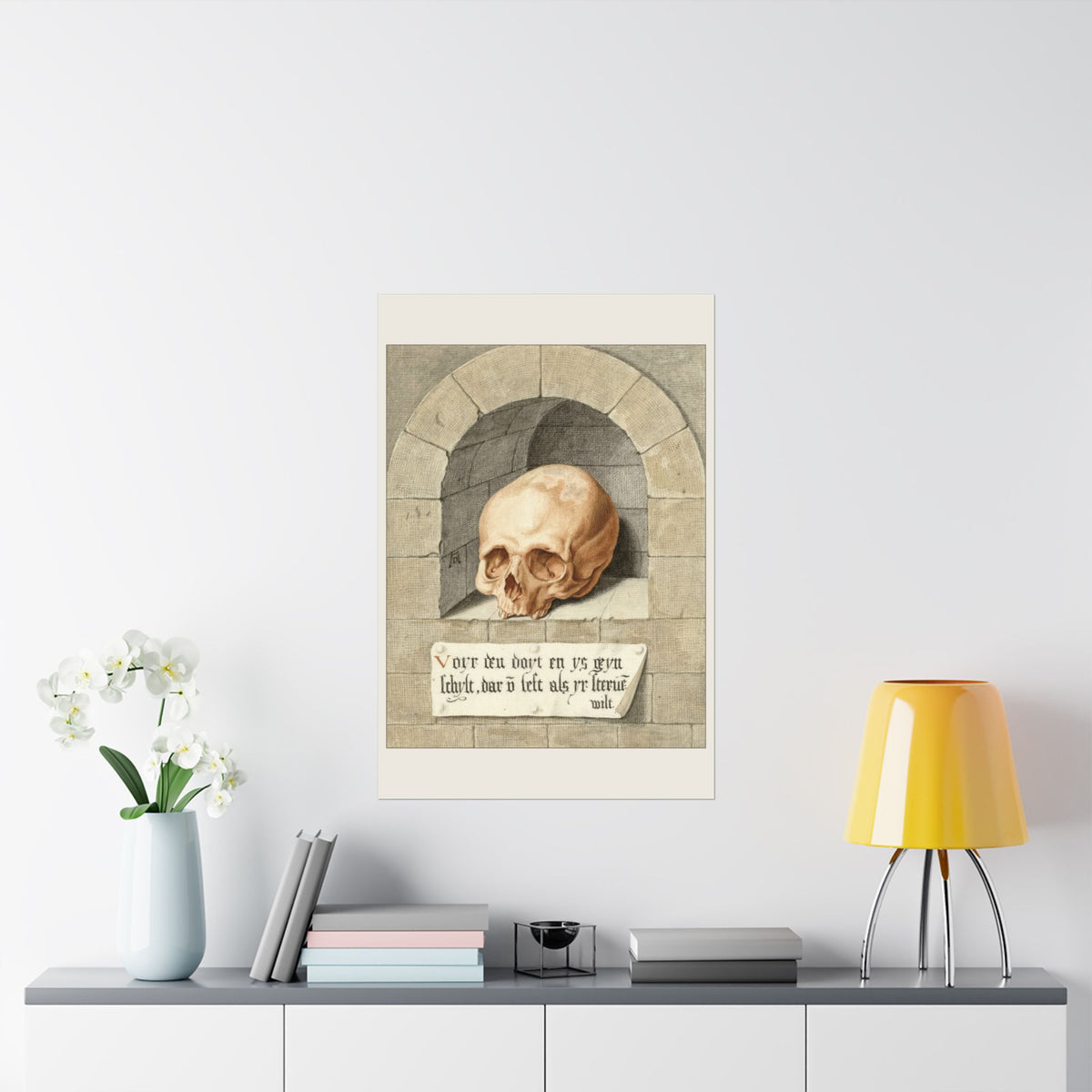
A solitary human skull rests within a stone architectural niche in this evocative 1785 drawing by Dutch artist Abraham Delfos (1731–1820), after an earlier painting by Bartholomäus Bruyn the Elder. Beneath the skull, an inscription in archaic Dutch delivers a direct warning about the inevitability of death. The restrained composition combines anatomical observation, historical lettering, and religious symbolism, reflecting the European tradition of Memento Mori — "Remember that you must die."
The composition presents a human skull positioned upon a stone ledge within a rounded architectural recess. Its warm ochre and reddish tones contrast with the muted gray masonry and dark interior of the niche.
Below the skull, a rectangular stone tablet bears a two-line inscription in Early Modern Dutch. The simple arrangement, without additional decorative objects, places the emphasis entirely on the skull and its accompanying message.
The original drawing was executed using brushwork in brown and gray, together with black and red chalk, creating delicate tonal variations and carefully modeled anatomical details.
The artwork incorporates several elements associated with the traditions of Vanitas and Memento Mori:
-
Human skull: The inevitability of death and the fate shared by all humanity.
-
Stone niche: A setting reminiscent of funerary monuments and memorial architecture.
-
Inscribed tablet: A direct reminder that death cannot be avoided.
-
Archaic Dutch lettering: Preserves the moral message of an earlier European artistic tradition.
-
Restrained composition: Emphasizes mortality without elaborate allegorical decoration.
Together, these elements transform an architectural study into a meditation on the brevity of life.
Voyr den doyt en ys geyn schylt,
dar u left als yu sterve wilt.
English Translation
Against death there is no shield;
Therefore, live as you would wish to die.
Created in 1785, Delfos's drawing reproduces a composition associated with the sixteenth-century German painter Bartholomäus Bruyn the Elder. The skull and its moralizing inscription reflect the Northern European tradition of religious and funerary imagery.
Memento Mori encouraged viewers to contemplate mortality and live with an awareness of life's temporary nature. Closely related Vanitas imagery explored the impermanence of earthly beauty, possessions, and accomplishments.
The combination of a realistic skull, architectural framing, and inscribed warning creates a direct and memorable example of historical mortality symbolism.
With its understated composition, antique lettering, and warm chalk tones, this reproduction complements libraries, studies, reading rooms, Gothic interiors, and collections devoted to historical art, funerary symbolism, and the macabre.
- Historical Vanitas drawing by Abraham Delfos, dated 1785
- After an earlier painting associated with Bartholomäus Bruyn the Elder
- Human skull resting within a stone architectural niche
- Original archaic Dutch inscription with a traditional Memento Mori message
- Reproduction of a drawing executed in brown and gray brushwork, black chalk, and red chalk
- Preserves the delicate tonal variations and aged appearance of the historical artwork
- Giclée printing on archival paper
- Smooth matte finish
- Available in multiple sizes
- Suitable for indoor wall display
- Supplied unframed
- Slight production size tolerance of approximately ±1/16 inch
Handle with clean, dry hands. Avoid prolonged exposure to direct sunlight and moisture. Gently remove surface dust with a clean, dry cloth.