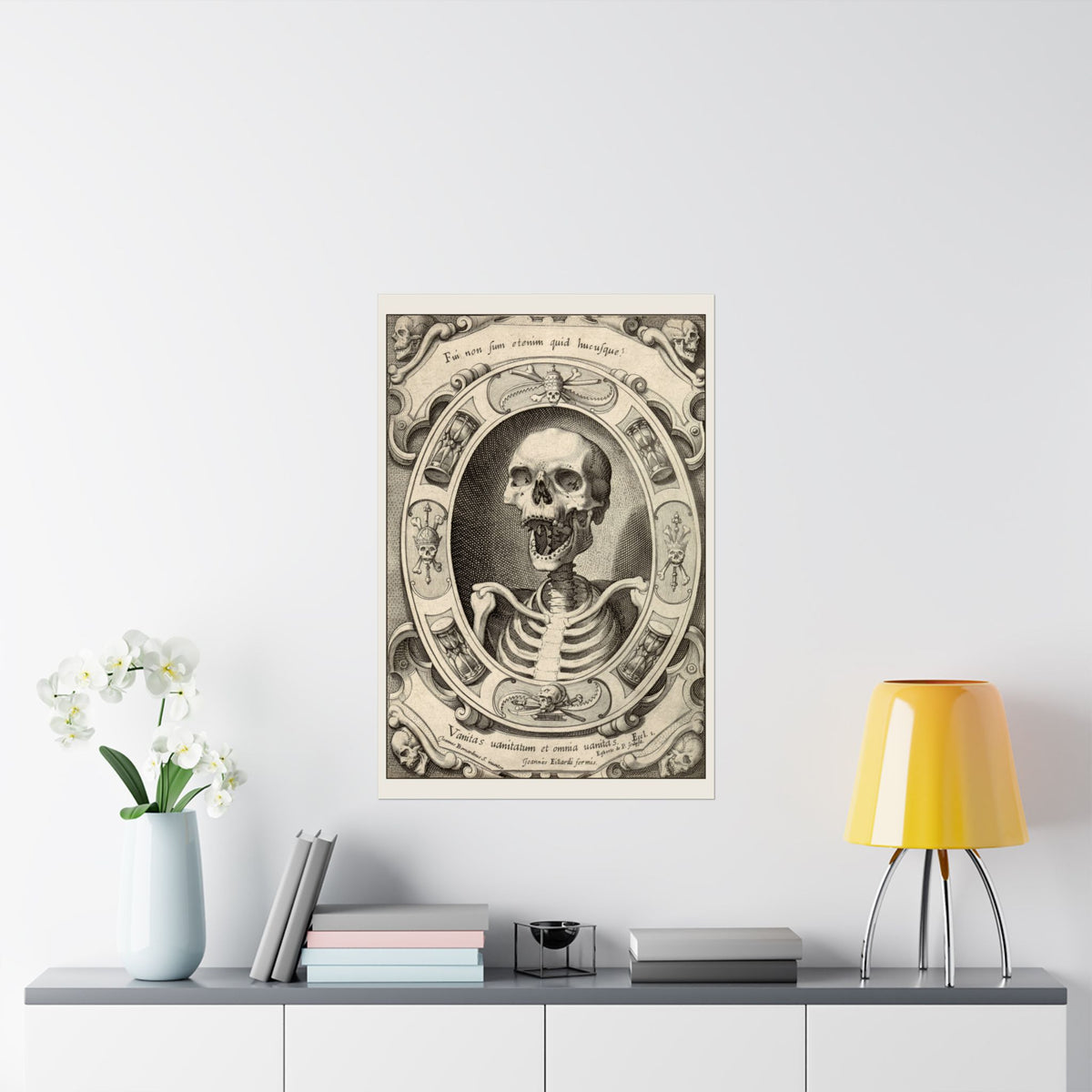
A skeletal figure with its mouth opened wide emerges from an elaborate oval frame in this striking Memento Mori engraving by Egbert van Panderen, a Flemish-associated printmaker active during the late Renaissance and early Baroque periods. Surrounded by symbolic imagery and Latin inscriptions, the composition confronts the viewer with an unsettling reminder of mortality. Its combination of anatomical detail, decorative ornamentation, and religious allegory reflects the European fascination with death, the passage of time, and the impermanence of earthly existence.
The engraving depicts a skeletal bust turned toward the left, its open mouth and hollow eye sockets giving the figure an expressive, almost animated appearance. The skeleton is enclosed within an ornate oval frame decorated with traditional Vanitas symbols.
Above the frame, a decorative cartouche contains a Latin inscription, while another inscription beneath the image includes a biblical passage from the Book of Ecclesiastes.
Upper Latin inscription
Fui non sum etenim quid hucusque?
Upper English translation
I used to be, now I am no more; what was it all for?
Lower Latin inscription
Vanitas uanitatum et omnia uanitas. Eccl. 1.
Lower English translation
Vanity of vanities, and all is vanity.
The composition combines detailed anatomical rendering with elaborate Renaissance ornamentation, using fine engraved lines and contrasting areas of light and shadow to emphasize the skeletal figure and surrounding decorative elements.
The artwork draws upon the European traditions of Vanitas and Memento Mori, using several visual and textual elements to communicate its message:
-
Skeletal bust: The inevitability of death and the fate shared by all humanity.
-
Open mouth: An expressive image of death that confronts the viewer directly.
-
Oval frame: A formal portrait arrangement transformed into a representation of mortality.
-
Vanitas ornaments: Reminders of the temporary nature of worldly possessions, beauty, and human achievement.
-
Latin inscriptions: Religious and philosophical reflections on mortality and the passing of earthly life.
-
Biblical quotation: A passage from Ecclesiastes reinforcing the themes of transience and human limitation.
Together, these elements transform a conventional portrait format into an allegory of death, replacing the likeness of a living individual with a reminder of humanity's common destiny.
Created after a design by Joannes Bernardinus S. and published by Johannes Eillarts, the engraving belongs to the tradition of Northern European religious and moralizing prints.
Memento Mori, Latin for "Remember that you must die," encouraged contemplation of mortality and preparation for the afterlife. Closely related Vanitas imagery emphasized the fleeting nature of beauty, wealth, ambition, and worldly accomplishments.
The work's elaborate cartouches, detailed crosshatching, and expressive skeletal anatomy demonstrate the technical and decorative qualities of early European engraving.
With its imposing skeletal portrait, Latin inscriptions, and historical symbolism, this reproduction complements libraries, studies, reading rooms, Gothic interiors, and collections devoted to religious allegory, historical printmaking, and macabre art.
- Historical Memento Mori engraving by Egbert van Panderen
- Based on a design attributed to Joannes Bernardinus S.
- Published by Johannes Eillarts
- Skeletal bust with open mouth within an ornate oval frame
- Decorative elements incorporating traditional Vanitas symbolism
- Original Latin inscriptions, including a biblical quotation from Ecclesiastes
- Reproduced with the intricate engraved details and aged appearance of the historical artwork
- Giclée printing on archival paper
- Smooth matte finish
- Available in multiple sizes
- Suitable for indoor wall display
- Supplied unframed
- Slight production size tolerance of approximately ±1/16 inch
Handle with clean, dry hands. Avoid prolonged exposure to direct sunlight and moisture. If necessary, gently remove surface dust with a clean, dry cloth.