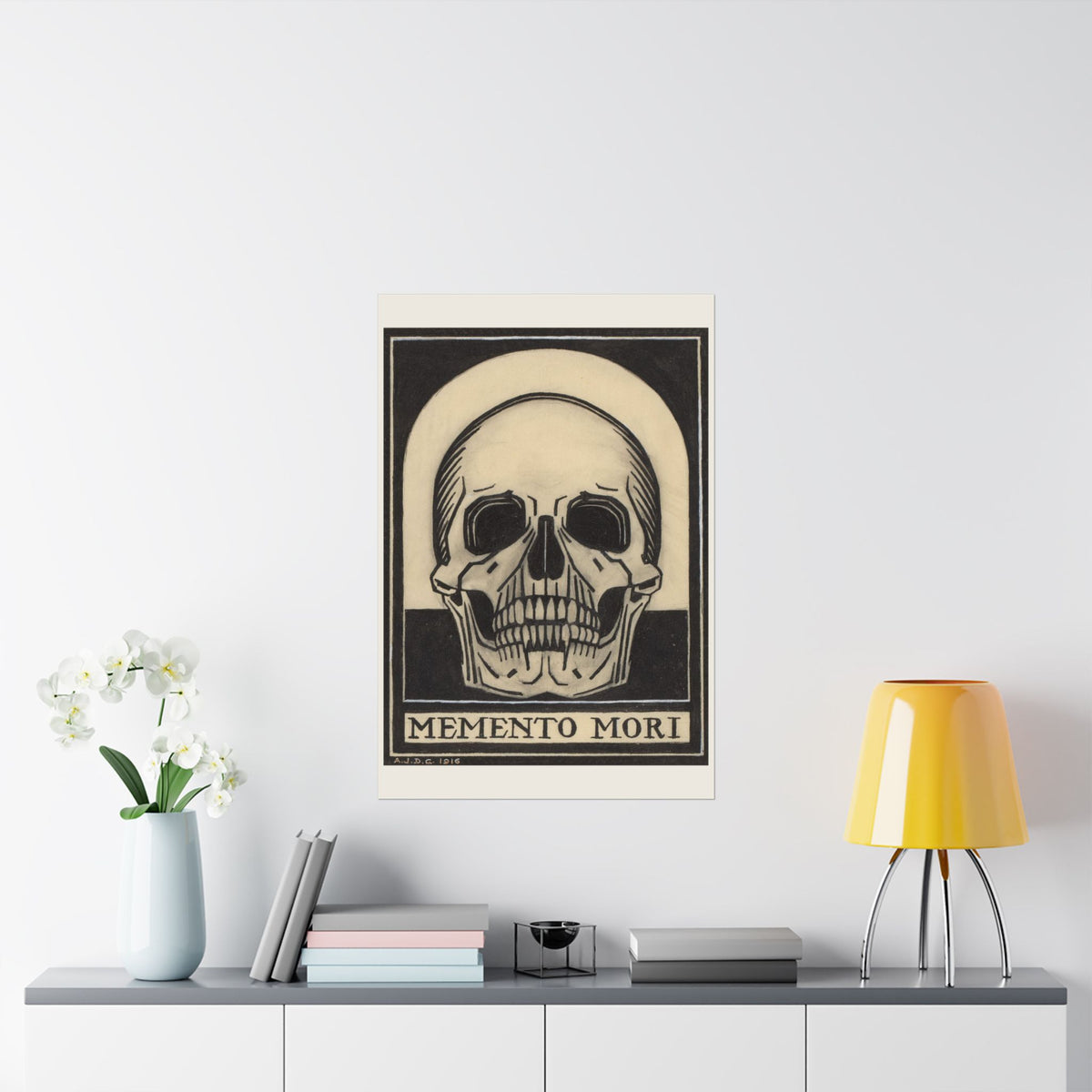
A skull reduced to its most essential forms becomes a powerful image of mortality in this striking 1916 drawing by Dutch artist Julie de Graag (1877–1924). Heavy black outlines, hollow eye sockets, and sharply defined teeth create an almost mask-like appearance, transforming a familiar anatomical subject into a bold, unsettling composition. With its dramatic contrasts and simplified forms, the artwork presents a distinctly modern interpretation of the centuries-old Memento Mori tradition.
The composition features a frontal view of a human skull, rendered in strong black lines against a pale background.
Large, dark eye sockets dominate the upper portion, while the nasal cavity, exposed teeth, and angular jaw are defined through a combination of thick outlines and carefully placed linear details.
The deliberately simplified anatomy creates a striking graphic effect, emphasizing the skull's expression and structure rather than realistic shading.
Executed in pen and brush with black ink over pencil, with corrections in white opaque paint, the original drawing demonstrates Julie de Graag's distinctive approach to line, form, and contrast.
The artwork reflects several themes associated with Memento Mori imagery:
-
Human skull: The inevitability of death and the mortality shared by all humanity.
-
Hollow eye sockets: The absence of life and the anonymous nature of human remains.
-
Exposed teeth: A stark reminder of the physical body and its eventual decay.
-
Strong black outlines: The reduction of human anatomy to essential, recognizable forms.
-
Frontal composition: A direct confrontation with mortality, placing the viewer face-to-face with the skull.
-
Simplified design: A modern interpretation of a traditional subject, emphasizing visual impact over anatomical realism.
Unlike elaborate Vanitas compositions filled with hourglasses, candles, and flowers, this drawing communicates its message through a single, uncompromising image.
Created in 1916 by Dutch artist Julie de Graag, this drawing is titled Memento Mori and belongs to the early twentieth-century tradition of expressive, graphic art.
De Graag was known for her highly stylized drawings and prints, frequently depicting animals, plants, and human subjects through simplified shapes, precise contours, and strong contrasts.
Her distinctive visual language combined decorative clarity with a powerful sense of structure, producing images that remain remarkably modern in appearance.
Memento Mori, Latin for "Remember that you must die," has appeared throughout European art for centuries. De Graag's interpretation removes the elaborate allegorical settings of earlier periods, presenting mortality through the skull alone.
With its bold graphic character, dramatic black-and-white design, and historical symbolism, this reproduction complements Gothic interiors, studies, libraries, contemporary spaces, and collections devoted to Expressionist art, skull imagery, and the macabre.
- Historical Memento Mori drawing by Julie de Graag
- Original artwork dated 1916
- Frontal human skull with bold black outlines and simplified anatomical details
- Distinctive early twentieth-century graphic style
- Original executed in pen and brush over pencil, with white opaque paint corrections
- Traditional Memento Mori symbolism exploring mortality and human existence
- Reproduced with the original artwork's expressive linework and historical appearance
- Giclée printing on archival paper
- Smooth matte finish
- Available in multiple sizes
- Suitable for indoor wall display
- Supplied unframed
- Slight production size tolerance of approximately ±1/16 inch
Handle with clean, dry hands. Avoid prolonged exposure to direct sunlight and moisture. Gently remove surface dust with a clean, dry cloth.