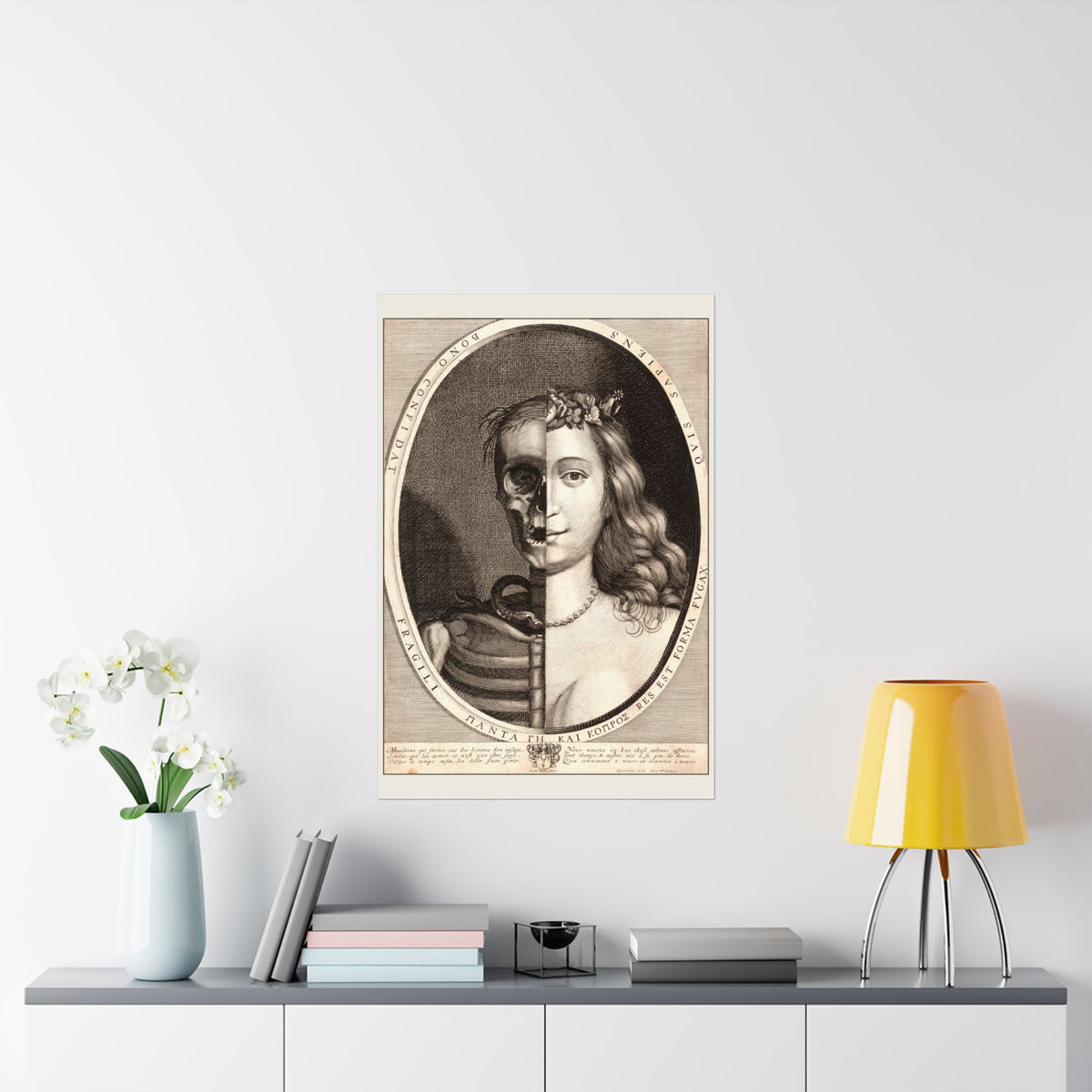
Beauty and death share a single face in this haunting seventeenth-century French engraving, depicting a young woman whose body is divided between living flesh and exposed skeletal remains. Published by René Guérineau and dated approximately 1615–1664, the composition presents a stark warning about the fleeting nature of physical beauty. Its unsettling contrast between youth and mortality reflects the European traditions of Memento Mori and Vanitas, in which the human body becomes a reminder of life's inevitable end.
The engraving depicts the bust of a young woman, with one half retaining her youthful appearance while the other reveals the skull and skeletal anatomy beneath.
The two contrasting halves form a single figure, confronting the viewer with the transformation that time and death ultimately bring to the human body.
Beneath the illustration appears a French inscription addressing those who place excessive importance on physical beauty. The accompanying verses reinforce the work's moral message, warning against vanity and the mistaken belief that youth and outward appearance can endure.
The artist uses intricate engraved lines, delicate crosshatching, and carefully modeled contrasts to distinguish the softness of living flesh from the stark anatomical structure of the skeleton.
Original inscriptions
QUIS SAPIENS BONO CONFIDAT FRAGILI? RES EST FORMA FUGAX.
ΠΑΝΤΑ ΓΗ ΚΑΙ ΚΟΠΡΟΣ
English translation
"What wise person would trust a fragile good? Beauty is a fleeting thing."
"All things are dust and dung."
The composition incorporates several themes associated with Vanitas and Memento Mori:
-
Young woman's face: Youth, beauty, and the temporary pleasures of earthly existence.
-
Exposed skeleton: The inevitability of death and the physical fate shared by all humanity.
-
Divided figure: The fragile boundary between life and death.
-
Contrasting appearances: The transformation of beauty through aging, decay, and mortality.
-
French inscription: A moral warning against excessive admiration of physical beauty.
-
Anatomical imagery: A reminder of the skeletal structure concealed beneath the outward appearance of the living body.
Together, these elements transform an elegant female portrait into an allegory of mortality, emphasizing that physical beauty and youth are temporary.
Produced in France during the seventeenth century, the engraving was published by René Guérineau and is attributed to an unidentified printmaker.
The work belongs to a longstanding European tradition of images combining living figures with skeletal anatomy, sometimes described as representations of the contrast between beauty and death.
Memento Mori, Latin for "Remember that you must die," encouraged contemplation of mortality and the transience of earthly existence. Closely related Vanitas imagery explored the impermanence of beauty, wealth, pleasure, and worldly accomplishments.
The French verses beneath the illustration address those who admire beautiful faces, emphasizing that physical attractiveness is fleeting and should not be mistaken for lasting value.
With its striking combination of feminine beauty, skeletal anatomy, and historical French lettering, this reproduction complements libraries, studies, reading rooms, Gothic interiors, and collections devoted to historical art, anatomical illustration, and the macabre.
- Historical French Memento Mori engraving, dating from approximately 1615–1664
- Published by René Guérineau
- Original printmaker unidentified
- Allegorical portrait combining a young woman's bust with exposed skeletal anatomy
- Traditional Vanitas symbolism contrasting beauty and mortality
- Original French inscription reflecting upon the transience of physical beauty
- Reproduced with the intricate engraved details and aged appearance of the historical artwork
- Giclée printing on archival paper
- Smooth matte finish
- Available in multiple sizes
- Suitable for indoor wall display
- Supplied unframed
- Slight production size tolerance of approximately ±1/16 inch
-
Handle with clean, dry hands. Avoid prolonged exposure to direct sunlight and moisture. Gently remove surface dust with a clean, dry cloth.