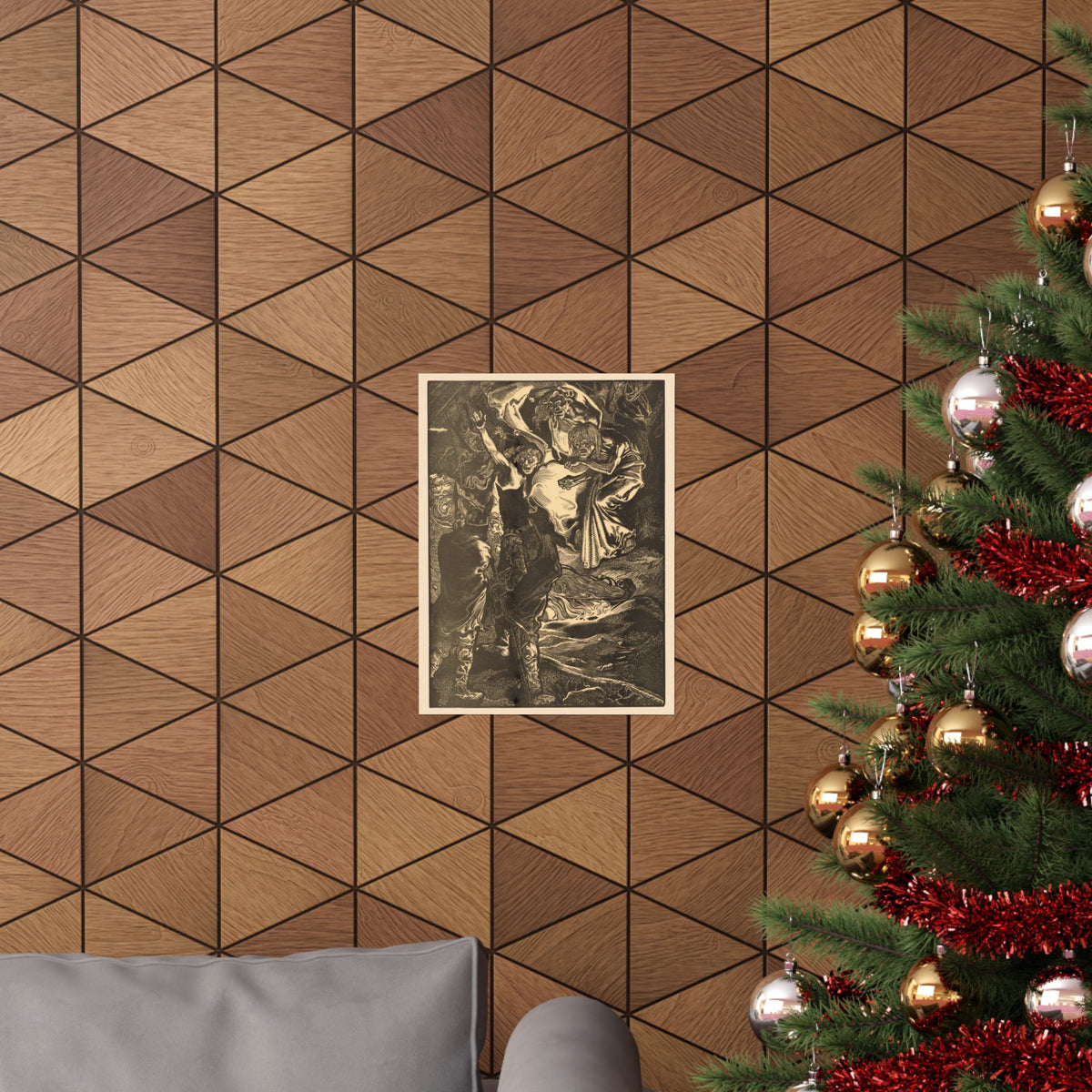
The three witches of Shakespeare's Macbeth emerge as mysterious figures of prophecy and supernatural power in this historical print by Johannes Josephus Aarts (1881–1934). Macbeth and his companion Banquo occupy the lower left of the composition, while the witches appear above them to the right, preparing to reveal their predictions. Aarts transforms one of Shakespeare's most memorable encounters into a visually compelling scene of fate, ambition, and the unknown, combining expressive figures with the unsettling presence of the supernatural.
The print, titled Macbeth en Banquo ontmoeten de drie heksen (Macbeth and Banquo Meet the Three Witches), depicts a pivotal encounter from William Shakespeare's tragedy Macbeth.
Aarts arranges the characters across the composition, placing Macbeth and Banquo in the lower-left portion and the three witches in the upper-right area.
The contrast between the two groups emphasizes the extraordinary nature of their meeting. The witches possess knowledge of events yet to unfold, while Macbeth and Banquo are about to hear predictions that will profoundly affect their futures.
The print was formerly titled Compositie met heksen (Composition with Witches).
Through its arrangement of figures and supernatural subject matter, the artwork offers an imaginative interpretation of Shakespearean drama.
In Act I, Scene III of Macbeth, Macbeth and Banquo encounter three mysterious witches upon a desolate heath.
The witches greet Macbeth with three titles: Thane of Glamis, Thane of Cawdor, and future King of Scotland. They also predict that Banquo, although he will never become king himself, will father a line of kings.
When Macbeth subsequently learns that he has been named Thane of Cawdor, the apparent fulfillment of the first prophecy strengthens his belief in the witches' predictions.
Their words become central to the tragedy, feeding Macbeth's ambition and contributing to the decisions that ultimately lead to his downfall.
Several elements of the artwork reflect the play's principal themes:
-
Macbeth: The Scottish nobleman whose encounter with the witches awakens dangerous ambitions for the throne.
-
Banquo: Macbeth's companion, who also receives a prophecy but responds with greater skepticism toward the supernatural figures.
-
The Three Witches: Mysterious beings associated with prophecy, deception, fate, and supernatural influence.
-
The Encounter: A turning point in the play, introducing predictions that shape the characters' subsequent actions.
-
Prophecy and Fate: The central tension between events foretold and decisions made through human ambition.
-
Supernatural Influence: The witches embody the uncertainty surrounding mysterious forces and their power over human expectations.
The scene has inspired artists, theatrical designers, and illustrators for centuries, becoming one of the most recognizable representations of witchcraft in European literature.
Johannes Josephus Aarts (1881–1934) was a Dutch artist and printmaker whose work explored mythological subjects, religious imagery, fantastical creatures, grotesque figures, and allegorical compositions.
His artistic interests extended to supernatural themes and imaginative interpretations of literary subjects.
In Macbeth and Banquo Meet the Three Witches, Aarts draws upon Shakespeare's dramatic vision of witchcraft and prophecy, presenting the encounter through an arrangement that separates the human characters from the mysterious figures who foretell their futures.
- Reproduction of Macbeth en Banquo ontmoeten de drie heksen (Macbeth and Banquo Meet the Three Witches) by Johannes Josephus Aarts
- Former title: Compositie met heksen (Composition with Witches)
- Historical Dutch print dating from the artist's lifetime, 1881–1934
- Macbeth and Banquo depicted in the lower-left portion of the composition
- Three prophetic witches positioned in the upper-right portion
- Inspired by William Shakespeare's tragedy Macbeth
- Representation of the famous encounter from Act I, Scene III
- Themes of witchcraft, supernatural prophecy, fate, ambition, and deception
- Historical literary illustration with expressive graphic composition
- Giclée printing on archival paper
- Smooth matte finish
- Available in multiple sizes
- Artwork proportionally scaled to preserve the original composition
- Printed margins may vary depending on the selected size
- Supplied unframed
- Slight production size tolerance of approximately ±1/16 inch
Handle with clean, dry hands. Avoid prolonged exposure to direct sunlight and moisture. Gently remove surface dust with a clean, dry cloth.