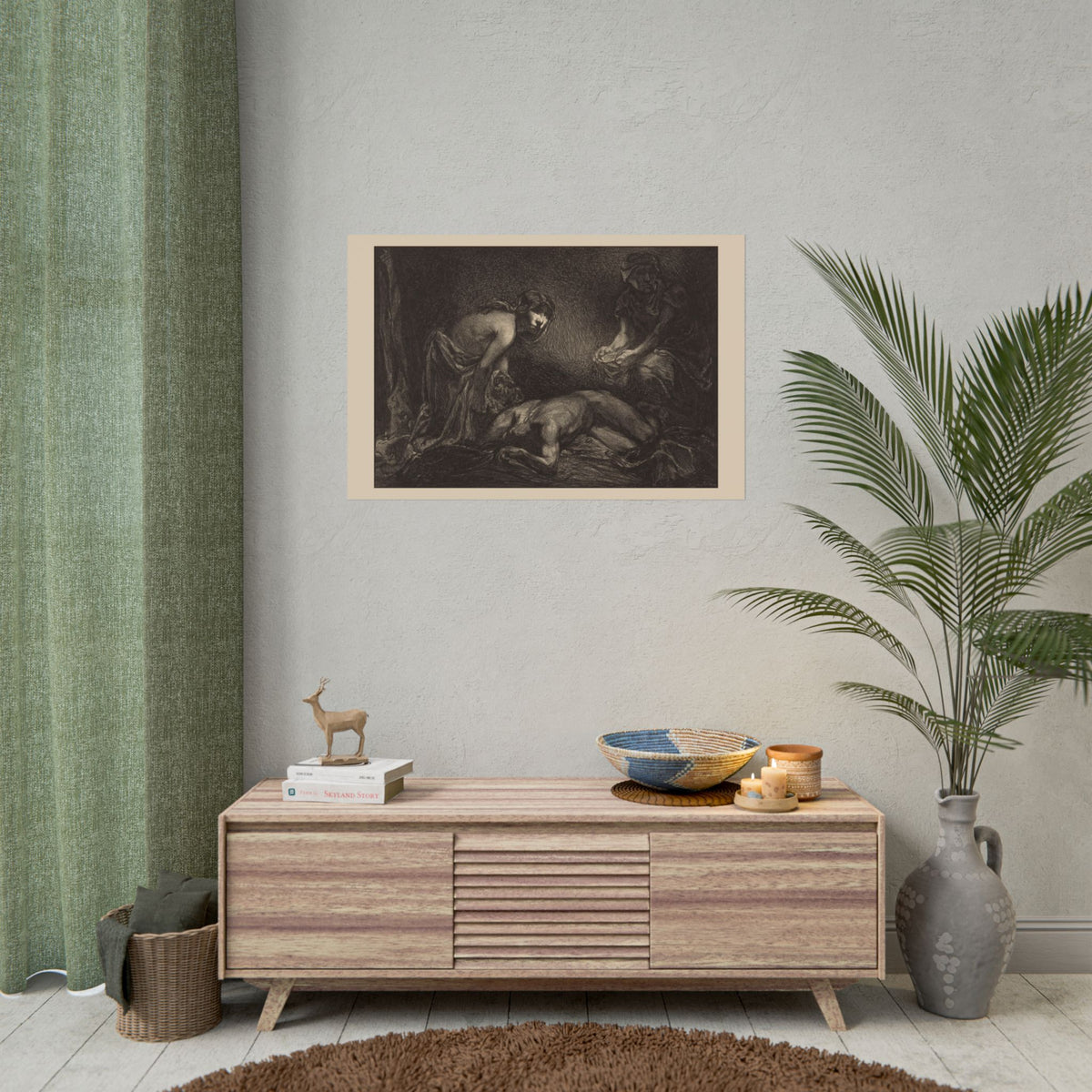
The biblical heroine Judith stands beside her maidservant and the decapitated body of Holofernes in this dramatic historical print reproduction by Johannes Josephus Aarts (1871–1934). Holding the severed head of the Assyrian general, Judith appears alongside her attendant, who prepares a sack to conceal it. The composition captures the aftermath of one of the most dramatic episodes in the Book of Judith, bringing together themes of courage, deception, violence, and deliverance through an uncompromising interpretation of biblical history.
The original lithograph, titled Judith en dienstmaagd met het hoofd en lichaam van Holofernes (Judith and Her Maidservant with the Head and Body of Holofernes), depicts the moments following Judith's killing of the Assyrian general.
Judith and her maidservant stand beside the headless body of Holofernes. Both women wear draped garments, although Judith's upper body is partially exposed.
Judith holds the severed head in her hands, while her maidservant holds open a sack intended to conceal it.
The scene originates from the Book of Judith, a biblical text included in the Catholic and Eastern Orthodox Old Testaments and regarded as apocryphal by most Protestant traditions.
According to the narrative, Judith is a courageous Jewish widow who enters the enemy camp and gains the confidence of Holofernes, the Assyrian commander threatening her people.
After Holofernes becomes intoxicated, Judith uses his own sword to behead him. She and her maidservant then escape with his head, an act that ultimately contributes to the defeat of the invading army.
Several elements contribute to the artwork's dramatic biblical symbolism:
-
Judith: The central heroine, traditionally representing courage, determination, faith, and deliverance from oppression.
-
The Maidservant: Judith's companion and accomplice, who assists in concealing the severed head and escaping the enemy camp.
-
The Severed Head: The unmistakable evidence of Holofernes' defeat and a traditional symbol of Judith's triumph.
-
The Headless Body: A stark representation of the fallen military commander, emphasizing the violent conclusion of the biblical episode.
-
The Concealing Sack: An important narrative detail describing how Judith and her maidservant transport the head out of the Assyrian camp.
-
The Draped Garments: Elements of the women's appearance that contribute to the composition's classical and historical character.
Together, these details place the artwork within the European tradition of biblical narrative art, particularly representations of Judith and Holofernes that have fascinated artists since the Renaissance.
The story of Judith has inspired numerous interpretations in painting, sculpture, and printmaking, often exploring the contrast between physical strength and moral courage, feminine determination and military power.
Johannes Josephus Aarts (1871–1934) was a Dutch artist and printmaker whose work encompassed biblical subjects, religious imagery, mythological figures, grotesque compositions, and allegorical themes.
In Judith and Her Maidservant with the Head and Body of Holofernes, Aarts concentrates on the immediate aftermath of the killing rather than the act itself.
The severed head, the fallen body, and the maidservant's open sack establish the narrative, while the arrangement of the figures emphasizes the extraordinary nature of Judith's deed.
- Reproduction of Judith en dienstmaagd met het hoofd en lichaam van Holofernes (Judith and Her Maidservant with the Head and Body of Holofernes)
- Original artist: Johannes Josephus Aarts
- Historical Dutch lithograph from the artist's lifetime (1871–1934)
- Depicts Judith and her maidservant beside the decapitated body of Holofernes
- Judith holds the severed head while her attendant prepares a sack
- Inspired by the biblical Book of Judith
- Themes of courage, faith, victory, mortality, and divine deliverance
- Dramatic religious imagery with expressive historical printmaking
- Original artwork held in the Rijksmuseum collection
- Giclée printing on archival paper
- Smooth matte finish
- Available in multiple sizes
- Artwork proportionally scaled to preserve the original composition
- Printed margins may vary depending on the selected size
- Supplied unframed
- Slight production size tolerance of approximately ±1/16 inch
Handle with clean, dry hands. Avoid prolonged exposure to direct sunlight and moisture. Gently remove surface dust with a clean, dry cloth.