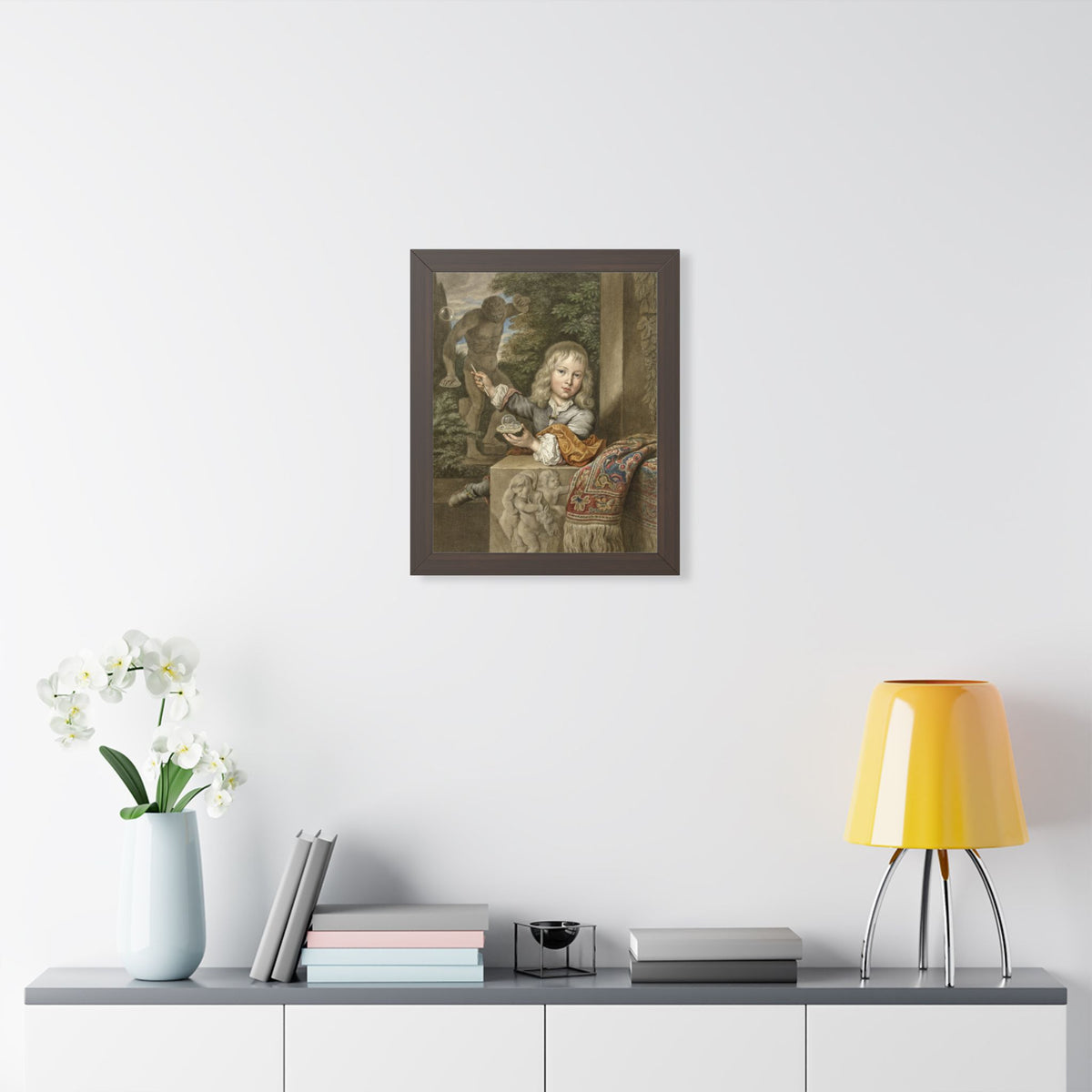
A young boy blowing soap bubbles becomes a symbol of life's fleeting nature in this delicate watercolor drawing by Abraham Delfos (1741–1820), created after a painting by Caspar Netscher. The subject reflects the traditional Homo Bulla allegory, in which the fragile, short-lived existence of a soap bubble represents human mortality. Combining childhood innocence with the symbolism of Vanitas and Memento Mori, this historical reproduction makes a distinctive addition to libraries, studies, and collections of allegorical art.
The drawing, titled Bellenblazende jongen (Boy Blowing Soap Bubbles), depicts a young boy engaged in the simple activity of blowing bubbles.
Created by Abraham Delfos after a painting by Caspar Netscher, the artwork belongs to a long European tradition of using childhood scenes to convey moral and philosophical ideas.
Its watercolor technique gives the composition a softer appearance than a traditional oil painting or engraving.
The image is associated with the classical allegory of Homo Bulla — Latin for "Man is a Bubble."
-
Young boy: Childhood, innocence, and the beginning of life.
-
Soap bubbles: The fragility and short duration of human existence.
-
Bubble blowing: The temporary pleasures and passing moments of everyday life.
Soap bubbles appear frequently in historical Vanitas imagery because they exist only briefly before disappearing.
The subject expresses a simple but powerful message: human life, like a soap bubble, is beautiful yet temporary.
Abraham Delfos (1741–1820) was a Dutch draftsman and artist whose work included drawings and reproductions after earlier paintings.
This watercolor was created after a composition by Caspar Netscher (1639–1684), a Dutch Golden Age painter known for his portraits and refined genre scenes.
The image reflects the Vanitas tradition, which encouraged viewers to contemplate mortality and the passage of time.
The related expression Memento Mori means "Remember that you must die," while Homo Bulla compares the brief duration of life to the existence of a fragile bubble.
Product features
- Museum-quality matte paper with archival properties
- Durable frame options including MDF, kiln-dried pine, or Ayous wood
- Protective acrylic cover
- Built-in or included hanging hardware
Care instructions
- If the poster does gather any dust, you may wipe it off gently with a clean, dry cloth. To remove spots or smudges from acrylic or glass, we recommend applying glass cleaner to a clean, soft, dry cloth or paper towel and then to the surface so that the cleaner does not settle on the frame, then buff the surface dry to remove any streaks.