Framed Allegory of Transience Woman Skull & Soap Bubbles Willem van Mieris 17th Century Art Print
Framed Allegory of Transience Woman Skull & Soap Bubbles Willem van Mieris 17th Century Art Print
Couldn't load pickup availability
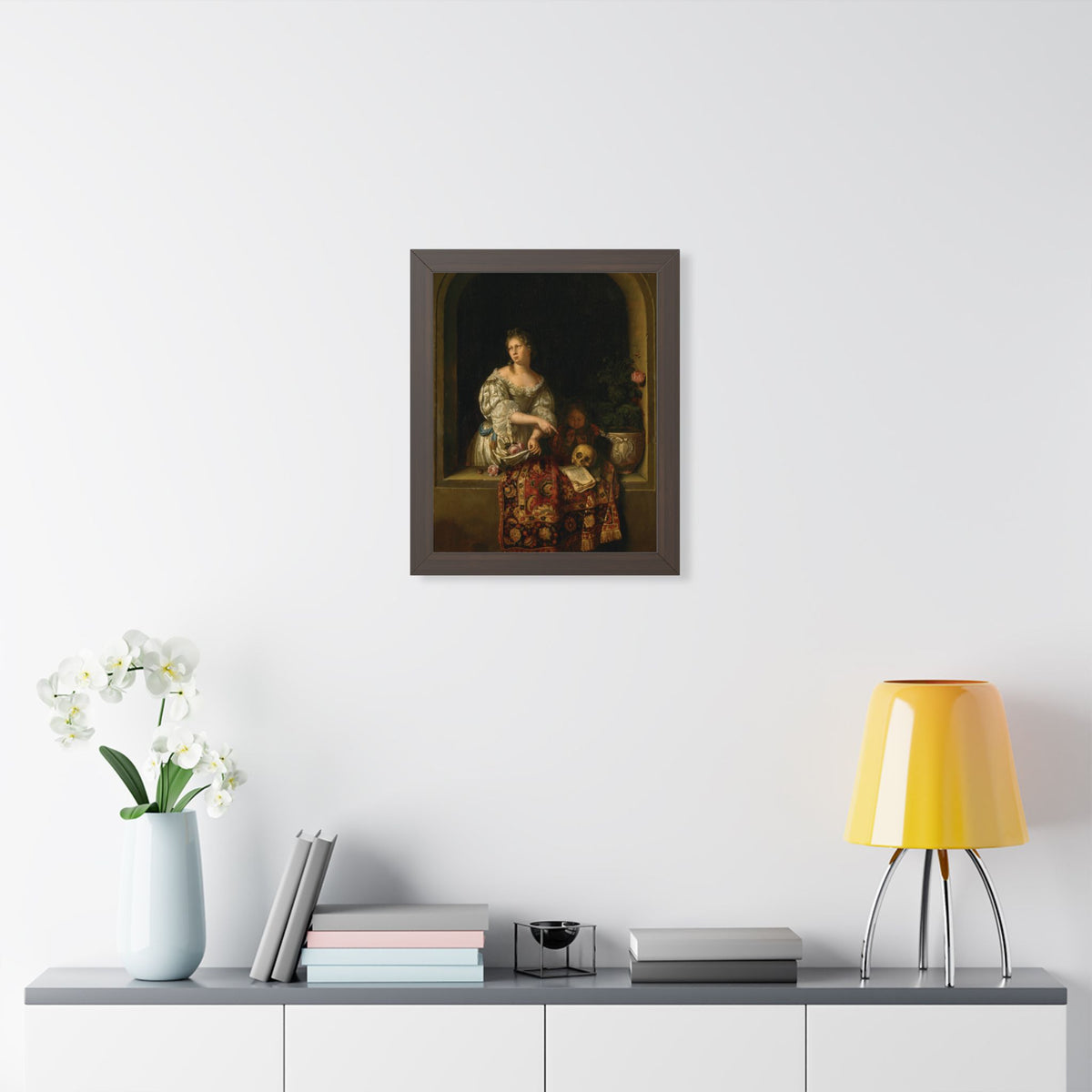
A young woman dressed in shimmering silver silk gestures toward a human skull and an open music book, while a child behind her blows delicate soap bubbles in this richly symbolic seventeenth-century Dutch painting attributed to Willem van Mieris. Created between 1670 and 1681, Allegory of Transience contrasts youthful beauty, flowers, and luxurious textiles with reminders of mortality and the passing of time. A richly patterned Persian carpet and flowering plant add to the composition's visual elegance, transforming an apparently graceful domestic scene into a meditation on the fragility of human existence. This historical reproduction is particularly suited to libraries, studies, traditional interiors, and collections of Dutch Golden Age, allegorical, and Memento Mori art.
The painting depicts an elegantly dressed young woman standing within an architectural window opening, surrounded by objects associated with beauty, pleasure, and mortality.
Wearing a luminous silk gown with elaborate sleeves, the woman gestures toward a human skull and an open music book resting upon a richly patterned Persian carpet draped across the windowsill.
She gathers flowers in her apron, while additional blossoms appear nearby, introducing a delicate contrast between living beauty and the lifeless skull.
Behind the woman, a young boy blows soap bubbles, an important traditional symbol of the temporary nature of human existence.
To the right, a potted poppy adds another element of floral symbolism, reinforcing the composition's meditation on beauty, sleep, and the passing of life.
The artist combines carefully observed textures, refined fabrics, decorative objects, and expressive figures to create a sophisticated allegorical scene.
Rather than presenting a conventional Vanitas still life composed entirely of symbolic objects, the painting places a living human figure at the center of its reflection on mortality.
The painting incorporates several traditional elements of Vanitas and Memento Mori imagery:
- Young woman: Youth, physical beauty, and the temporary nature of human life.
- Human skull: The inevitability of death and the mortality shared by all humanity.
- Soap bubbles: The fleeting nature of existence, associated with the traditional allegorical expression Homo Bulla — "Man is a Bubble."
- Child blowing bubbles: Youthful innocence and the contrast between the beginning of life and its inevitable end.
- Open music book: Music, artistic accomplishment, and pleasures that disappear as quickly as the sounds they produce.
- Flowers held in the apron: Natural beauty, youth, and the brief duration of earthly pleasures.
- Potted poppy: Sleep, oblivion, and the traditional association between flowers and the transience of life.
- Persian carpet: Luxury, wealth, refined taste, and material possessions.
- Elegant silk clothing: Fashion, social distinction, and the impermanence of physical beauty and worldly status.
- Window setting: A carefully staged space in which the objects and figures invite contemplation of life's temporary character.
Together, these elements communicate the central message of Vanitas: beauty, youth, pleasure, wealth, and artistic accomplishments are temporary, while mortality remains unavoidable.
The contrast between the young woman, the child, and the skull makes this painting particularly expressive, bringing the different stages of human existence into a single composition.
Product features
- Museum-quality matte paper with archival properties
- Durable frame options including MDF, kiln-dried pine, or Ayous wood
- Protective acrylic cover
- Built-in or included hanging hardware
Care instructions
- If the poster does gather any dust, you may wipe it off gently with a clean, dry cloth. To remove spots or smudges from acrylic or glass, we recommend applying glass cleaner to a clean, soft, dry cloth or paper towel and then to the surface so that the cleaner does not settle on the frame, then buff the surface dry to remove any streaks.