Finis Memento Mori Skull Hourglass Cartouche 1649 Jacob Matham Art Print
Finis Memento Mori Skull Hourglass Cartouche 1649 Jacob Matham Art Print
Couldn't load pickup availability
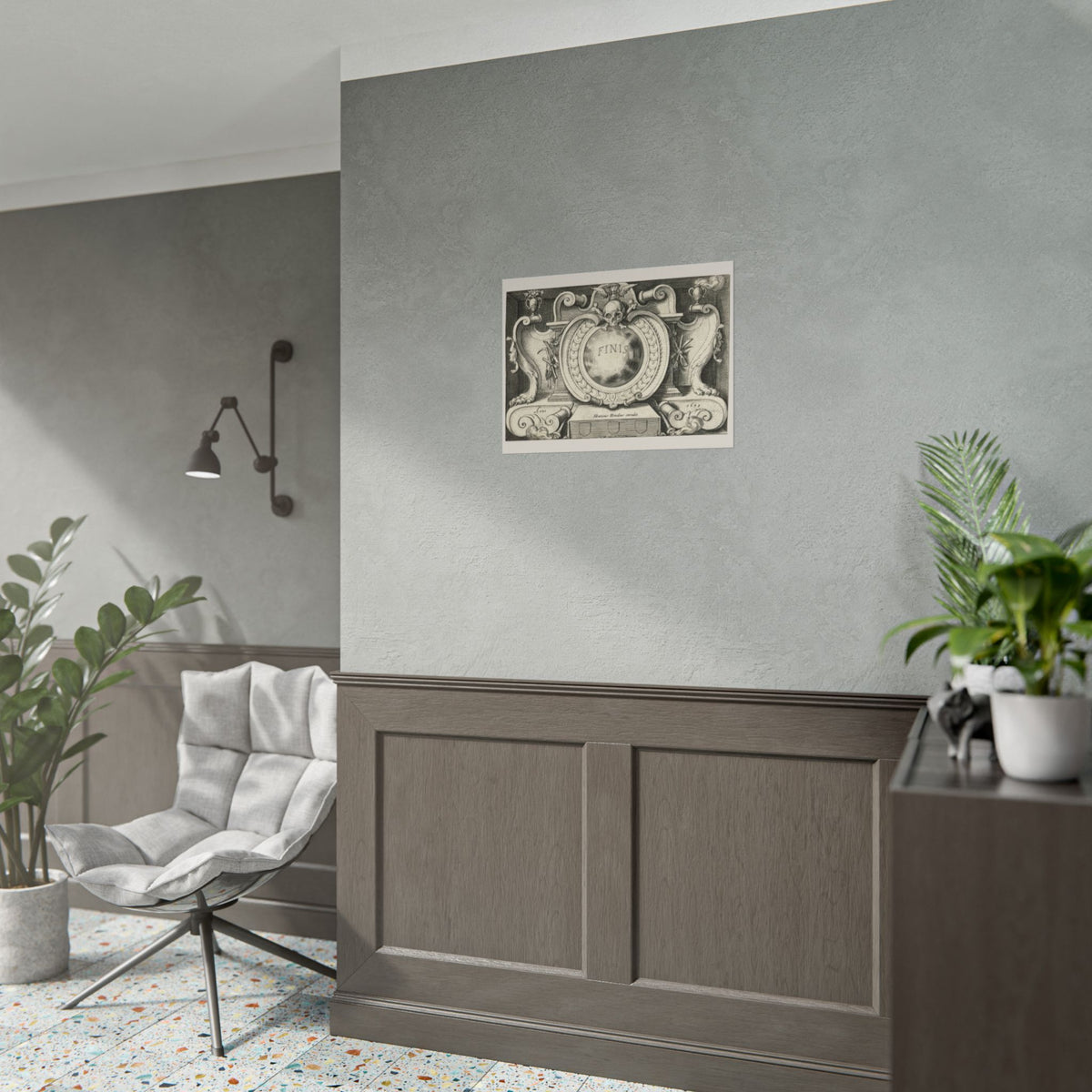
FINIS — The End. A single Latin word delivers the central message of this 1649 Dutch engraving, in which a human skull and hourglass crown an elaborate ornamental cartouche. Attributed to Jacob Matham (1571–1631) and published by Hendrick Hondius I (1573–1650) in The Hague, the composition transforms decorative Renaissance-inspired ornament into a solemn reflection on mortality. Its restrained symbolism serves as a reminder that time passes and every earthly existence must eventually reach its conclusion.
The composition features an ornamental cartouche resting upon a pedestal, with the Latin word FINIS prominently displayed at its center.
Above the cartouche, a human skull and hourglass form the principal symbols of mortality and the passage of time. The arrangement combines decorative architectural elements with traditional Vanitas imagery.
The carefully engraved lines, ornamental flourishes, and contrasting areas of light and shadow emphasize the formal symmetry and decorative character of the composition.
Unlike elaborate Vanitas still lifes filled with numerous symbolic objects, this engraving conveys its message through a small number of carefully arranged elements.
The artwork incorporates several traditional elements of Memento Mori and Vanitas imagery:
- Human skull: The inevitability of death and the fate shared by all humanity.
- Hourglass: The continuous passage of time and the limited duration of human life.
- FINIS inscription: Latin for "The End," emphasizing the ultimate conclusion of earthly existence.
- Ornamental cartouche: A decorative frame that gives the moral message prominence.
- Pedestal: An architectural foundation presenting the inscription as a formal statement.
- Symmetrical composition: A restrained visual arrangement that emphasizes the central message.
Together, these elements present a direct reminder that human life, regardless of accomplishment or worldly distinction, eventually comes to an end.
Dated 1649, this engraving was published by Hendrick Hondius I in The Hague. The Rijksmuseum attributes the printmaking to Jacob Matham, while an earlier attribution to Hondius as the engraver has been rejected.
The work belongs to the Northern European tradition of moralizing prints, in which architectural ornament and symbolic imagery were used to communicate religious and philosophical ideas.
Memento Mori, Latin for "Remember that you must die," encouraged reflection upon mortality and preparation for the end of earthly life. Related Vanitas imagery emphasized the temporary nature of wealth, beauty, ambition, and human achievement.
The combination of a skull, hourglass, and the word FINIS creates an unusually concise expression of these themes.
With its decorative cartouche, historical Latin lettering, and stark mortality symbolism, this reproduction complements libraries, studies, reading rooms, Gothic interiors, and collections devoted to historical engraving, Renaissance-inspired ornament, and the macabre.
- Historical Memento Mori engraving dated 1649
- Printmaking attributed to Jacob Matham
- Published by Hendrick Hondius I in The Hague
- Ornamental cartouche featuring the Latin word FINIS
- Human skull and hourglass symbolizing mortality and the passage of time
- Traditional Vanitas allegory expressed through decorative architectural ornament
- Reproduced with the intricate engraved details and aged appearance of the historical artwork
- Giclée printing on archival paper
- Smooth matte finish
- Available in multiple sizes
- Suitable for indoor wall display
- Supplied unframed
Handle with clean, dry hands. Avoid prolonged exposure to direct sunlight and moisture. Gently remove dust with a clean, dry cloth.