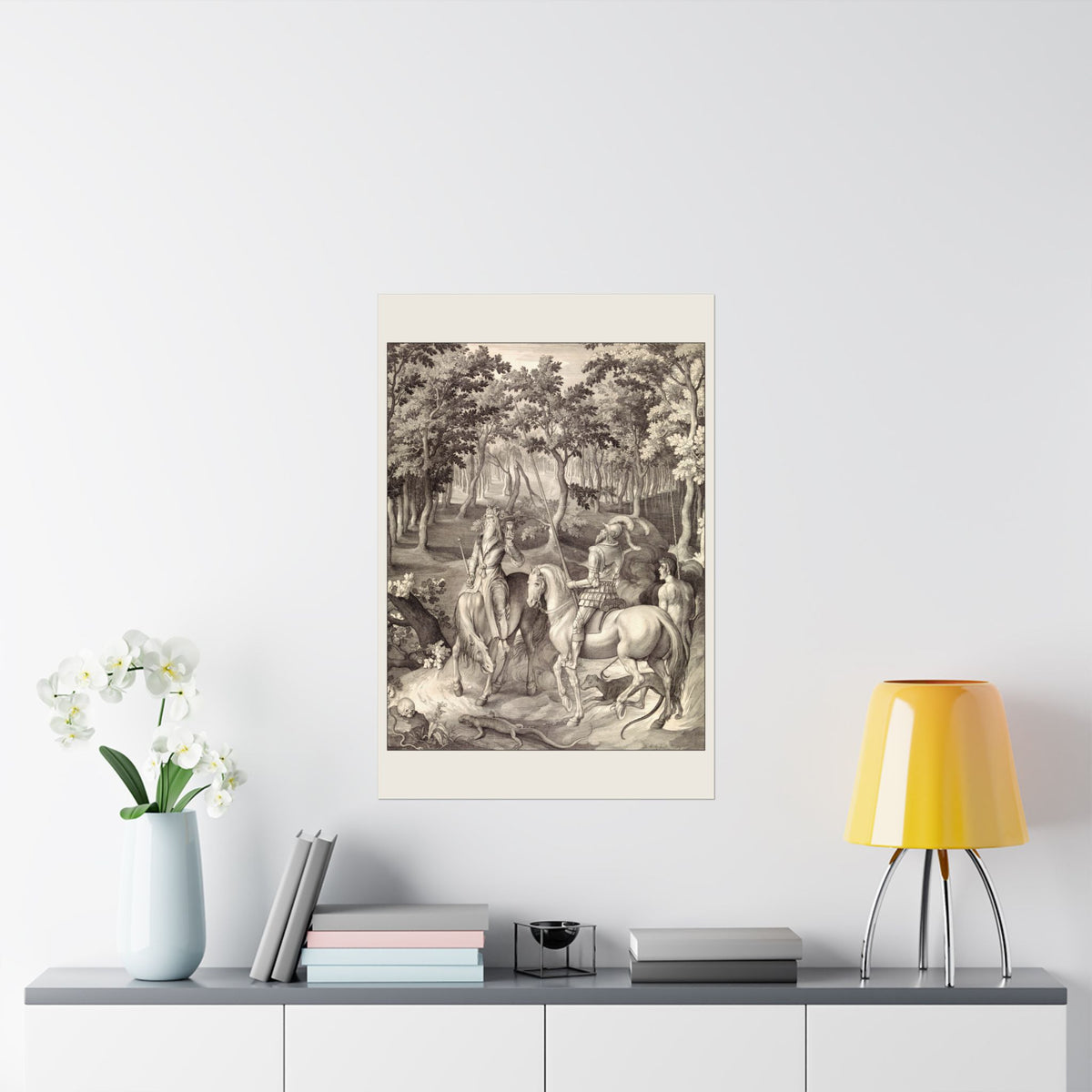
Deep within a wooded landscape, a mounted knight encounters two ominous companions: Death and the Devil. The scene unfolds like a dark Renaissance fable, filled with strange creatures, skeletal imagery, and reminders of humanity's uncertain fate. Created in 1618 by Dutch engraver Nicolaes de Bruyn (1571–1656), this elaborate allegorical print combines the grandeur of mounted warriors with the unsettling symbolism of Memento Mori, exploring mortality, temptation, and the challenges of earthly existence.
The engraving depicts an armored knight on horseback traveling through a densely wooded landscape, accompanied by two disturbing figures.
Before the knight rides Death, represented as a crowned figure on horseback holding an hourglass and scepter. A serpent adorns Death's crown, reinforcing the composition's sinister atmosphere.
Beside the knight's horse walks a devil-like figure carrying a rod associated with judicial authority.
The forest floor contains several symbolic creatures, including a salamander, a dog, and a serpent beside a human skull. A broken tree stands in the woodland behind Death.
The elaborate forest setting, detailed armor, expressive figures, and carefully engraved foliage create a richly textured composition characteristic of early seventeenth-century Dutch printmaking.
The artwork incorporates several traditional elements of Memento Mori and moral allegory:
-
Mounted knight: Human courage, determination, and the journey through earthly life.
-
Death on horseback: The inevitability of mortality and its power over all living beings.
-
Hourglass: The relentless passage of time and the limited duration of human existence.
-
Crown and scepter: Death's universal authority over humanity.
-
Devil-like figure: Temptation, evil, and the spiritual dangers encountered during life.
-
Human skull: A direct reminder of mortality and the fate shared by all humanity.
-
Serpent: Traditionally associated with temptation, sin, and spiritual danger.
-
Broken tree: The interruption of life and the fragility of earthly existence.
-
Salamander and dog: Additional elements of the natural world that contribute to the composition's allegorical character.
Together, these elements present life as a journey in which courage and worldly power must confront the unavoidable presence of death and spiritual temptation.
Created in 1618 by Nicolaes de Bruyn, this engraving reflects the Northern European tradition of elaborate allegorical prints.
Working in Rotterdam, De Bruyn became known for his detailed engravings featuring biblical subjects, mythological scenes, landscapes, and complex moral compositions.
The artwork belongs to the broader tradition of Knight, Death and the Devil imagery, a subject famously explored by Albrecht Dürer in his 1513 engraving.
While De Bruyn's composition differs considerably from Dürer's, both explore the encounter between a mounted knight and personifications of mortality and evil.
The imagery also reflects the tradition of Memento Mori — Latin for "Remember that you must die" — which encouraged reflection upon human mortality and the temporary nature of earthly power.
The combination of an elaborate woodland setting, mounted figures, symbolic animals, and the personification of Death creates a distinctive example of seventeenth-century moral allegory.
With its historical armor, mysterious forest, allegorical creatures, and dramatic mortality symbolism, this reproduction complements libraries, studies, Gothic interiors, and collections devoted to Renaissance and Baroque art, historical engraving, medieval-inspired imagery, and the macabre.
- Historical Knight, Death and the Devil engraving by Nicolaes de Bruyn
- Original artwork dated 1618
- Created in Rotterdam
- Armored knight on horseback accompanied by personifications of Death and the Devil
- Death depicted wearing a serpent-adorned crown and carrying an hourglass and scepter
- Symbolic animals including a serpent, salamander, and dog
- Human skull, broken tree, and richly detailed woodland landscape
- Traditional Memento Mori symbolism exploring mortality, temptation, and the human journey
- Detailed early seventeenth-century Dutch engraving
- Reproduced with the intricate engraved details and aged appearance of the historical artwork
- Giclée printing on archival paper
- Smooth matte finish
- Available in multiple sizes
- Vertical portrait composition
- Suitable for indoor wall display
- Supplied unframed
- Slight production size tolerance of approximately ±1/16 inch
Handle with clean, dry hands. Avoid prolonged exposure to direct sunlight and moisture. Gently remove surface dust with a clean, dry cloth.