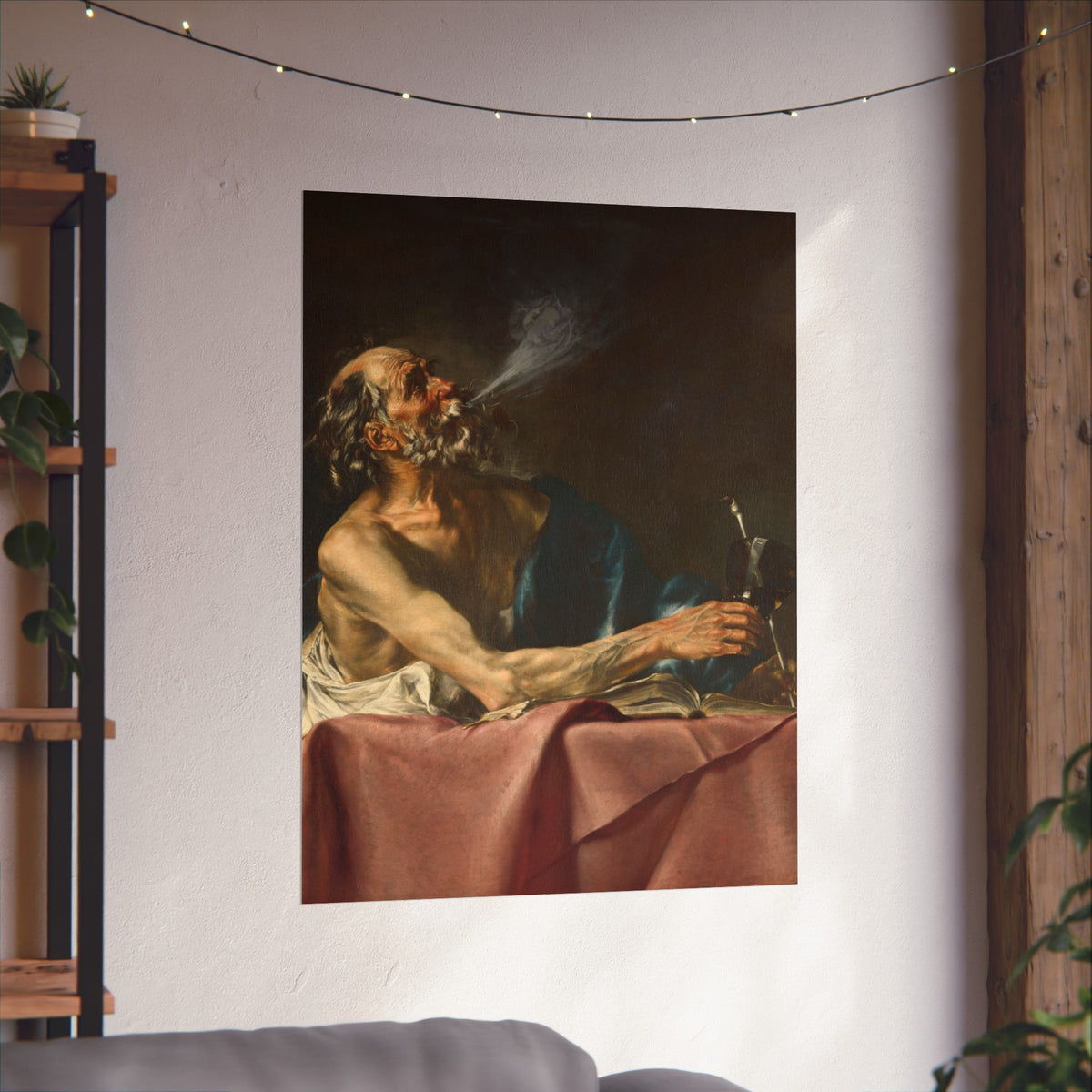
The Smoker Allegory of Transience Old Man with Pipe Hendrick van Someren 1620 Art Print
The Smoker Allegory of Transience Old Man with Pipe Hendrick van Someren 1620 Art Print
Couldn't load pickup availability
An elderly man pauses over a pipe and a glass of wine in this evocative early seventeenth-century painting by Hendrick van Someren. Seated at a table with an open book before him, the figure holds a long smoking pipe in one hand and a traditional Dutch roemer drinking glass in the other. Painted around 1615–1625, The Smoker: Allegory of Transience transforms an apparently ordinary scene of leisure into a reflection on the fleeting nature of pleasure and human existence. Its expressive figure, dramatic lighting, and contemplative subject make this historical reproduction a distinctive addition to libraries, studies, traditional interiors, and collections of Dutch Golden Age and allegorical art.
The painting depicts an elderly man seated at a table, holding a smoking pipe in his left hand and a roemer, a traditional stemmed drinking glass, in his right.
An open book lies on the table before him, introducing an element of reading, learning, or contemplation into the otherwise informal scene.
The man's age contrasts with the immediate pleasures of tobacco and drink, inviting viewers to consider the relationship between enjoyment, aging, and the limited duration of human life.
Rather than presenting a traditional Vanitas still life composed of skulls, candles, and hourglasses, the artist develops the theme of transience through a human figure engaged in familiar activities.
The composition combines careful observation of the sitter, contrasting textures, and atmospheric lighting to create a compelling example of seventeenth-century allegorical painting.
The painting incorporates several elements associated with Vanitas and the allegory of transience:
- Elderly man: Aging, human mortality, and the inevitable progression of life toward death.
- Smoking pipe: Sensory pleasure, leisure, and the fleeting nature of earthly enjoyment.
- Tobacco smoke: An implied symbol of transience, vanishing almost immediately after it appears.
- Roemer drinking glass: Wine, conviviality, and the temporary pleasures of material existence.
- Open book: Knowledge, contemplation, and the contrast between intellectual pursuits and physical enjoyment.
- Seated figure: A moment of stillness that invites reflection on the passage of time.
- Ordinary domestic setting: The presence of mortality within everyday human experience.
Together, these elements communicate the central theme of the painting: earthly pleasures are temporary, and the passage of time eventually overtakes every human life.
Unlike more conventional Memento Mori compositions, the painting expresses its message without relying on an explicit image of death.
Painted around 1615–1625 and attributed to Hendrick van Someren, The Smoker: Allegory of Transience belongs to the early seventeenth-century tradition of allegorical genre painting.
During this period, European artists frequently depicted drinkers, smokers, musicians, and elderly figures to explore the relationship between everyday pleasures and the brevity of human existence.
Tobacco had become an increasingly familiar commodity in Europe, and the smoking pipe emerged as a recognizable subject in seventeenth-century painting.
The act of smoking was particularly suited to allegorical interpretation because smoke disappears almost as soon as it is produced, providing a visual parallel to the temporary nature of earthly life.
The painting's theme relates closely to Vanitas, a tradition rooted in the biblical Book of Ecclesiastes and concerned with the impermanence of worldly possessions, pleasures, and accomplishments.
It also shares the philosophical concerns of Memento Mori — Latin for "Remember that you must die" — although its message is conveyed through the figure's age and activities rather than a skull or other conventional mortality symbol.
The artwork has previously been associated with Giovanni Serodine and Jusepe de Ribera, but these attributions are no longer accepted in the Rijksmuseum catalogue, which identifies Hendrick van Someren as the painter.
The original painting is preserved in the Rijksmuseum collection, where it is catalogued as The Smoker: Allegory of Transience (SK-A-332).
With its expressive elderly figure, historical smoking pipe, traditional drinking glass, and contemplative allegorical meaning, this reproduction complements libraries, studies, reading rooms, traditional interiors, and collections devoted to Dutch Golden Age painting, historical portraiture, and philosophical art.
- Reproduction of The Smoker: Allegory of Transience by Hendrick van Someren
- Original painting dated approximately 1615–1625
- Elderly man holding a tobacco pipe and traditional roemer drinking glass
- Open book resting on the table before the seated figure
- Allegorical themes of aging, mortality, leisure, and the fleeting nature of earthly pleasures
- Symbolism associated with Vanitas and Memento Mori traditions
- Historical depiction of smoking and drinking in early seventeenth-century European art
- Expressive figure, atmospheric lighting, and carefully rendered details
- Original artwork held in the Rijksmuseum collection
- Reproduced with the colors, details, and historical appearance of the original painting
- Giclée printing on archival paper
- Smooth matte finish
- Available in multiple sizes
- Artwork proportionally scaled to preserve the original composition
- Suitable for indoor wall display
- Supplied unframed
- Slight production size tolerance of approximately ±1/16 inch
Handle with clean, dry hands. Avoid prolonged exposure to direct sunlight and moisture. Gently remove surface dust with a clean, dry cloth.