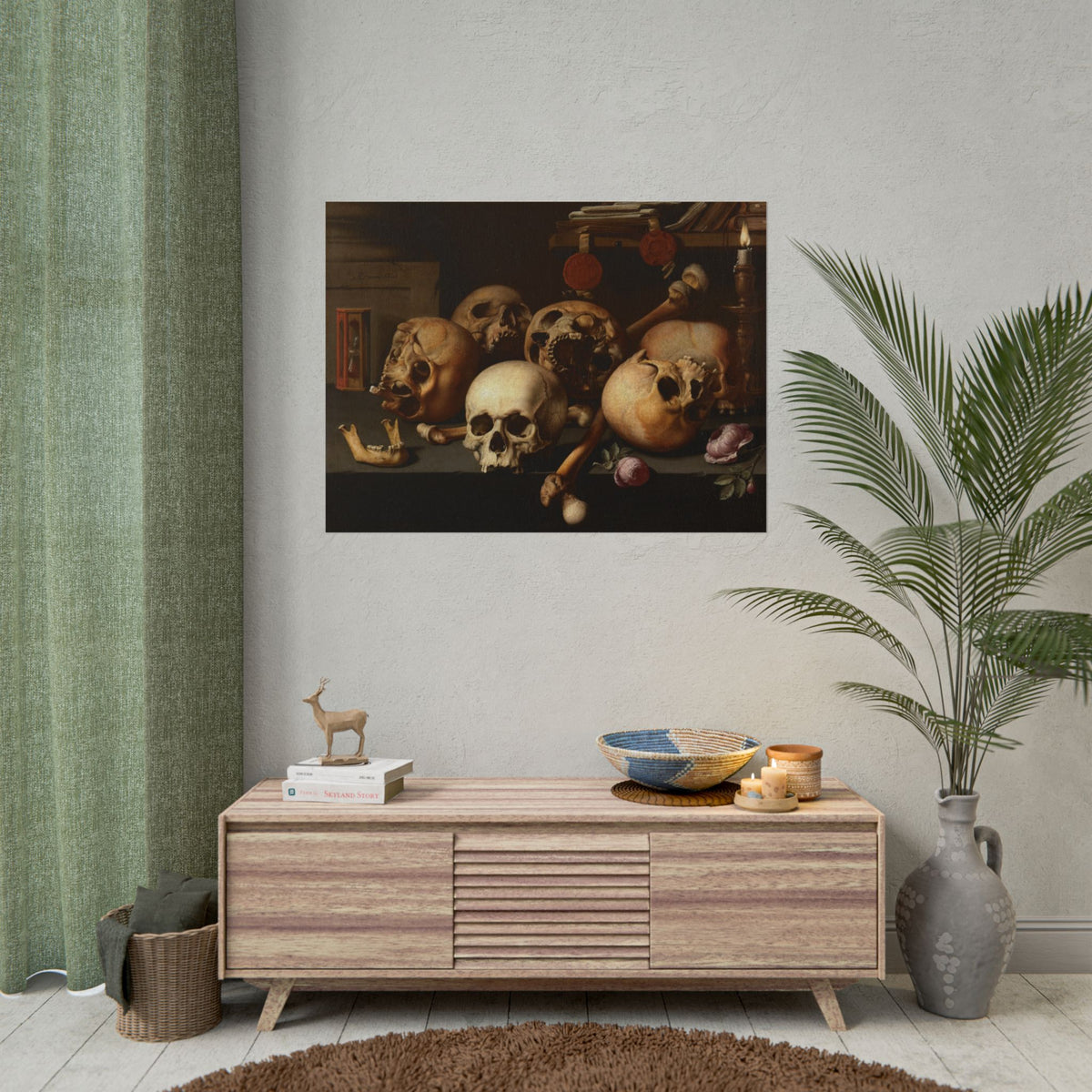
Six human skulls, scattered bones, fading roses, and a burning candle create a dramatic meditation on mortality in this seventeenth-century Dutch still-life painting. Rich amber tones emerge from deep shadows, illuminating the skulls and objects arranged across a stone surface. Painted around 1660–1665 by Aelbert Jansz van der Schoor, this remarkable example of Vanitas art combines striking realism, historical symbolism, and the atmospheric lighting of the Dutch Golden Age. Its unusual composition makes a distinctive addition to Gothic interiors, libraries, studies, and collections of historical macabre art.
The painting presents an elaborate arrangement of human skulls and bones on a stone table or ledge.
Several skulls occupy the center of the composition, their varied positions and carefully rendered anatomical features creating a powerful visual effect.
Scattered bones, a detached jawbone, and delicate pink roses complete the foreground. An hourglass and a burning candle introduce additional reminders of passing time and mortality.
In the background, a shelf holds books and documents bearing red wax seals, suggesting knowledge, legal affairs, and worldly accomplishments.
The composition features rich golden-brown colors, dramatic shadows, and carefully controlled highlights that emphasize the skulls, flowers, and surrounding objects.
The painting incorporates several traditional elements of Vanitas and Memento Mori imagery:
-
Human skulls: The inevitability of death and the mortality shared by all humanity.
-
Scattered bones: The physical remains of human existence and the ultimate fate of the body.
-
Hourglass: The continuous passage of time and the limited duration of earthly life.
-
Burning candle: Life's gradual consumption and eventual extinguishing.
-
Pink roses: Beauty, youth, and the temporary pleasures of earthly existence.
-
Books: Human knowledge and intellectual achievements that cannot overcome mortality.
-
Sealed documents: Wealth, authority, worldly affairs, and the impermanence of human accomplishments.
-
Dark background: A dramatic contrast emphasizing the fragile nature of life and the certainty of death.
Together, these elements communicate the central message of Memento Mori: human life is temporary, and neither wealth, knowledge, beauty, nor worldly achievement can prevent its eventual conclusion.
Painted between approximately 1660 and 1665 by Dutch artist Aelbert Jansz van der Schoor, this artwork belongs to the tradition of Dutch Golden Age Vanitas painting.
During the seventeenth century, Dutch artists frequently incorporated skulls, flowers, candles, hourglasses, books, and luxury objects into carefully arranged still lifes.
These paintings encouraged viewers to reflect upon mortality and the temporary nature of earthly pleasures and accomplishments.
The term Vanitas derives from the biblical Book of Ecclesiastes and refers to the transience and futility of worldly pursuits.
Closely related to Memento Mori — Latin for "Remember that you must die" — such works combined moral symbolism with extraordinary attention to light, texture, and realistic detail.
Van der Schoor's composition is particularly striking for its unusually large arrangement of human skulls, richly illuminated against a dark background.
The original painting is preserved in the Rijksmuseum collection, where it is catalogued as Vanitas Still Life (SK-A-1342).
With its dramatic skull imagery, warm colors, and historical significance, this reproduction is well suited to Gothic interiors, libraries, studies, reading rooms, and collections devoted to Dutch Golden Age art, historical painting, and macabre symbolism.
- Reproduction of Vanitas Still Life by Aelbert Jansz van der Schoor
- Original Dutch Golden Age painting dated approximately 1660–1665
- Dramatic arrangement of human skulls, bones, roses, an hourglass, and a burning candle
- Historical books and documents with red wax seals
- Rich amber and golden-brown colors with deep contrasting shadows
- Traditional Vanitas and Memento Mori symbolism exploring mortality and the passage of time
- Original artwork held in the Rijksmuseum collection
- Reproduced with the detailed textures, rich colors, and historical character of the original painting
- Giclée printing on archival paper
- Smooth matte finish
- Available in multiple sizes
- Horizontal landscape composition
- Suitable for indoor wall display
- Supplied unframed
- Slight production size tolerance of approximately ±1/16 inch
-
Handle with clean, dry hands. Avoid prolonged exposure to direct sunlight and moisture. Gently remove surface dust with a clean, dry cloth.