Allegory of Transience Woman Skull & Soap Bubbles Willem van Mieris 17th Century Art Print
Allegory of Transience Woman Skull & Soap Bubbles Willem van Mieris 17th Century Art Print
Couldn't load pickup availability
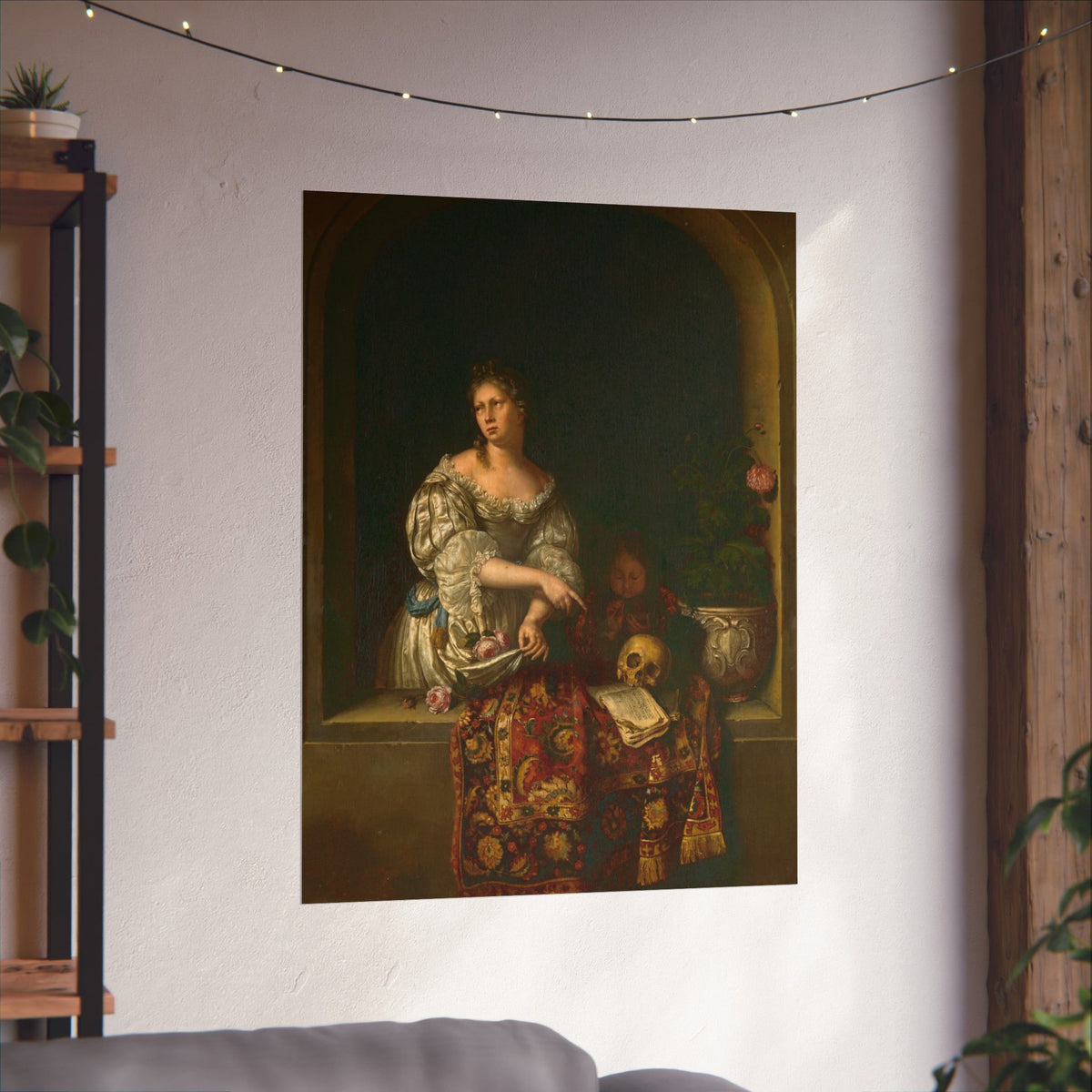
A young woman dressed in shimmering silver silk gestures toward a human skull and an open music book, while a child behind her blows delicate soap bubbles in this richly symbolic seventeenth-century Dutch painting attributed to Willem van Mieris. Created between 1670 and 1681, Allegory of Transience contrasts youthful beauty, flowers, and luxurious textiles with reminders of mortality and the passing of time. A richly patterned Persian carpet and flowering plant add to the composition's visual elegance, transforming an apparently graceful domestic scene into a meditation on the fragility of human existence. This historical reproduction is particularly suited to libraries, studies, traditional interiors, and collections of Dutch Golden Age, allegorical, and Memento Mori art.
The painting depicts an elegantly dressed young woman standing within an architectural window opening, surrounded by objects associated with beauty, pleasure, and mortality.
Wearing a luminous silk gown with elaborate sleeves, the woman gestures toward a human skull and an open music book resting upon a richly patterned Persian carpet draped across the windowsill.
She gathers flowers in her apron, while additional blossoms appear nearby, introducing a delicate contrast between living beauty and the lifeless skull.
Behind the woman, a young boy blows soap bubbles, an important traditional symbol of the temporary nature of human existence.
To the right, a potted poppy adds another element of floral symbolism, reinforcing the composition's meditation on beauty, sleep, and the passing of life.
The artist combines carefully observed textures, refined fabrics, decorative objects, and expressive figures to create a sophisticated allegorical scene.
Rather than presenting a conventional Vanitas still life composed entirely of symbolic objects, the painting places a living human figure at the center of its reflection on mortality.
The painting incorporates several traditional elements of Vanitas and Memento Mori imagery:
- Young woman: Youth, physical beauty, and the temporary nature of human life.
- Human skull: The inevitability of death and the mortality shared by all humanity.
- Soap bubbles: The fleeting nature of existence, associated with the traditional allegorical expression Homo Bulla — "Man is a Bubble."
- Child blowing bubbles: Youthful innocence and the contrast between the beginning of life and its inevitable end.
- Open music book: Music, artistic accomplishment, and pleasures that disappear as quickly as the sounds they produce.
- Flowers held in the apron: Natural beauty, youth, and the brief duration of earthly pleasures.
- Potted poppy: Sleep, oblivion, and the traditional association between flowers and the transience of life.
- Persian carpet: Luxury, wealth, refined taste, and material possessions.
- Elegant silk clothing: Fashion, social distinction, and the impermanence of physical beauty and worldly status.
- Window setting: A carefully staged space in which the objects and figures invite contemplation of life's temporary character.
Together, these elements communicate the central message of Vanitas: beauty, youth, pleasure, wealth, and artistic accomplishments are temporary, while mortality remains unavoidable.
The contrast between the young woman, the child, and the skull makes this painting particularly expressive, bringing the different stages of human existence into a single composition.
Painted between 1670 and 1681 and attributed to Willem van Mieris, Allegory of Transience belongs to the Dutch Golden Age tradition of allegorical and Vanitas painting.
The artwork was formerly attributed to Frans van Mieris the Elder, but that attribution is no longer accepted in the Rijksmuseum catalogue, which identifies Willem van Mieris as the attributed painter.
During the seventeenth century, Dutch artists frequently combined elegant figures, luxurious fabrics, flowers, musical instruments, skulls, and everyday objects to explore the relationship between earthly beauty and human mortality.
The term Vanitas derives from the biblical Book of Ecclesiastes and reflects the temporary nature of worldly possessions, pleasures, and achievements.
Closely associated with Memento Mori — Latin for "Remember that you must die" — these works reminded viewers that youth, beauty, and material prosperity eventually disappear.
One of the painting's most distinctive elements is the child blowing soap bubbles, a motif associated with Homo Bulla, the classical allegorical comparison of human life to a fragile bubble.
Soap bubbles were especially popular in seventeenth-century Dutch allegorical art because their brief existence provided an immediately recognizable visual metaphor for mortality.
The combination of this imagery with a skull, flowers, music, and luxurious textiles places the painting within a broader tradition of moral reflection expressed through highly refined decorative subjects.
The inclusion of a Persian carpet also reflects the importance of luxury textiles in Dutch Golden Age interiors and painting.
The original artwork is preserved in the Rijksmuseum collection, where it is catalogued as Allegory of Transience.
With its elegant female figure, child blowing bubbles, rich floral details, Persian carpet, and traditional mortality symbolism, this reproduction complements libraries, reading rooms, studies, traditional interiors, and collections devoted to Dutch Golden Age painting, historical fashion, allegorical art, and philosophical imagery.
- Reproduction of Allegory of Transience, attributed to Willem van Mieris
- Original Dutch Golden Age painting dated approximately 1670–1681
- Elegantly dressed young woman pointing toward a human skull and open music book
- Child blowing soap bubbles in the background
- Flowers gathered in the woman's apron and a potted poppy beside the window
- Richly patterned Persian carpet draped across the windowsill
- Traditional Vanitas, Memento Mori, and Homo Bulla symbolism
- Allegorical themes of youth, beauty, mortality, luxury, and the passage of time
- Detailed seventeenth-century costume, decorative textiles, and floral imagery
- Original artwork held in the Rijksmuseum collection
- Reproduced with the colors, textures, and historical appearance of the original painting
- Giclée printing on archival paper
- Smooth matte finish
- Available in multiple sizes
- Artwork proportionally scaled to preserve the original composition
- Suitable for indoor wall display
- Supplied unframed
- Slight production size tolerance of approximately ±1/16 inch
Handle with clean, dry hands. Avoid prolonged exposure to direct sunlight and moisture. Gently remove surface dust with a clean, dry cloth.