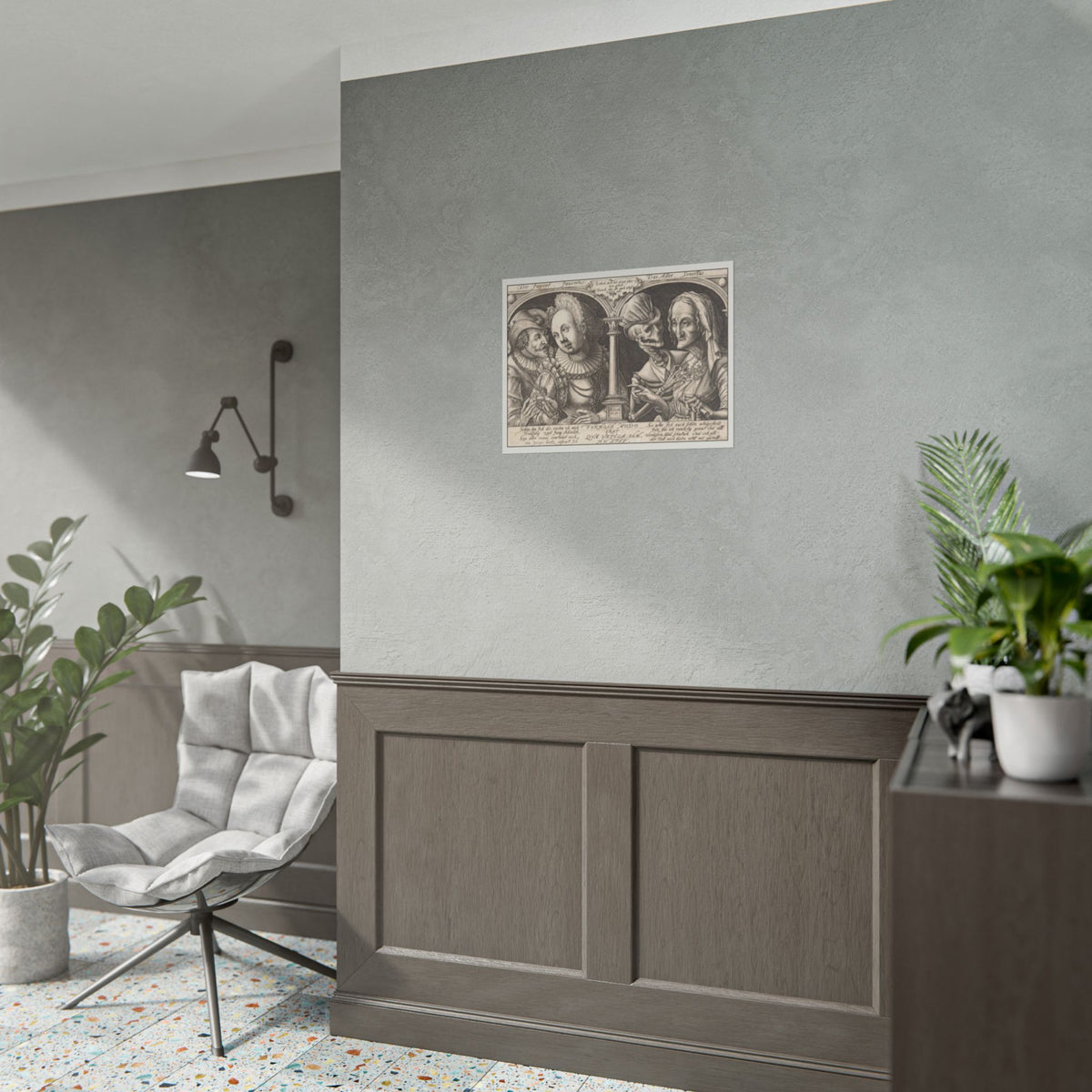
Allegory of Beauty Young Lovers Old Woman & Skeleton Matthäus Greuter Vanitas Art Print
Allegory of Beauty Young Lovers Old Woman & Skeleton Matthäus Greuter Vanitas Art Print
Couldn't load pickup availability
Youth and old age confront one another in this striking allegorical engraving by Matthäus Greuter (1564–1638). On one side, an elegantly dressed young couple exchange affectionate glances; on the other, an elderly woman adorned with serpents and bones stands beside a male skeleton. The contrast creates a powerful visual reminder that beauty, romance, and youth are temporary. With its elaborate historical costumes, expressive figures, and original German inscriptions, the artwork offers a fascinating example of early European Vanitas symbolism.
The engraving contrasts two stages of human existence through a carefully arranged composition.
On the left, a fashionable young man and woman gaze affectionately at one another. Their elaborate clothing, decorative collars, and refined appearance emphasize youth, beauty, and worldly pleasures.
On the right, an elderly woman wearing a necklace of serpents and bones appears beside a male skeleton, presenting a stark contrast to the youthful couple.
Architectural details divide the composition, while original German inscriptions above and beneath the figures reinforce its message about the passing of youth and the inevitability of old age and death.
Fine engraved lines, delicate crosshatching, and detailed historical costumes give the artwork its distinctive character.
The composition incorporates several traditional elements of Vanitas and Memento Mori imagery:
- Young couple: Youth, romance, beauty, and the pleasures of earthly life.
- Elderly woman: Aging and the inevitable decline of physical beauty.
- Male skeleton: The certainty of death and the fate shared by all humanity.
- Serpents and bones: Decay, mortality, and the unsettling transformation of the human body.
- Elegant clothing: Wealth, fashion, and outward appearances that cannot prevent aging.
- Contrasting figures: The passage from youth and beauty to old age and death.
Together, these elements express a central theme of Memento Mori: youth and physical beauty inevitably fade with time.
Created by Matthäus Greuter, this engraving is dated broadly between 1574 and 1638 by the Rijksmuseum.
Greuter was a German-born engraver and printmaker known for his detailed illustrations, allegorical compositions, and decorative prints.
The artwork belongs to the European tradition of moralizing imagery, which frequently contrasted youth with old age and beauty with mortality.
Closely related to Vanitas and Memento Mori — Latin for "Remember that you must die" — such compositions encouraged viewers to reflect on the temporary nature of physical beauty and earthly pleasures.
The original German inscriptions add historical interest, making the engraving especially appealing to collectors of Renaissance and early Baroque art.
Original inscriptions
Die Jugent . Iuuentus (German, Latin.)
Das Alter . Senectus (German, Latin.)
Erheb dich nit deine scho- / nen gestalt.
Denck, das du auch wirst / heßlich altt.
FORMOSA MODO ERAT : QVAE VETVLA JAM HIC STAT.
Schön bin Ich des rühm ich mich / Holdselig zart Jung Adenlich —
kein alter mann erwürbet mich — / ein Junges hertz erfrewe Ich.
So war Ich auch schön Wolgestallt / Jetz bin ich runtzlig grau vnd altt
verlaßen . blöd . schwach vnd erkallt : / der Todt mich bulen will mit gewallt.
English translations
"Youth."
"Old Age.
"Do not pride yourself on your beautiful appearance. Remember that you, too, will become ugly and old."
"She who now stands here as an old crone, was just recently beautiful."
"Beautiful I am, of this I boast—gracious, delicate, young, and noble. No old man shall win me; I delight a young heart."
"So was I also once beautiful and well-formed. Now I am wrinkled, gray, and old—abandoned, feeble, weak, and cold: Death wants to court me by force."
With its unusual pairing of young lovers, an elderly woman, and a skeleton, this reproduction makes a distinctive addition to Gothic interiors, libraries, studies, reading rooms, and collections of historical art and macabre imagery.
- Historical Allegory of Beauty engraving by Matthäus Greuter
- Original artwork dated between 1574 and 1638
- Young couple contrasted with an elderly woman and male skeleton
- Detailed Renaissance-era clothing, ornamental architecture, and expressive figures
- Original German inscriptions preserved within the composition
- Traditional Vanitas symbolism exploring youth, aging, beauty, and mortality
- Reproduced with the intricate engraved details and historical appearance of the original artwork
- Giclée printing on archival paper
- Smooth matte finish
- Available in multiple sizes
- Horizontal landscape composition
- Artwork proportionally scaled to preserve the original composition, with printed margins that may vary by size
- Supplied unframed
- Slight production size tolerance of approximately ±1/16 inch
Handle with clean, dry hands. Avoid prolonged exposure to direct sunlight and moisture. Gently remove surface dust with a clean, dry cloth.